Man Airlifted to Hospital Following Suspected Sea Snake Bite on Popular Queensland Beach
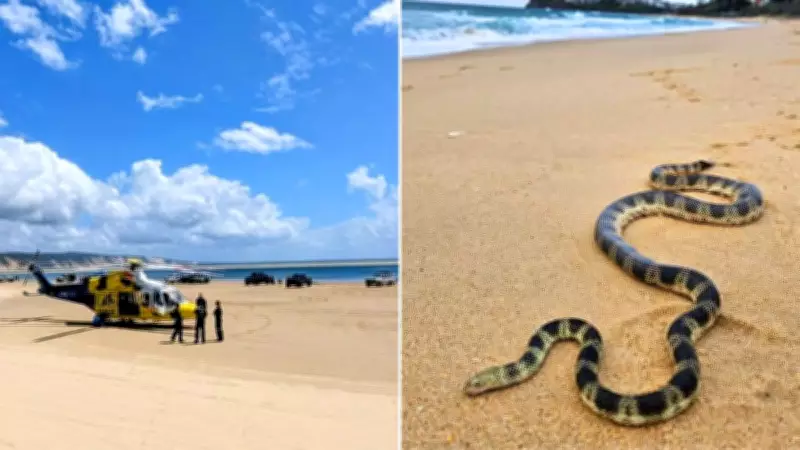
A young man has been transported to hospital via helicopter after suffering a suspected sea snake bite on a popular Queensland beach. The incident occurred at Double Island Point in the Gympie region on Sunday morning, prompting an emergency medical response.
Emergency Response on the Beach
The Sunshine Coast-based LifeFlight aeromedical crew was dispatched to the scene around 11am following reports that a man in his 20s had been bitten on the foot. The rescue helicopter landed directly on the beach, where a critical care doctor and Queensland Ambulance Service flight paramedic worked alongside local paramedics to stabilise the patient.
After receiving initial treatment at the scene, the man was flown to Sunshine Coast University Hospital for further medical care. Hospital officials confirmed on Monday afternoon that the patient was no longer in their care, though they did not provide additional details about his condition or recovery.

Rare and Dangerous Encounter
While details about how the bite occurred remain unclear, experts emphasize that encounters with sea snakes—particularly bites—are exceptionally uncommon. "Very, very rare," said snake expert Stuart McKenzie, owner of Sunshine Coast Snake Catchers. "I actually can't remember the last time I heard about someone getting bitten by a sea snake."
Despite their elusive nature, sea snakes rank among the most venomous reptiles in Australian waters. "All sea snakes are highly venomous... so, they're certainly not a snake that you want to muck around with," McKenzie warned.
Australia is home to approximately 30 species of sea snakes, all of which possess potent venom. Many of these species inhabit waters along the country's east coast, including the Queensland region where the incident occurred.
Understanding Sea Snake Behavior
McKenzie explained that most human interactions with sea snakes are more likely to occur on land than in the ocean. "If I was to guess... the most likely way that someone would get bitten by a sea snake is probably when it's washed up on the beach," he said. "They will only become beached if they are exhausted, injured or sick, so no matter what, they must be taken to the wildlife hospital to seek medical attention."
The expert strongly advised against returning beached sea snakes to the ocean, noting that rescues are provided free of charge by licensed professionals. Sea snakes are specially adapted for aquatic life, where buoyancy supports their bodies, making them particularly vulnerable when stranded on land.
Debunking Common Myths
McKenzie also addressed persistent misconceptions about sea snake bites. "There's sort of old wives tales that a sea snake can only bite you if it's on your little finger or your little toe," he said. "Any snake can bite you as long as it gets its mouth over your skin and can inject its fangs."
Despite their powerful venom, sea snakes are generally not aggressive creatures. "They're pretty reluctant to bite in my experience," McKenzie noted. "I've only ever seen them open their mouth when they're in pain or unwell."
Safety Guidelines for Beachgoers
McKenzie urged beach visitors to exercise caution and maintain distance from sea snakes, whether encountered in the water or washed ashore. "It's basically the same as any snake encounter: try and keep a safe distance," he advised. "If you see it on the beach, don't pick it up or try and put it back in the ocean, just keep a safe distance."
He recommended contacting wildlife rescuers or licensed snake catchers if encountering a stranded animal. While there's no need to pour water over them, providing shade from direct sunlight can be helpful if it can be done safely.
First Aid Response to Snake Bites
If bitten by any snake, including sea snakes, treat it as a medical emergency. First aid should be applied in the same manner as for land snake bites. "Applying a pressure bandage to the bitten limb and calling for an ambulance, remaining still," McKenzie explained as the proper response protocol.

This incident serves as a reminder of the importance of wildlife awareness and proper emergency response procedures when enjoying Australia's beautiful coastal environments.