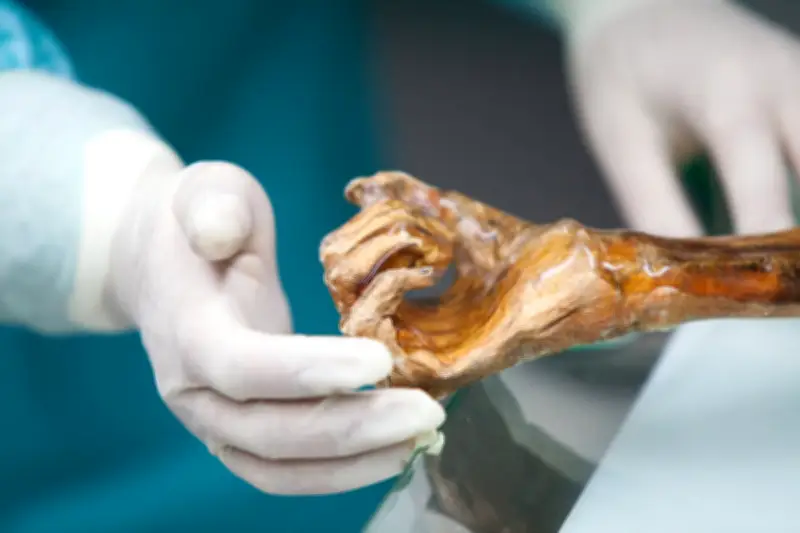
Scientists have successfully baked a sourdough loaf of bread using yeast strains harvested from a 5,000-year-old mummy, and they are now exploring the possibility of brewing beer with the same ancient yeast.
The yeast was obtained from Ötzi the Iceman, a remarkably well-preserved corpse that was frozen in Alpine ice near the border between Italy and Austria for over 5,300 years before being discovered in 1991. Since his discovery, Ötzi has been extensively studied, providing valuable insights into the lives of prehistoric European people.
Researchers have been analyzing the microorganisms preserved on and within Ötzi's remains. A surprising outcome of this research was the extraction of yeast, which was then used to create sourdough bread. Microbiologist Mohamed Sarhan, who works at the Institute for Mummy Studies at Eurac Research, described the process in statements posted on the institute's website. "Eventually, we obtained a completely normal dough that rose within 24 hours – basically just like with ordinary yeast. We made some really good dough with it," Sarhan said.

Sarhan admitted that his lack of baking experience affected the final product. "I've never baked bread before – and it showed. So the result definitely had room for improvement. But as I said, these were our very first experiments," he added.
The team is now considering other applications for the ancient yeast, including homemade beer. "We want to pursue this further and involve specialized research teams from the food sector in the process. Bread is currently one of the obvious applications we're considering; another is beer – we've already discussed this with experts from German brewer Weihenstephan," Sarhan said.
The harvested yeasts are cold-adapted and are believed to have entered Ötzi's body after his death. Genetic analysis suggests that the yeasts colonized his remains relatively soon after he died.
Ötzi continues to captivate scientists and the public alike. His body bears the oldest known tattoos, with a total of 61 markings. There is also great interest in the circumstances of his death, which occurred high in the mountains about 5,300 years ago. He appears to have been killed by an arrow shot into his back, a case often described as one of the world's oldest unsolved murders.