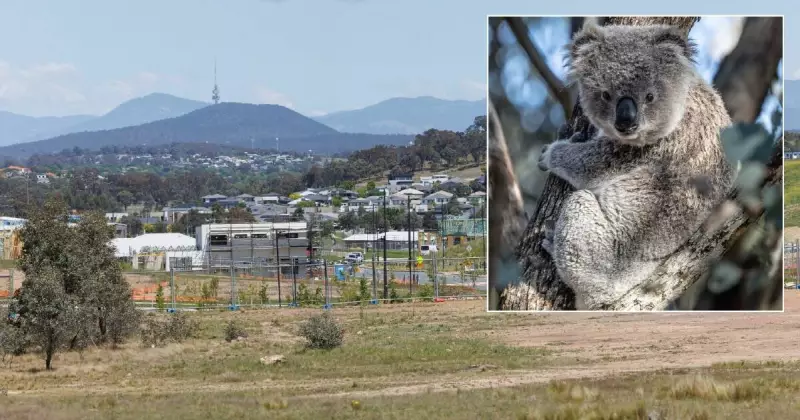
A new report from the ACT's conservation office has delivered a clear warning: the clearing of trees in the developing northern Canberra suburb of Jacka "should be avoided" to protect a potentially key habitat for koalas.
Significant Sighting Triggers Detailed Scrutiny
The warning follows the significant discovery of a gula – the Ngunnawal name for koala – in Jacka in October 2024. ACT Flora and Fauna Conservator Bren Burkevics immediately flagged the sighting as highly significant, triggering a series of conservationist functions.
Between October 2024 and February 2025, authorities conducted intensive auditory, thermal, and visual surveys of the area. These efforts revealed "far more koala activity than anticipated," according to Mr Burkevics. The conservation team confirmed at least one male koala was using the site, potentially as part of its home range.

Report Highlights Habitat Importance and Development Risk
The subsequent due-diligence report, released after a Freedom of Information request by independent Kurrajong member Thomas Emerson, paints a critical picture. It states the area could be an important movement corridor for dispersing koalas, vital for maintaining genetic flow between populations.
The report is blunt about the implications for the stalled residential development: "Conserving known occupied connected habitats is vitally important to meet conservation goals, and also means that finding or creating appropriate offset habitat is likely to be very challenging." It concludes that to meet statutory commitments, clearing this habitat should be avoided.
The findings contradict earlier assumptions in the Gungahlin Strategic Assessment, which had suggested koala presence was unlikely, despite historical NSW sightings in 1980 and 2000.
Unanswered Questions and a Tragic Discovery
The report acknowledges major unknowns about koala habitat in the border landscape, warning it is a "risk to assume" other areas with similar trees are suitable. It recommends further acoustic monitoring starting in October 2025 to coincide with the breeding season, and thermal monitoring in winter to detect less vocal female koalas.
In a tragic postscript, after the report was completed, a koala was found dead in the nearby suburb of Taylor. Freedom of Information documents show the conservation office planned DNA testing to see if it was the same individual spotted in October 2024. A draft answer to an Assembly question stated a veterinarian could not determine the cause of death or confirm its identity.
Political Pressure and Calls for Transparency
Following the conservator's report, the Suburban Land Agency is now completing a self-assessment. An ACT government spokesperson said in October 2025 that this assessment would evaluate if the Jacka development would significantly impact nationally protected matters, determining if a federal referral is needed. The assessment was expected to be finalised in January 2026.
Thomas Emerson has criticised the process, stating the community is "wary of plans to continue developing Jacka." He argues relentless urban sprawl is environmentally harmful and economically unsustainable, advocating instead for densification and innovative housing solutions.
"Canberrans will expect full transparency around the SLA's self-assessment process," Mr Emerson said, highlighting that the original deadline of December 2025 had passed.