A dramatic overnight rescue unfolded in one of Western Australia's most remote and historic locations last week, when a woman was pulled from a deep cave in the Great Victoria Desert.
The Midnight Rescue Operation
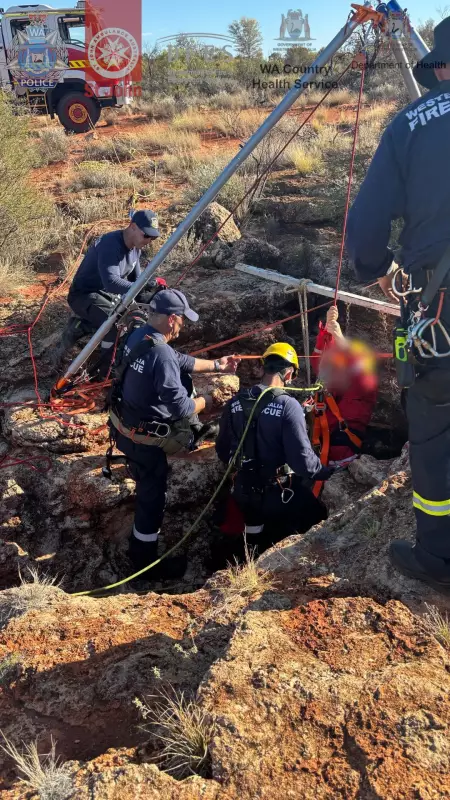
A 60-year-old woman spent twelve harrowing hours trapped in a cave at Empress Spring, roughly 350 kilometres north-east of Laverton. Emergency services were alerted after she suffered injuries from a fall into the cavern, which features a sheer 10-metre drop.
According to a police spokeswoman, the woman's partner immediately provided crucial assistance while awaiting professional help. He lowered first aid supplies, water, and even camp chairs down to her. The complex vertical rescue operation, requiring specialised lifting gear, was finally completed at 5:35 am last Saturday.

The woman was transported to Laverton Hospital with injuries that, thankfully, were not considered life-threatening. Reflecting on the incident, Senior Sergeant Brendan Grogan from Laverton police emphasised the importance of preparation. "It also reinforces the importance of being well prepared, as the woman and her partner were," he said, "and serves as a reminder of how quickly a perfect day outdoors can shift into a potentially life-threatening emergency."
Echoes of History: The Discovery of Empress Spring
This modern drama is set against a rich historical backdrop. The very site of the rescue, Empress Spring, was discovered under desperate circumstances over a century earlier. On August 10, 1896, explorer David Carnegie and his exhausted party were led to a series of hidden rock holes by an Aboriginal man.
Stranded in the desert and parched, Carnegie and his companion Charles Stansmore used a rope to descend into a cavern. Initially finding it dry, they discovered a narrow passage that led to a life-saving water source. Carnegie named the spring after Queen Victoria.
Carnegie's epic journey is documented in his book Spinifex and Sand. Historian William J. Peasley, who retraced Carnegie's steps for his book In The Hands Of Providence, described him as "a desert explorer of the highest order" who showed compassion and wrote vividly about the landscape.
A Landscape That Endures
Today, visitors to the area can still connect with this history. The track is now named David Carnegie Road, leading to a plaque commemorating the centenary of his discovery. The spring itself remains largely as Carnegie described it: a series of holes in a limestone outcrop, surrounded by buckbush and mulga scrub.
Nearby, Breaden Bluff—named for Carnegie's expedition member Joe Breaden—offers stunning views and extensive cave systems, evidence of an ecosystem that has been "just ticking away out here" for millennia.
The recent rescue is a stark reminder that while the desert's ancient stories are etched in its rocks, new chapters of human challenge and resilience are still being written beneath its vast, unforgiving sky.
Postscript: David Carnegie returned to England in 1897, published his book, and was awarded the Gill Medal by the Royal Geographic Society. He later took a post in Nigeria, where he was killed by a poisoned arrow in a skirmish in 1900, aged just 29.