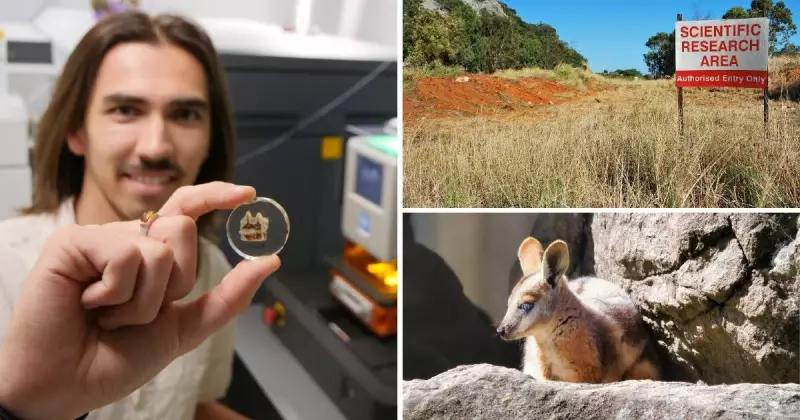
New research is turning the long-held perception of the shy, sedentary rock wallaby on its head, revealing that some ancient individuals were surprisingly adventurous long-distance travellers. A groundbreaking study led by the University of Wollongong (UOW) has used fossil evidence to prove that crucial movement between colonies was a natural part of their history, with direct implications for how we protect them today.
Chemical Clues in Ancient Teeth Tell a Travel Tale
The discovery, published in the journal Quaternary Science Reviews, centred on the analysis of fossil remains from the Mount Etna Caves near Rockhampton in central Queensland, dating back around 280,000 years. Researchers, including lead author Chris Laurikainen Gaete from UOW, employed a sophisticated technique analysing the chemical signatures locked within the wallabies' teeth.
"The teeth incorporate unique chemicals from the food they ate, which is directly linked to the underlying geology," explained Mr Laurikainen Gaete. "A plant growing on limestone has a different signature to one growing on basalt. Since the caves are in a limestone block, a local wallaby would show a strong limestone signature. If we see a different signature, we know that animal was feeding elsewhere."

Homebodies and Highwaymen: The Fossil Evidence of Movement
The chemical analysis painted a clear picture of ancient behaviour. While the majority of the fossilised rock wallabies were confirmed as homebodies, sticking to small, local ranges, the study uncovered remarkable exceptions. At least one intrepid individual was found to have travelled more than 60 kilometres across the prehistoric landscape.
This epic journey likely involved crossing significant barriers, including the crocodile-infested Fitzroy River. This finding provides the first direct fossil evidence that individual rock wallabies historically undertook long-distance dispersals. These rare but vital journeys would have connected otherwise isolated populations, mixing genes and bolstering the long-term genetic health and resilience of the species.
"We used the chemical signatures preserved in fossil teeth to reconstruct how individual kangaroos moved through the landscape," said Professor Anthony Dosseto of UOW's Wollongong Isotope Geochronology Laboratory. "Most were homebodies, relying on local resources, with a few notable and important exceptions."
A Roadmap for Future Rock Wallaby Conservation
The research carries profound implications for contemporary conservation efforts. Many rock wallaby species are now threatened, with their habitats fragmented by major roads, urban development, and industrial activity. These human-made barriers may be inadvertently preventing the kind of natural dispersal events that the fossil record proves were essential for population health.
"Future management shouldn't view rock wallabies as isolated colonies," Mr Laurikainen Gaete emphasised. "Long-distance dispersal has always been part of their natural history and by protecting landscape connectivity, we ensure this deep-time behaviour remains part of their future survival."
The team plans to apply the same isotopic technique to studies of modern rock wallaby populations, including analysing roadkill, to understand current movement patterns. Combined with genetic testing, this could map where animals are travelling from and how far they get, informing where wildlife corridors or other interventions are most needed.
Dr Scott Hocknull, a palaeontologist at CQUniversity involved in the study, highlighted the power of this approach: "This study demonstrated the power of new isotopic techniques to reconstruct ancient animal behaviour at the level of the individual. Long-term species survival depends on individuals being able to move between habitats."
The message from deep time is clear: protecting the rock wallaby's future requires conserving its ancient right to roam.