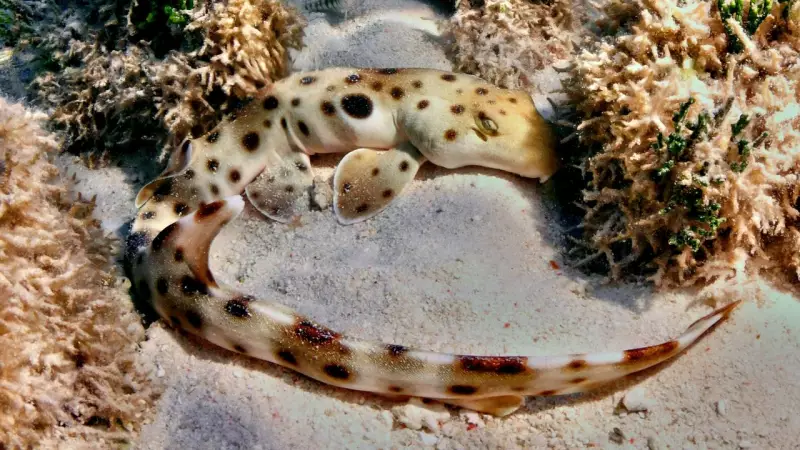
In a discovery that upends fundamental biological assumptions, scientists in Far North Queensland have revealed a small, resilient shark species can successfully reproduce without requiring any additional energy from food. The finding, centred on the humble epaulette shark (Hemiscyllium ocellatum), has sent ripples through the marine biology world and offers new hope for species survival in a warming climate.
A Shark That Breaks All the Rules
The research, led by Dr. Jodie Rummer from the Australian Research Council Centre of Excellence for Coral Reef Studies at James Cook University in Cairns, focused on the reproductive habits of these remarkable bottom-dwelling sharks. Epaulette sharks, named for the distinctive black spots behind their pectoral fins resembling military epaulettes, are a common sight on the Great Barrier Reef.
The study's most astonishing finding was that female epaulette sharks did not increase their food intake at all during pregnancy. This directly contradicts the long-held biological principle that reproduction is an energetically costly process, requiring mothers to consume more calories to support the development of their young. "We were blown away," Dr. Rummer stated, highlighting the significance of the deviation from the norm.

Conservation Implications for a Changing World
This unique adaptation is not just a biological curiosity; it has profound implications for conservation. The research, published in the scientific journal PLOS ONE, suggests that epaulette sharks are exceptionally well-equipped to handle environmental stressors where food may become scarce.
Their ability to reproduce successfully without extra energy input could be a critical survival trait as ocean temperatures rise and ecosystems change. Unlike many other species that might struggle to find resources for breeding, epaulettes appear to have an inbuilt buffer. This resilience is particularly relevant for the Great Barrier Reef ecosystem, which faces ongoing pressures from climate change.
The study involved closely monitoring sharks in controlled environments at James Cook University's research facilities. Scientists meticulously tracked their food consumption, metabolic rates, and reproductive outcomes over extended periods to arrive at their conclusive data.
A Local Marvel with Global Significance
The epaulette shark is already famed for its ability to walk on its fins out of water and survive in low-oxygen conditions—traits that help it navigate the challenging tidal pools of its reef habitat. This latest discovery adds "energetically efficient breeder" to its list of extraordinary adaptations.
For marine biologists in Cairns and around the world, the research opens new avenues for understanding how some species might persist in the face of global environmental change. It challenges scientists to look beyond conventional models and consider a wider range of survival strategies in the animal kingdom.
As Dr. Rummer and her team continue their work, the unassuming epaulette shark stands as a powerful symbol of nature's ingenuity, offering a glimmer of resilience from the heart of the Great Barrier Reef.