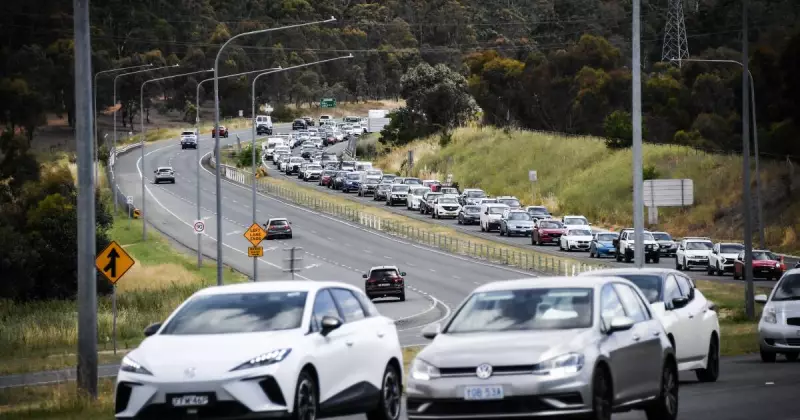
Canberra drivers are already altering their daily routines in response to increased traffic congestion at the start of the year, with road officials noting a noticeable spread of the morning peak hour.
Drivers adapt to post-holiday crunch
Roads ACT executive branch manager Tim Rampton confirmed that motorists encountered extra congestion earlier this week as people returned to work and re-established their travel patterns. This annual phenomenon has been compounded this year by significant road construction projects across the city.
"This year, we've obviously got the complications and the added road works in and around the network," Mr Rampton said. "So people are sort of coming back and not necessarily realising some of their normal routes to and from work are impacted by construction."

He emphasised that while congestion was present, it was not beyond the network's capacity. Traffic has already begun to settle through the week as commuters made behavioural changes, such as leaving earlier or choosing alternative routes.
Data reveals February as peak congestion month
Traffic data from navigation firm TomTom provides a clear picture of Canberra's congestion patterns. On Monday, January 16, 2026, congestion levels peaked at 36 per cent at 8am, which was above the usual level of 33 per cent. Interestingly, Tuesday's morning peak reached 38 per cent, but this was actually below the typical 41 per cent congestion level for that day.
The data consistently shows that February is the worst month for congestion on Canberra's roads, a trend observed in both 2023 and 2024. January and December are historically the least congested months. The morning peak hour in the ACT typically falls between 8am and 9am, with Tuesday, Wednesday, and Thursday being the busiest weekdays.
Mr Rampton highlighted that the first week of February is always a critical period, coinciding with more people returning to work and children going back to school after the summer holidays.
Roadworks and proactive management
Major disruptions contributing to this year's traffic include road closures in the city centre, Commonwealth Avenue bridge works, and light rail extension works. Roads ACT is monitoring the situation closely from its traffic management centre, operating from 7am to 7pm on weekdays.
Officials can manually override traffic signals to manage abnormal congestion, such as that caused by accidents or major events. "We will override it for a period of time and just provide more green time to a particular movement to try and sort of flush some of the vehicles through," Mr Rampton explained.
However, he acknowledged the limits of this approach. "Generally, the biggest improvements come on the network from changes to travel behaviour. We can only do so much with what we have and the tools we have." He cited the Tuggeranong Parkway as an example, which lacks traffic signals, making direct management difficult.
The experience from the London Circuit works showed that drivers began adapting by leaving earlier, causing the peak to spread from around 7:30am out to 9:30am. This behavioural shift is seen as a natural response in a growing city. Roads ACT continues to work with the National Capital Authority and makes minor adjustments to traffic flows to ensure safety and efficiency as Canberra's commuters navigate a changing road landscape.