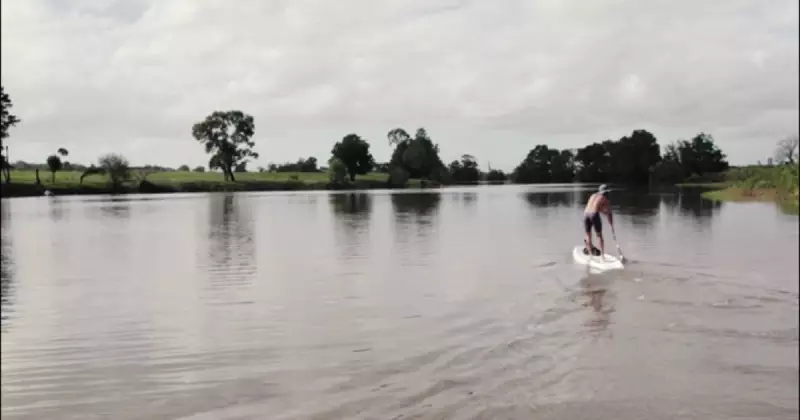
An intrepid stand-up paddleboarder has completed a monumental journey down the entire length of the Hunter River, blending extreme adventure with vital environmental science. Evan Sutter paddled over 470 kilometres from the river's source in the Barrington Tops to the sea at Newcastle, collecting water samples that revealed a disturbing presence of microplastics even in remote upper reaches.
An Epic Four-Day Paddle Against the Elements
In January 2026, Sutter embarked on his ambitious source-to-sea expedition, driven by a deep love for rivers and adventure. Living in Cooks Hill near Newcastle, the Hunter had long been a source of fascination for him. The journey spanned four gruelling days, requiring not just endurance but significant logistical planning and adaptability.
He navigated the changing river on a 12-foot (3.6 metre) paddleboard, switching to a kayak when water levels dropped too low for the board's fin. Some sections were so dry or obstructed that he was forced to carry his gear for hours on foot. "I would trek until there was enough water for me to put the SUP back in," Sutter recalled, noting these portages were among the toughest challenges.

With a land crew meeting him at pre-arranged points, he faced unpredictable conditions, including battling against both tide and wind during the final 70-kilometre stretch from Maitland to Newcastle. The physical toll was immense, with cramping, blistered hands and feet pushing him to his limits.
Citizen Science Uncovers a Hidden Pollution Problem
More than just a personal challenge, Sutter's paddle was a mission of discovery. Partnering with the HEAL (Healthy Environments and Lives) network and researchers from the University of Newcastle, he collected water samples along the entire route to assess the river's health.
He witnessed the Hunter's dramatic transformation, from crystal-clear waters under a dense canopy in the upper reaches, through agricultural and mining zones, to the tidal estuary. He observed concerning discharges near Maitland, stating, "you do see some ugly stuff spilling out of pipes."
The laboratory analysis of his samples yielded a startling discovery. Researchers found microplastics, including PVC and PC, present even at the most remote upstream sites near the source in Barrington. This was unexpected, as pollution was assumed to increase closer to urban and industrial centres like Singleton and Newcastle.
"You would think that it would appear when you come down into Newcastle or through Singleton," Sutter said. "So they were surprised by the levels they found up closer to the source. I think there's no place that isn't touched by plastics at the moment." The research indicated these plastics posed a severe ecological risk.
A Documentary to Inspire Love and Protection
Sutter's remarkable journey is now the subject of a four-part documentary titled "Run. River. Run," which chronicles both the athletic feat and the story of the Hunter River itself. One of his key motivations is to encourage others to connect with and appreciate the natural wonders in their own backyard.
He expressed surprise at how few people he encountered on the river, especially in the stunning wilderness near Barrington. "Why aren't people out here camping and fishing and really enjoying this wild place? It's right on our doorstep," he questioned, suggesting people often rush over rivers without truly seeing them.
For Sutter, this connection is the first step toward conservation. "Once you love something, you're more likely to want to protect it," he said. His SUP adventure stands as a powerful testament to citizen science, human endurance, and the urgent need to safeguard Australia's vital waterways from hidden threats like microplastic pollution.