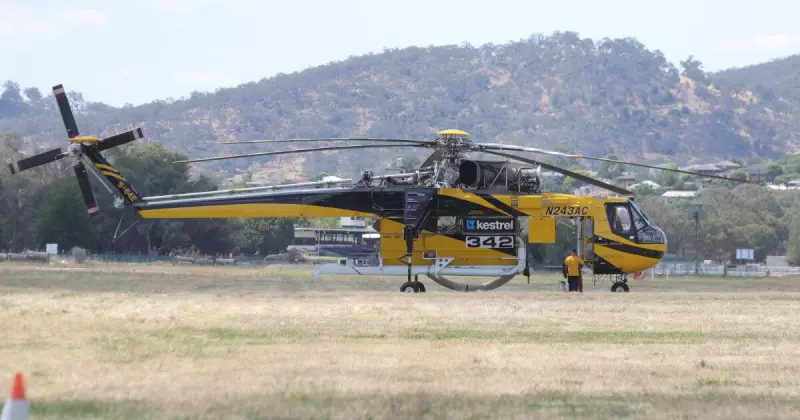
The distinctive scent of bushfire smoke and the relentless thrum of water-bombing helicopters over the Namadgi National Park this week must act as a stark alarm for every person living in the Australian Capital Territory.
A Close Call in Remote Terrain
While the four separate fires detected near Bendora and Corin dams have now been downgraded to patrol status, their emergence delivered a potent warning. These blazes, which ignited in remote and difficult country, appeared with little warning. Described as slow-moving, they still demanded an immense effort from more than 75 firefighters over several days, supported by aircraft and boats, to be contained.
This incident underscores the harsh reality of the fire season now unfolding. The region faces a dangerous convergence of risk factors that requires urgent attention from every household, not just those bordering bushland.

The Converging Risks for the Bush Capital
The ACT is currently experiencing extreme temperatures alongside significant fuel loads. As noted by ACT Rural Fire Service officers, grasses are curing rapidly, soils are drying out, and invasive species such as lovegrass stand tall and ready to burn.
Residing in the "bush capital" is a privilege that offers a beautiful lifestyle, but it carries an immutable responsibility. The boundary between suburbia and forest is often perilously thin. Canberra's unique geography, with its dispersed town centres and suburban developments, means the idea of a completely safe, built-up area is a fallacy during a catastrophic event. In 2003, fire did not halt at farmland edges; it charged directly into urban streets.
A City Divided by Fire Memory
A significant demographic divide on fire awareness now exists in Canberra. Hundreds of thousands of current residents did not live through the trauma of the 2003 firestorm; for them, it is a historical documentary, not a visceral memory. They lack the ingrained "muscle memory" of watching an apocalyptic sky.
Similarly, while the Black Summer of 2019-2020 is more recent, the sheer terror of an advancing fire front remains an abstract concept for many newer arrivals. While survivors of the 2003 disaster need no reminder to clear gutters and maintain fire plans, newer residents must actively learn these critical behaviours.
We cannot depend on luck or assume that a few wet years have eliminated the threat. The guidance from authorities is unambiguous and must be heeded. The ACT Rural Fire Service and Emergency Services Agency are better equipped and more technologically advanced than two decades ago, but they cannot be omnipresent.
The Call to Action: Remove Complacency
Practical steps are required from every resident immediately:
- Clean your gutters and remove combustible materials from around your home.
- Download and learn to use the official "Hazards Near Me" application.
- Understand the fire danger rating system.
- Most crucially, develop and discuss a bushfire survival plan with your household. Decide when you will leave, where you will go, and what you will take.
As RFS Chief Officer Rohan Scott stated, we should love where we live, but we must respect the landscape. We have built a community within a native forest, and as temperatures soar, that forest can become a threat with frightening speed. Complacency is the one fuel source we have the absolute power to eliminate. It must be removed before emergency sirens begin to wail.