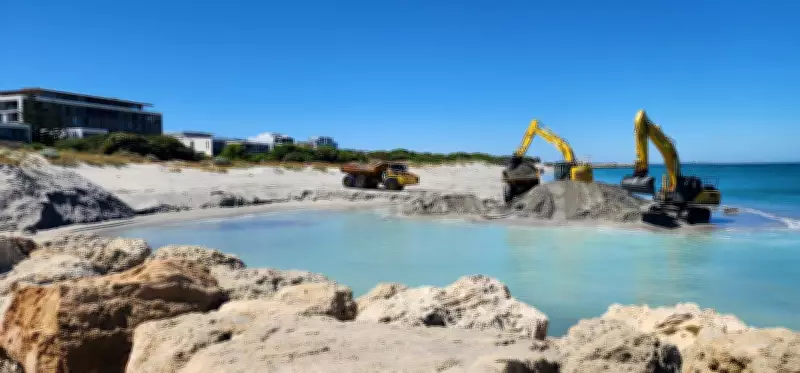
Cockburn Launches Major Sand Restoration at C.Y. O'Connor Beach After Severe Erosion
The City of Cockburn council has taken decisive action to address significant environmental damage at C.Y. O'Connor Beach and the adjacent Rollinson Road park area. Severe erosion on the northern section of the beach, coupled with sand drift issues in the park, has prompted the closure of beaches on work days to facilitate urgent restoration efforts.
Extensive Erosion and Immediate Response
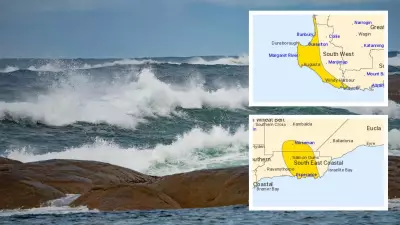
Over the recent summer holidays, wave action at Catherine Point Groyne and strong sea breezes led to substantial sand loss, blowing sand over the dunes and into the park area. This resulted in the erosion of approximately 20,000 cubic meters of sand from the northern side of Catherine Point Groyne, with a large volume accumulating at the northern end of the beach near Island Street Groyne.
Rory Garven, the City of Cockburn's service manager of sustainability, emphasized the scale of the issue. "The loss of more than 50 meters of shoreline over the past two decades has marked C.Y. O'Connor Beach as an erosion hot-spot," he stated. In response, MCS Civil has been contracted to carefully remove excess sand from dune vegetation and carry out sand nourishment and beach restoration.

Beach Closures and Restoration Timeline
Works commenced on February 11 and are scheduled for completion by March 3. During this period, the northern beach section between Island Street Groyne and Catherine Point will be closed to the public on weekdays. It will reopen on Fridays from approximately 5 PM through the weekend, with barrier fencing and signage in place to ensure public safety.
The restoration process involves back-passing sand from the accumulation zone down the beach from north to south, utilizing excavators and trucks. "Sand is being transported by the City's contractor to replenish the eroded areas," Mr. Garven explained.
Innovative Artificial Reef Initiative
In a proactive move to combat coastal erosion, the City of Cockburn installed a West Australian-first artificial reef off C.Y. O'Connor Beach in March 2022. This reef, monitored by The University of Western Australia's ocean graduate school, has shown promising early results. Preliminary research indicates that the first stage, completed in 2022, contributed to a 10% reduction in wave height and a 20% reduction in wave energy reaching the shoreline.
The second stage, completed in November 2024 and funded by an $802,260 expansion including a $600,000 grant from the Coastal and Estuarine Risk Mitigation program, has doubled the reef's size. "We assume that this expansion will further reduce wave energy and sand erosion," Mr. Garven noted. The reef has also become a thriving habitat, with 57 fish species and 56 non-fish species observed, and marine flora growth on concrete bombora modules is expected to aid in wave energy reduction.
Long-Term Coastal Management Strategies
The City of Cockburn allocates an annual budget of $590,000 for sand nourishment and beach re-profiling along its coastline, which includes C.Y. O'Connor north and south, Coogee, and Ngarkal Beach. "Costs vary based on factors like erosion extent and contractor availability," Mr. Garven added.
With sea levels predicted to rise this century, other beaches in the area are expected to face similar erosion challenges. To address this, the city is developing an updated Coastal Hazard Risk Management and Adaptation Plan (CHRMAP). This plan will consider community input, with a pop-up consultation scheduled for March 21 near Coogee Beach Cafe to discuss coastal hazards and vulnerabilities.
A draft CHRMAP and report are expected to be completed for council consideration this year, aiming to manage coastline development and mitigate future risks effectively.