In a renewed effort to preserve and revitalise traditional Indigenous knowledge, the Stories Behind the Fishing Net: Sitting with the Aunties project has brought together Elders, knowledge holders, and community members on Widjabal Wia-bal Country in northern New South Wales. The project focused on the ancient practice of weaving fishing nets from native fibres, weaving together not just string but also stories, memories, and cultural responsibilities.
Reviving a Tradition Disrupted by Colonisation
The project emerged from a longer movement to restore weaving practices that were disrupted by colonisation. It took place while the Northern Rivers region was still recovering from the catastrophic floods of 2022, providing a space for community members to reconnect with Country, culture, and each other. The net-making process was deeply rooted in Country, carrying with it the responsibility to take only what is needed.
Knowledge Shared Across Nations
Nearly two decades ago, Yolŋu Elder, educator, master weaver, and knowledge holder Merrkiyawuy “Merrki” Ganambarr-Stubbs began sharing weaving knowledge with Bundjalung women from Cabbage Tree Island. Her connections to the Northern Rivers through her husband’s family enabled this knowledge to be shared across Nations through reciprocity, respect, and collective responsibility.

The late Aunty Gwen Williams, a respected Bundjalung Elder and knowledge holder, learned this weaving practice from Merrki. She later developed the fishing-net project with co-author Kylie Day, envisioning a net made from locally gathered fibres that would bring the community together. Although Aunty Gwen passed before the workshops were implemented, her vision remained central. Her sister Aunty Jacqui Williams, along with other Elders, family, and community members, helped carry the work forward.
Bundjalung Nyangbal knowledge holder Uncle Marcus Ferguson guided the identification and careful collection of native fibres. His teaching reinforced that harvesting is governed by responsibility: knowing what to take, when to take it, and what must be left for Country.
Weaving Stories and Strengthening Bonds
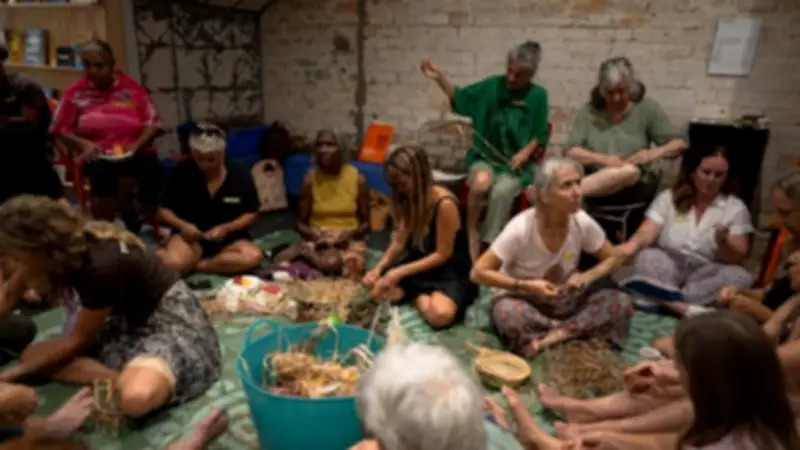
The project was about more than just making a fishing net. Sitting with the Aunties, listening, learning, and weaving stories together made the process powerful. Women led the preparation and weaving of fibres into string. The string was then passed to the men, who shaped the net through knots, adding their own knowledge, stories, and responsibilities. These were culturally guided and connected roles, rather than a simple or universal gender divide. Respecting these roles recognised women’s leadership, supported men’s cultural knowledge and wellbeing, protected cultural authority, and created safe spaces for learning across generations.
Men of different generations worked together to construct the net, led by Uncle Phil Roberts of the Bundjalung Tribal Society. The net was taken apart and remade several times so techniques could be practised and refined. Net-making also drew on skills recognised in contemporary education: observation, testing, pattern recognition, design, adjustment, and problem-solving. Yet these skills were taught through Country, culture, and relationships, alongside knowledge of plants, waterways, sustainable harvesting, and care for local ecosystems.
The Limits of Digitisation
Some knowledge is best understood by doing. It is held in the hands, shared through relationships, and practised on Country. Growing efforts to digitise Indigenous cultural heritage can support preservation, but they also raise important questions about cultural authority, consent, and Indigenous Cultural and Intellectual Property. Who has the right to record knowledge? Who decides how it is used? What must remain protected?
Digitisation and artificial intelligence can record or reproduce aspects of a practice, but they cannot replace the feeling of fibre between your fingers, the moment an Aunty corrects your hands, or the cultural protocols governing what can be shared, by whom, and when. As one Aunty reminded us: “We learn off one another and we follow through with it […] I believe we’ve all got some gift.”

Looking Forward
Elders and Aunties were not simply research participants. They were knowledge holders who guided the process and determined what could be shared. Participants described experiencing culturally safe spaces, strengthened relationships, renewed connections to Country, and opportunities to learn across generations. The finished net mattered, but so did the relationships formed while making it.
The work will continue. The project has been invited to explore different native fibres, compare their strength and durability, investigate traditional preservation methods, and deepen the men’s knowledge and wellbeing dimensions that emerged through net-making. Like the fishing net itself, community is made strong through connection: thread by thread, story by story, across generations.
The authors acknowledge the Elders, knowledge holders, and community members who generously shared their knowledge, time, and care. Deep respect is paid to the late Aunty Gwen Williams, her family, and the vision she entrusted to this work.