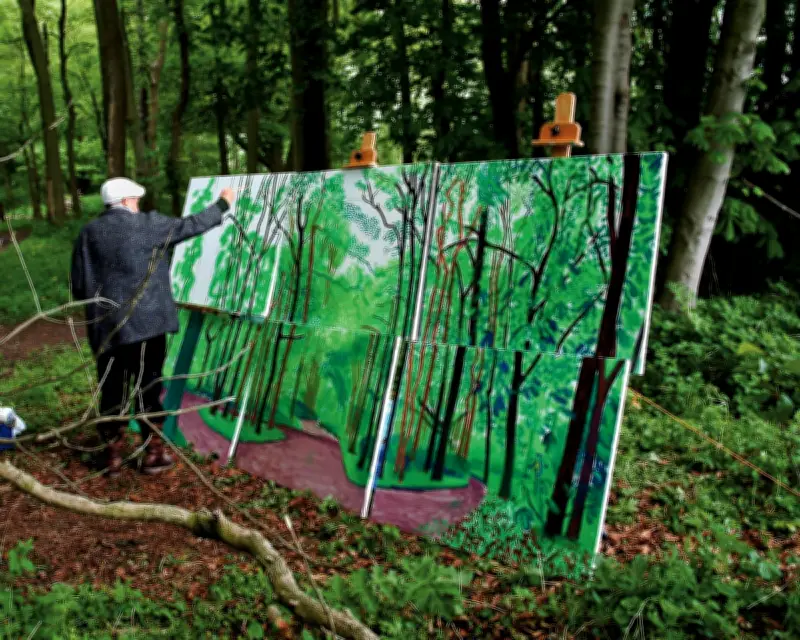
It was spring in Paris, and I was surrounded by lush green leaves and white blossoms—not in a park, but inside the Fondation Louis Vuitton, immersed in David Hockney's iPad paintings of his Normandy garden. One room depicted this verdant haven under moonlight, with glowing white lunar discs, blue clouds, and the shadowy silhouettes of tree branches.
This was the opening of David Hockney 25 in April 2024, a blockbuster exhibition curated with the artist's close involvement. It covered his entire career but emphasized his work from the 21st century. The show boldly argued that Hockney's later paintings of straw bales and ponds rival his iconic swimming pools and portraits—and it succeeded. Visitors moved from early masterpieces bathed in Californian light to Yorkshire fields with emerald hedgerows and purple trees, all making perfect sense.
A Memorable Dinner and Artistic Insights
One of my most treasured memories is a quiet dinner at Hockney's west London home after a private visit to the National Gallery. Using his privilege as a modern master, he took me there after hours; the only other guests were painter Leon Kossoff and his family. Over fresh lychees, Hockney passionately discussed his book Secret Knowledge, arguing that Old Masters like Caravaggio used camera obscura. I wasn't convinced, but I was captivated by the man whose glamorous yet eerie world was captured in Jack Hazan's film A Bigger Splash.

From LA Glamour to Yorkshire Fields
In the 21st century, Hockney deliberately distanced himself from his famous 20th-century persona. He focused on art history and perspective rather than male beauty or Hollywood hedonism—though he once told me, "When you see a really beautiful person, it's like a door opens." He preferred the countryside, living in Bridlington, Yorkshire, in a house with California-colored interiors. His studio was a tiny bedroom, but he painted outdoors en plein air, like a French Impressionist.
It was hard to adjust to this unglamorous Hockney. The first time I saw him in person, he had peroxide blond hair, taking a bow at Sadler's Wells for his opera set design. But as his deafness worsened, he stopped designing for ballet and opera, letting his hair turn gray. One Hockney seemed to die, replaced by another.
The Pandemic and a New Creative Burst
However, his earlier work on Stravinsky's The Rake's Progress showed his enduring fascination with art history and perspective. When he began painting Yorkshire woodlands and harvests, he was equally clever. But it took a global crisis for his late-career passions to become urgent. Living in Normandy during the pandemic, he used his iPad to paint his garden and emailed the images to spread cheer. I ended up on his list, waking each morning to fresh Hockneys depicting spring—trees rustling, rain on ponds—as evidence of hope.
Love and the Final Chapter
What once seemed like a retirement—painting pastoral scenes—now felt profound. His insistence on capturing the seasons' endless variety and nature's resilience resonated deeply. In one email, he mentioned "JP who I love"—Jean-Pierre Gonçalves de Lima, his assistant and later lover. Their relationship seemed to make him happy, and his late art bloomed. Hockney found love and poured it into his Normandy paintings, a kiss to the world.
Yet he remained enigmatic. At a Fitzwilliam Museum exhibition, I tried to get him to discuss a 1970s painting of his former lover Peter Schlesinger, but he only talked about perspective. And seeing his muse Celia Birtwell—still as glamorous as in Mr and Mrs Clark and Percy—intensified my nostalgia for early Hockney.
A Lasting Legacy
Honestly, Hockney's 1960s and early 1970s works will endure. His framing makes him a great narrative painter. But he made his point about simply looking at nature in his late work. When art seemed to abandon drawing, he returned to his Yorkshire roots to assert art as pure perception. As he aged, he showed how democratic art can be: we should all observe, draw, and paint. An iPad suffices; it's the voyage of the eye that matters.

In that sublime Paris exhibition, his late vision triumphed. This cussed Yorkshireman even had a show at London's Serpentine Gallery this year. An artist who started the century unfashionable ended as the toast of the art world—one last glorious spring.