Concert performance of Wagner's Tristan und Isolde at Barbican Hall
The London Symphony Orchestra's regular concert performances of complete operas have become an institution. Janáček's The Makropulos Affair and Strauss's Salome had critics raving about high-definition orchestral textures and brutally streamlined drama. But few operas are more obviously made for the concert hall than Wagner's Tristan and Isolde. The composer designated it a Handlung (act or plot), yet Tristan stands out even among his narration-heavy works for its sheer absence of onstage action. No other more closely encapsulates his notion that operas should be “deeds of music made visible”. Tristan’s ultimate drama is rooted in the orchestra.
Pappano's conducting and orchestral details
Using the soft gestures with which you might stroke a cat (no baton here), Antonio Pappano teased the opening into being – unhurried, impossibly delicate, exquisitely in tune. Over the next almost-four hours of music, numerous details came to the fore that are more often muddied or lost when the orchestra is sunk beneath a staging. There were harsh twangs of double bass and an oboe trill that cut straight through the thick symphonic texture. There was a horn lick never previously heard and a troubled, circling bassline allowed more prominence than usual. The strings were instantly responsive, their articulation immediately hard-edged or cashmere-soft, their sound effortfully excavated or as light as silk in the breeze. Drake Gritton’s cor anglais solos from the back of the balcony and the front of the stage were beautifully shaped, his tone beguiling.
Vocal performances and role debuts
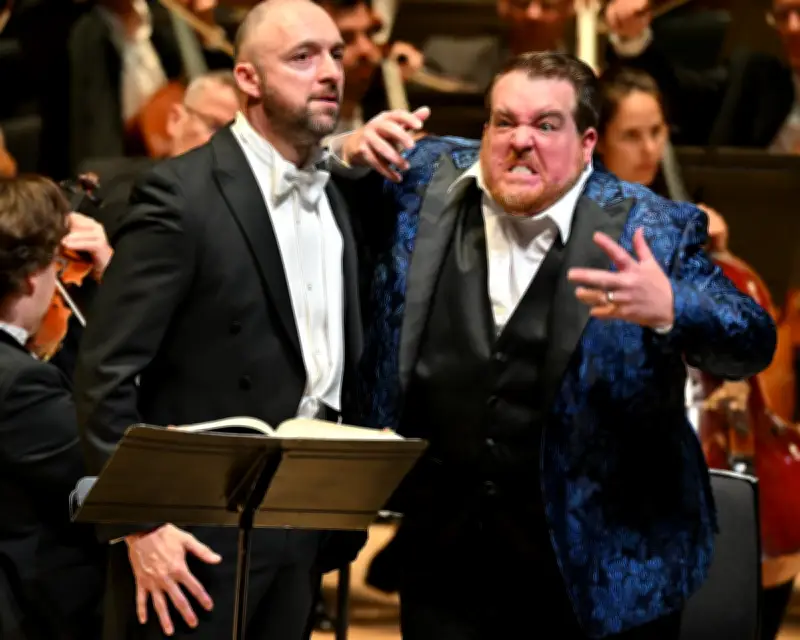
The sung element was a more mixed affair. In his 20th outing as Tristan, tenor Clay Hilley was blistering – unbelievably loud at times, but also capable of delicacy. Where Hilley acted throughout, his Isolde, Sara Jakubiak, was making her role debut and kept a close eye on her score, while Marina Prudenskaya’s muscular, covered Brangaene moved constantly but not per se in character. Jakubiak’s marmoreal soprano nevertheless persuasively communicated Isolde’s deep fury in act one and held its own in the decibel game: this is a role she will surely make her own. Franz-Josef Selig provided exquisite German diction and richly upholstered tone as King Marke; Gyula Orendt was a flexible, sympathetic Kurwenal. Perhaps inevitably the tenors and basses of the London Symphony Chorus were less lusty than usual from the back of the stage.

Star of the performance: LSO and Pappano
But the inevitable star of this performance was the LSO itself, blended by the final chords into a single, minutely balanced instrument played by one of our finest Wagner conductors today. According to the review, the performance was repeated on 12 July.