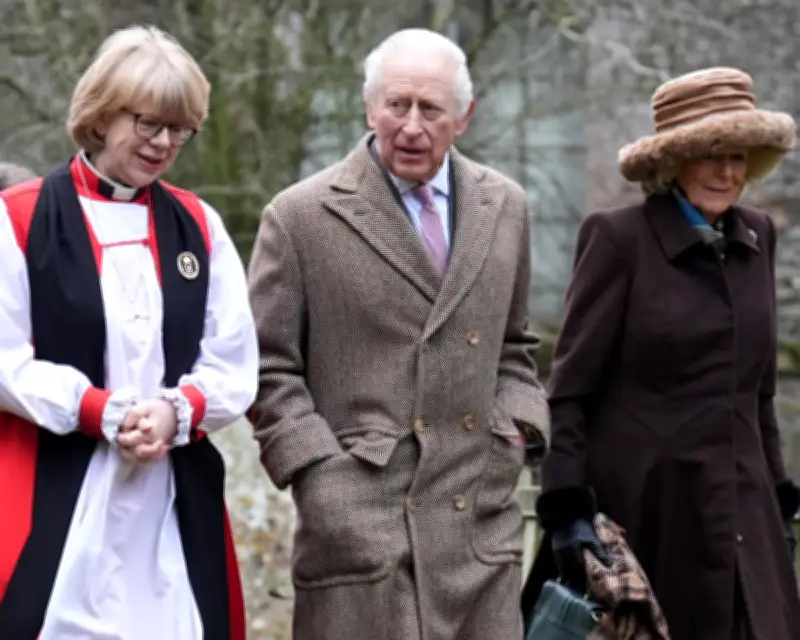
King Charles and Queen Camilla attended a church service at St Peter's church in Wolferton on the Sandringham estate in Norfolk on 25 January 2026, accompanied by the Archbishop of Canterbury, Sarah Mullally. The outing comes amid a growing controversy over the monarch's reported desire to redefine his role from 'defender of the faith' to 'protector of the space for faith within the multi-faith nation'. This shift has provoked fury among Britain's religious right, with some accusing the king of betrayal.
Accusations of betrayal from former chaplain
Dr Gavin Ashenden, a former chaplain to Queen Elizabeth II, has been vocal in his criticism. 'While the monarch cannot technically be a traitor, we might take refuge in grammar and find that the verb carries our feelings even if the noun cannot,' he said. 'Parliament and the oath it presented to the king as a condition of being crowned are betrayed; the Church of England is betrayed. The constitution is betrayed; Anglicans are specifically betrayed. And Christians in general will legitimately feel abandoned at the very least. Some of them too will feel betrayed.' Ashenden, who regularly appears on GB News to lament what he calls the 'woke takeover' of the church, has also suggested that Islam is inherently and uniquely violent.
Christian Institute director weighs in
Ciarán Kelly, director of the Christian Institute, echoed these sentiments. 'Christianity, not some multi-faith mishmash, is the bedrock of our nation's laws and culture,' he said. 'This latest move seems designed to convey the message that Christianity is just one religion among many, and that all are equally valid. They are not.'

King's long-standing position
However, critics point out that the king has held this view for decades. In a 1994 interview with Jonathan Dimbleby, then-Prince Charles first expressed his desire to be 'defender of faith' rather than 'defender of the faith'. Conservative Christians reacted strongly at the time, with the Grand Secretary of the Grand Orange Lodge of Scotland declaring, 'There is no place for Charles imposing his woolly religious beliefs or disbeliefs on the United Kingdom.' Even the then-Archbishop of York, John Habgood, warned that this could 'cause the British constitution to unravel'. Despite these predictions, the constitution remains intact.
Queen Elizabeth II held similar views
Notably, Queen Elizabeth II herself articulated a similar position in a speech at Lambeth Palace years later. She stated that the role of the Church of England 'is not to defend Anglicanism to the exclusion of other religions', but rather to 'create an environment for other faith communities and indeed people of no faith to live freely'. Given that Ashenden was one of her chaplains at the time, critics question whether he ever called the queen a traitor or challenged her on 'woke' theology.
Historical context of multi-faith approach
The multi-faith approach that so upsets traditionalists is itself a product of the Protestant Reformation. Before Martin Luther's 95 Theses, countries enforced Catholicism as the only version of Christianity. With the advent of Protestantism, rulers had to choose which denomination to support. In Germany, the decision was made to let each region's ruler follow their own conscience. Fast forward 250 years, the separation of church and state became enshrined in the US Constitution, and Britain has long functioned as a secular state in practice, despite religious coronation services.

A call for tolerance
For some, this shift represents the end of Christian civilisation as we know it. But supporters argue it is a just and necessary evolution. Ravi Holy, the vicar of Wye in Kent and a standup comedian, wrote in an opinion piece, 'To extend my soft drink analogy: there are no longer just two colas on the market; we also have Sprite and Fanta, Dr Pepper and Tango (other brands are available) and, of course, there are those who eschew all kinds of fizzy pop – and they should be free to do so. So, in the same spirit of generosity and tolerance that the Germans displayed in the 16th century, we need to create a society in which people of all faiths and none can live together in the 21st century. This, it seems to me, is precisely what the king, like the queen before him, is attempting to do. So, as far as I'm concerned, he's no traitor, he's 100% faithful. It's the critics I worry about.'