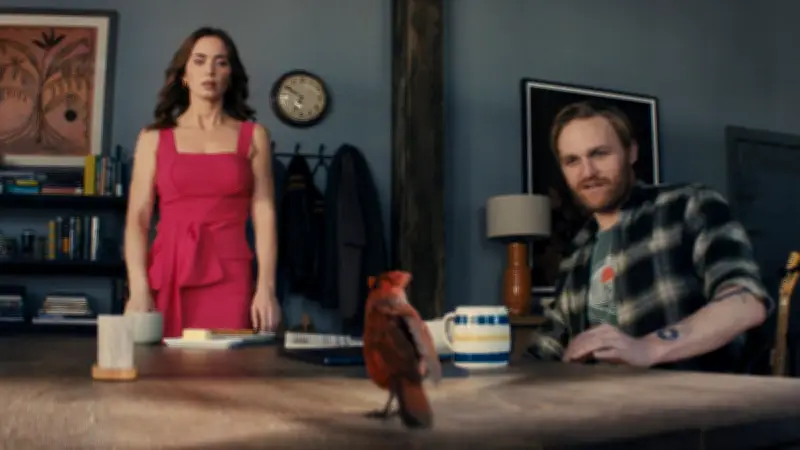
A little bird told me ... Emily Blunt, left, and Wyatt Russell in Disclosure Day. Photograph: Universal Pictures and Amblin Entertainment/AP
Unsure about Disclosure Day? You are not alone. Audiences have propelled Spielberg’s alien thriller to the top of the box office, yet some exiting the cinema appear to believe this sappy extravaganza is not the director’s finest hour.
Close Encounters of a Deferred Kind
A sage person once told me every noted director’s career is an ongoing conversation with the audience. Some film-makers – Michael Haneke, say – sit on high, like a headteacher at an assembly, and loftily number the ways in which we’ve let ourselves and the school down. There are others – Lars von Trier and Ari Aster spring to mind – whose work sidles up uncomfortably close, gooses the viewer and then flees the scene sniggering before the relevant authorities can be alerted. The career of Steven Spielberg – arguably the most remarkable career in the history of popular cinema – has long depended on the audience being on the exact same page, looking up wide-eyed and guileless towards the light: his greatest films, from Close Encounters to The Fabelmans, invite further discussion, an awestruck back-and-forth.

You can therefore understand why Spielberg has broached the subject of social division with Disclosure Day, his much-trumpeted return to the summer event movie: he has almost as much skin in this game as the rest of us non-trillionaires. Yet if early box office has been solid enough, secondary indices – not least a slew of disappointed foyer texts from friends and loved ones – would suggest the film has itself proved distinctly polarising. In the US, market research firm CinemaScore – which polls opening-day cinemagoers to assess a film’s commercial prospects – graded Disclosure Day a B, the joint second-worst for a Spielberg film, ahead of AI: Artificial Intelligence (recipient of a harsh C), dead level with Indiana Jones and the Dial of Destiny. Headmaster Haneke again shakes his weary head.
Human Secrets and Lies
Despite the proximity of aliens, the new film’s focus is primarily human: the secrets we keep, the lies we tell. Disclosure Day thereby dovetails neatly with the themes of several mature-period Spielberg works, notably 2015’s Bridge of Spies and 2017’s The Post. To locate the source of this interest, you need only revisit The Fabelmans – Spielberg’s probing and perceptive movie-memoir of 2022 – which dramatised the effects similar deceptions had on his own household growing up. Screenwriter David Koepp has form in this area, too: his script for last year’s spry and gripping Steven Soderbergh thriller Black Bag unpicked the alibis of bedhopping spies. Yet Disclosure Day’s weak spot is its tissue-thin and arbitrary-seeming plot, its own diaphanous cover story for some altogether antiquated and simplistic editorial.
The setup, granted, is strong: Close Encounters, updated for the information age. First contact here is no longer as harmonious as a five-note call-and-response; as demonstrated by Emily Blunt’s weathergirl, left speaking in tongues, it’s more a matter of mainlining everything on social media (news, multiple languages, a whole century’s crashlandings and cover-ups) in one fell swoop. Phones are bad and must be tossed and driven over. On the trusted list: ordinary people, organised religion, local news (framed as the right, digestible amount of information) and – this being Spielberg – the family home. This ageing viewer has some sympathy for all that, but as a directorial vision, Disclosure Day feels far more old world than new, more 20th century than 21st. How many X-Files reboots does one civilisation need?

Personnel Problems
Set Disclosure Day against Spielbergian precedents, and it has an obvious personnel problem. No one in this cast disgraces themselves – and it’s fun watching Wyatt Russell’s goofball charm, so central to TV’s short-lived Lodge 49, bouncing around on an Imax screen – but Koepp’s characters neither register nor stick in the mind in the way Close Encounters’ Roy Neary or ET’s Elliott did. Rather than real, indelible, flesh-and-blood people, these are cardboard-cutout heroes and villains, moving parts voided of depth so as to be yanked around more efficiently. Colman Domingo is a fine actor, but not even he can sell us on a figure who’s some combination of underground resistance leader, directorial stand-in and part-time construction manager. In a cardigan. Wasn’t Spielberg meant to be reflecting reality here?
A Divided Director
At a certain point, even Spielberg appears divided. The opening stretch is identifiably the work of the sharp, savvy Spielberg, confident enough to drop viewers in medias res and reassure us with slow-drip narrative intelligence; he almost casually pulls off a car chase through a rural farmhouse. Yet Disclosure Day hinges on a flatpack reconstruction of an old image: Domingo’s recreation of the Blunt childhood home, familiarly lit by Janusz Kamiński, mechanically scored by John Williams. Here, the sappy Spielberg takes over, and the film draws wearily on muscle memory: how we used to live, how Spielberg used to direct. (Although his VFX game used to be much stronger: how is it that a film-maker who once had us believing in dinosaurs should now struggle to conjure believable woodland creatures?) A twinge of summer movies past, nostalgic for popcorn paradises lost, Disclosure Day appears terribly hazy, if not outright befuddled, on crucial plot points. Could any viewer pin down what the threat coming out of Korea is? Or how that metallic doohickey works? Koepp’s script boils down to one word – the Blunt character’s final declaration of “listen”, positioned here as Dr Spielberg’s prescription for all our social ills. Some part of me – the part who’s grown up with Spielberg’s films, wrestled with them, made peace with them, admired the best of them – longed to respond with a hearty “hear hear”. But Disclosure Day’s closing hour is such a tail-off that it just sounds defensive, a last-gasp “hear me out”: the cry of creatives who haven’t quite worked out the story they want to tell, desperate to keep their audience on side.