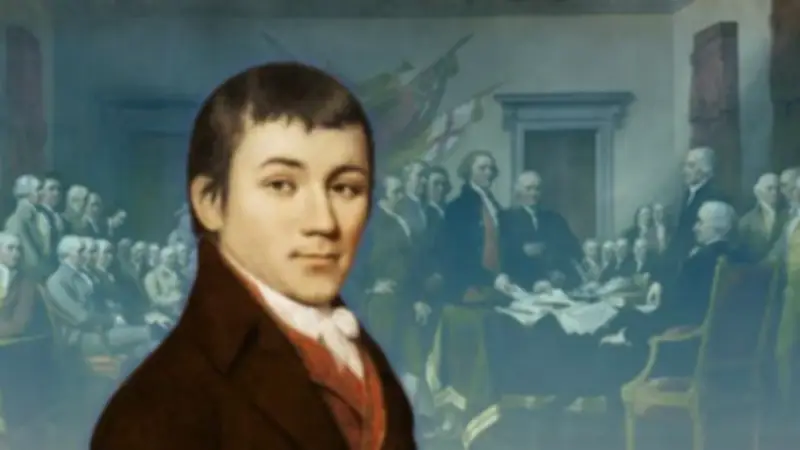
The Dark Vision of Charles Brockden Brown
Murder, suicide, spontaneous combustion, sleepwalking, and ventriloquism are among the sensational events in the novels of Charles Brockden Brown (1771-1810). As the United States' first professional author, Brown is considered the Founding Father of the nation's literature. According to one biographer, he is "the most important American author no one has ever heard of." His fiction engaged deeply with politics and culture after the American Revolution, and his novels remain crucial for understanding the nation's early decades and the current US political environment.
Early Life and Context
Brown was born into a Quaker family in Philadelphia just before the American Revolution. As a young boy, he witnessed the chaos of independence in the nation's first capital. His father was arrested for refusing to swear an oath of allegiance. After training as a lawyer, Brown turned to literature in his mid-twenties to earn an income, first contributing to literary magazines, then publishing four gothic novels in just two years (1798-1800).
In 1776, Thomas Jefferson declared in the Declaration of Independence that all men were entitled to "Life, Liberty and the pursuit of Happiness." The First Amendment guaranteed freedom of speech, press, assembly, and petition. However, by the time Brown wrote his novels, the optimism of the Founding Fathers was under threat. Crises exposed the limits of these ideals. Physical violence was rampant, from mob violence to tax insurrections like the Whiskey Rebellion (1791-4) and Shays' Rebellion (1786-7). The Alien and Sedition Acts of 1798 allowed President John Adams to deport foreign residents and suppress speech critical of him. Yellow Fever outbreaks in Philadelphia, which killed some of Brown's friends, made life uncertain. These outbreaks feature in Brown's novels Ormond (1799) and Arthur Mervyn (1799-1800).

American Gothic
Brown's novels anticipate the work of better-known American gothic writers like Edgar Allan Poe and Nathaniel Hawthorne, who explore the darkness of the human psyche. Many of Poe and Hawthorne's tales have supernatural climaxes, but Brown's horror stems from real violence, psychological torment, and corruption faced by Americans in urban centers and along the frontier. The psychological extremities in his fiction cannot be separated from their American setting. In the preface to his second novel Edgar Huntly (1799), Brown argues that "incidents of Indian hostility, and the perils of the Western wilderness" are the most suitable topics for American gothic literature.
Wieland: A Gothic Mirror to the Nation
Brown's first novel, Wieland: or, The Transformation (1798), offers a clear analogy for an early nation in turmoil. Its subtitle is "An American Tale." Written as a series of letters by its heroine Clara Wieland in the early 1770s, the novel depicts a Philadelphian family plagued by unlocatable disembodied voices. As the novel progresses, these voices become increasingly violent and manipulative. Seeming to emanate from Clara's closet, they make thuggish threats toward her. Amid this confusion, Clara's brother Theodore claims he has heard the voice of God ordering him to kill his wife and children, an instruction he carries out. Uncertain of the cause, Clara confronts Frank Carwin, an itinerant stranger who recently spent time in Europe. Carwin confesses he is a "biloquist" or ventriloquist who has been tricking the family but denies responsibility for Theodore's violence. In a pessimistic conclusion, Theodore commits suicide from guilt, and Clara leaves America for Germany.

Political Allegory and Free Speech
A story centered on mysterious outsiders, murderous patriarchs, and the power of the voice, Wieland holds up a gothic mirror to political questions of the 1790s, including national and civic identity and the role of free speech. The "transformation" in the subtitle can refer to Carwin's multiple vocal performances, Theodore's shift from loving husband to murderer, and America's development from colony to nation. Brown saw himself as a politically engaged writer and believed fiction could educate the public. Wieland has been interpreted as a warning against political radicalism and violent conduct. For some scholars, meddling Carwin is a "child of the Revolution"—a self-made man who wreaks havoc on the young nation with his excessive vocal freedom. Brown's message is that such anarchy must be halted, and the government should forge a unified national identity rather than allowing radical individualism.
Alternatively, some scholars interpret Wieland as a progressive critique of nativism and reactionary politics. In this view, Brown warns his post-Revolution readers against suspicions of the democratic freedom of movement and speech that Carwin represents. Instead, Theodore must shoulder blame for his extremist violence. The Wieland family is held responsible for not correctly identifying the source of the voices before it is too late.
Relevance Today
Wieland's themes of nativism, paranoia, and free speech persist. As the United States celebrates its 250th anniversary, the Trump administration's authoritarian actions reveal that the Founding Fathers' promises continue to be undermined by the nation's dark side. Americans still live in Brown's world of social and political uncertainty. Suspicion is directed against migrants, white male violence is overlooked, and those who speak the truth of the nation's history are censored. Today, Wieland serves as a prescient parable of the failure to correctly judge and protect against deception. Falling for ventriloquism may seem far-fetched, but believing online misinformation and manipulation is not. The problem is exacerbated by the rise of convincing generative AI productions.
Sara Sligar's recent novel Vantage Point (2025) modernizes Brown's novel, depicting Clara as the victim of deepfake and hologram technology, and Theodore as a Senate candidate who refuses to believe his sister's claims of innocence and becomes increasingly paranoid. Brown's novels continue to serve as cautionary political tales, warning against the civic failure of manipulating and harming others. They urge readers and citizens to seek alternative explanations and use common sense in the face of inexplicable events. These interrogations of civic responsibilities are as alive in the 21st century as they were for Brown in the 18th.