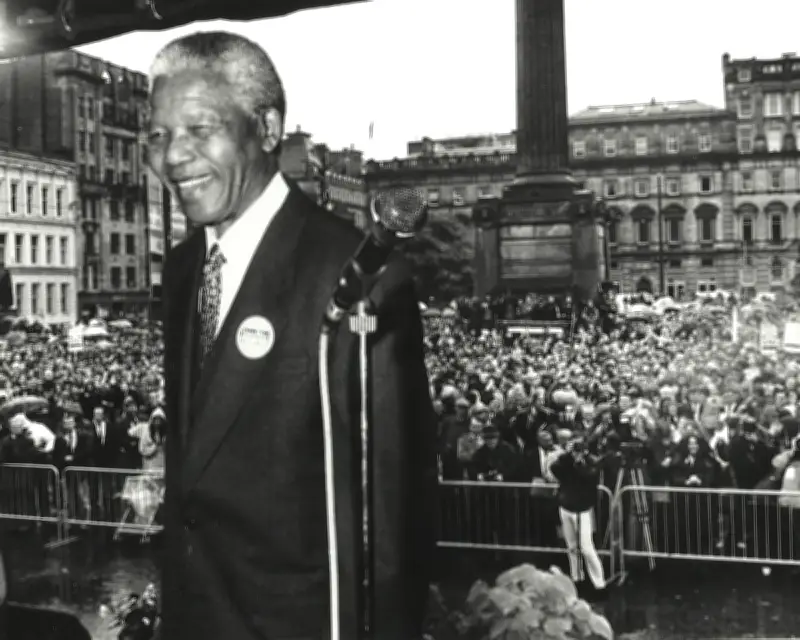
A new documentary series titled Free Nelson Mandela offers a gripping and revelatory look at the sprawling tale of the decades-long struggle against apartheid. Directed by James Rogan, the three-part series ends in 1994 when Nelson Mandela became president of South Africa, capturing the grim reality faced by Mandela and his allies during their resistance.
A Nuanced and Unflinching Portrayal
The documentary pulls no punches, depicting a world of white South Africans who viewed Black compatriots as inferior, British Young Conservatives with “Hang Nelson Mandela” posters, and the physical violence, emotional torment, and economic unfairness of apartheid. Mandela is mostly present as a looming absence — central to the narrative yet, as a prisoner, aside from it. His half-life on Robben Island becomes a framing device as lawyers, activists, journalists, politicians, and pop stars are pulled into his slipstream. As Dali Tambo, son of former ANC leader Oliver Tambo, says: “He became more than himself.”
The Personal Cost of Resistance
While history books record events, this series brutally emphasises the personal cost of Mandela’s resistance. He lost his mother and son in consecutive years and mourned them remotely. His wife Winnie Mandela is a complex figure about whom the series is wisely nonjudgmental. If her radicalism eventually became incompatible with her husband’s gentle pragmatism, the documentary makes clear she had every justification for her rage. She was physically and mentally tormented by the authorities, forcibly moved to a town full of racist white Afrikaners, and her house was burned down. As Nelson’s granddaughter Ndileka Mandela says: “My grandfather was insulated by prison. She was in the eye of the storm.”

The Philosophy of Ubuntu and Global Solidarity
The case of Winnie Mandela becomes a metaphor for the wider dilemmas Mandela faced. The series offers an enlightening explanation of the philosophy of Ubuntu, rooted in various African tribes, which translates as “I am because you are” and expresses intertwined humanity. But as violence escalated through the 1980s, it arguably wasn’t compatible with the anti-apartheid movement’s wilder fringes. Mandela’s three-way release negotiation — with the ANC, his fellow prisoners, and the South African authorities — remains a miracle of diplomacy. It was helped by a world waking up to South Africa, with mainstream British and American engagement becoming a significant driver in apartheid’s demise. Writer Jerry Dammers describes performing Free Nelson Mandela by the Specials at the 1986 Festival for Freedom as “the proudest moment of my life”.
A Lingering Sense of Loss
The series shows that Mandela’s release in 1990 was not inevitable and demonstrates how much could have gone wrong. It alludes to the Truth and Reconciliation process but steps away at that point, suggesting Mandela’s post-prison life is worthy of another series. Alongside victory, there is a lingering sense of loss. As activist Barbara Masekela says of Mandela: “When you worked closely with him, there was always a kind of deep sadness.” The documentary suggests that Mandela’s impending sainthood was a product of that — his years of resistance sharpened him but tempered him too. By the time of his death, he had come to represent light because he had spent so much time in the darkness.
Free Nelson Mandela is now showing on Channel 4.