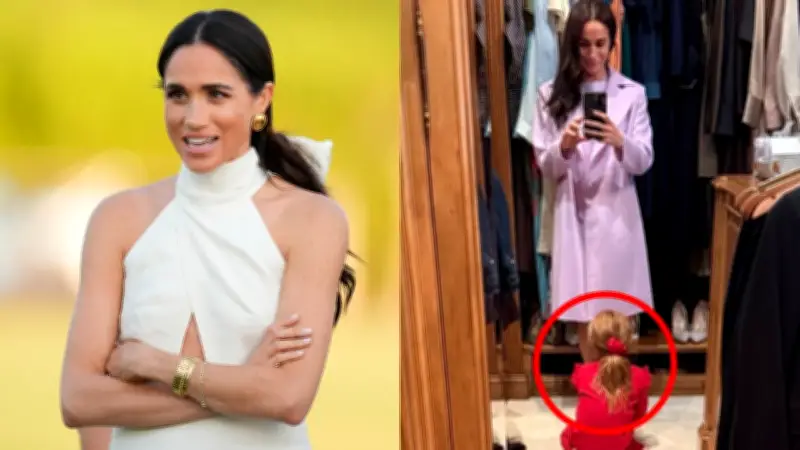
Meghan Markle has publicly responded to growing criticism over a parenting contradiction some critics say she can't ignore on the eve of Princess Lilibet's fifth birthday.
The 44-year-old Duchess of Sussex, who regularly shares glimpses of family life on both her personal Instagram account and her lifestyle brand, As Ever, has faced accusations of hypocrisy following a recent speech focused on online safety for young people.
Speaking at the World Health Assembly in Geneva, Switzerland, on May 17, Meghan delivered a 10-minute address centred on protecting children from the harms of social media, warning about the dangers posed by powerful algorithms and the growing influence of artificial intelligence.

The speech sparked debate online, with some critics questioning why the duchess continues to post images of her children if she is concerned about their online safety.
"You can't lecture people about childhood safety online while also plastering your children online," one X user said, while another penned: "Flying 6,000 miles to speak to a handful of people about the dangers of children being online, while publicly sharing your own children online to sell white-label products and being associated with a travel sustainability initiative, is the kind of contradiction that wildly undermines credibility."
In response, a spokesperson for the duchess told Newsweek there was an important distinction between sharing family memories and exposing children to public scrutiny.
"The Duchess has always been clear that there is a distinction between sharing moments from her life and exposing her children to public scrutiny," they said. "By obscuring their faces, she is demonstrating the very principle she advocates for: giving children privacy, agency, and protection in an increasingly digital world."
The spokesperson added: "Far from being contradictory, by concealing their faces she is actually reflecting the message she delivered in Geneva: that parents can choose to share family experiences while still taking deliberate steps to protect identities, privacy, and digital footprint."
The comments come on the eve of Princess Lilibet's fifth birthday, with royal watchers speculating Meghan may mark the occasion with a social media tribute similar to the one she shared for Prince Archie's seventh birthday last month.
"7 years later…happy birthday to our sweet boy," Meghan captioned the post, which featured a collection of family images, including a photograph of baby Archie resting on Prince Harry's chest and another showing Archie and Lilibet holding hands on a beach.
A few days later, the former actress shared photos from a family trip to Disneyland, again ensuring her children's faces were not visible.
While Meghan has consistently obscured Archie and Lilibet's faces in the images she shares online, some royal fans recently pointed to a little-known California law that they believe could be one reason behind the approach.
"It turns out that California has a law, the 'Child Vlogger Bill of Rights', that requires parents to put money into a trust fund for kids shown on social media for monetisation purposes," one royal watcher shared on Reddit. "However, there is a loophole that if you don't show the kids' faces, you are exempt from this law."
Under the Child Content Creator Rights Act, which took effect in California last year, if a child is involved in at least 30 per cent of a content creator's paid posts per month, 65 per cent of their income must be put into a trust account for when the child turns 18.
The new laws don't specify whether the children's faces need to be shown to require compensation, but state that content must include "the likeness, name, or photograph of the minor".
During her Geneva speech, delivered at the inauguration of the Lost Screen Memorial, Meghan urged world leaders and families to prioritise children's safety online.

"One day, generations from now, children will look back at this era with disbelief, that adults once allowed digital spaces to exist without basic protections for young people. But let's do something now so that they will also look back and see that during this increasingly polarised time- where people can barely agree on basic facts- that beyond politics, or party lines, beyond demographics, incomes, or ideologies, race or religion, we could all universally agree on one thing: we want our children to be safe."
Meanwhile, during an appearance at Project Healthy Minds' World Mental Health Day Festival in New York last October, she again spoke about the importance of safeguarding her children online.
"Luckily, [our children] are still too young for social media, but we know that day is coming," she said. "Like so many parents, we think constantly about how to embrace technology's benefits while safeguarding against its dangers. And that hopeful intention of separation is rapidly becoming impossible."