In her fiction debut, The Ruiners, Ellena Savage probes the awkward realities of white privilege, social mobility and a lack of ancestral connection. At first it seems that Savage has turned away from the experimental ambition of her successful memoir, Blueberries, but the novel gradually reveals itself to be craftier and more subversive than it appears. This anti-inheritance novel is in direct, playful conversation with one of its inspirations – Great Expectations by Charles Dickens – and, while knowledge of the coming-of-age novel isn't essential, it's delightful to see Savage tease the themes of the original in her surreal contemporary take.
A Modern Pip Adrift
Having failed to fulfil or even define her own ambition, 29-year-old Pip drifts aimlessly through her life. She is smart, funny and vaguely unhappy. In quick succession, her estranged father dies and leaves her an inheritance of $50,000 and she falls quickly, recklessly in love with Sasha, a brooding young writer who narrates the third part of the novel. With the inheritance Pip sees the opportunity to change her situation. She quits her job – 'I've developed a rare blood disorder, I wrote. As such, I must cut my hospitality management career short. I hereby tender my resignation, effective immediately' – and marries Sasha, and together they spend the entirety of her small fortune on a rotting house on the remote (fictional) Greek island of Fokos. In the background, a trash volcano burns relentlessly and waste pirates fight to offload their illegal garbage on to the shores. But the move does little to improve their circumstances or resolve their unhappiness.
Dickensian Echoes
Savage's references to Great Expectations are both overt – the opening section of the book is named after Dickens' novel, the two protagonists also share a name – and subtle. For Dickens lovers, Magwitch also makes a canine cameo towards the end. Like the original Pip, Savage's protagonist is adrift when she becomes an orphan. Despite having only minimal connection to her father, whose death she doesn't feel strongly about, she still mourns the loss of her 'Mummy' (the language here another deliberate nod to Dickens). In both novels, an unexpected inheritance offers the opportunity for the protagonist to reinvent themselves, and both Pips desperately want to be loved by someone who is perhaps incapable of such feelings. But where Dickens uses his Pip to reveal the great economic and emotional cost of keeping up appearances, Savage delights in the ruins.

Playful Yet Tragicomic
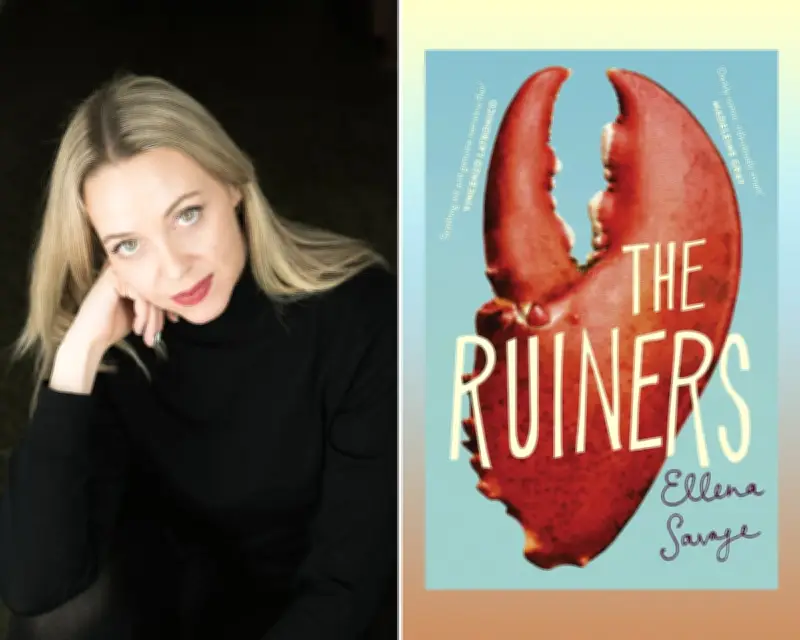
The Ruiners is also incredibly playful, although play is a hard thing to transmit in a novel, particularly when it's grounded in such dry humour. So it's either hilarious, tragic or takes itself far too seriously, depending on how you come at it. But for anyone willing to see the humour in the ridiculous, flawed ways we try to connect with each other in the ruins of the world, there are a lot of laughs to be had. The red lobster on the cover, long associated with surrealist art (Salvador Dalí's red lobster phone is noted for its sexual innuendo) is another meta-element that Savage exploits perfectly in the book's strange and tragically funny ending.
Three Narrators, Multiple Perspectives
Her three narrators – Pip, Sasha and Viv, Pip's oldest and best friend – are painfully earnest. They are at the age of uncertainty, when the socialist politics that used to ignite their passions have started to drain them and years of working towards uncertain, unfulfilled goals have dimmed their self-righteous fury. Despite this, they cling to the possibility of love and meaning. Through her young, brilliant, tortured narrators, Savage critiques the many failures of contemporary society – economic collapse, the global waste crisis, extreme individual and political greed, the housing and environmental crises, even the form of the novel itself. But its high-level intellect (a given for anyone familiar with Savage or her earlier work), is softened by its resolute belief in love and art, not as grand pursuits but as messy and legitimate human experiences.

Flawed Characters, Real Connections
Are they chasing love? Evolution? A good story? Their perspective on their goals and each other shifts constantly throughout the novel, depending on who is telling the story. While none of the three is upwardly mobile, no one is static either. Viv observes Pip in an unexpectedly tender moment with Sasha that makes him realise how much she's changed. Sasha, who is aloof and unlikable for a lot of the novel, reveals a vulnerability when he shares his experiences of being bullied and excluded as a child. Pip comes to realise sex won't fix what's broken. 'It empties me,' she tells Viv, 'I think because love hasn't come to fill in the void'. All three of them are selfish and self-aware, awful and wonderful, sometimes at the same time.
Thankfully, The Ruiners is a book that holds its various contradictions with ease. Savage is a sharp, incisive writer with a lot to say about the world. But it's what she says about people and life that really hits home here. It's all ridiculous, she seems to be saying, it's all wonderful. The Ruiners by Ellena Savage is out now (Summit Books, $34.99).