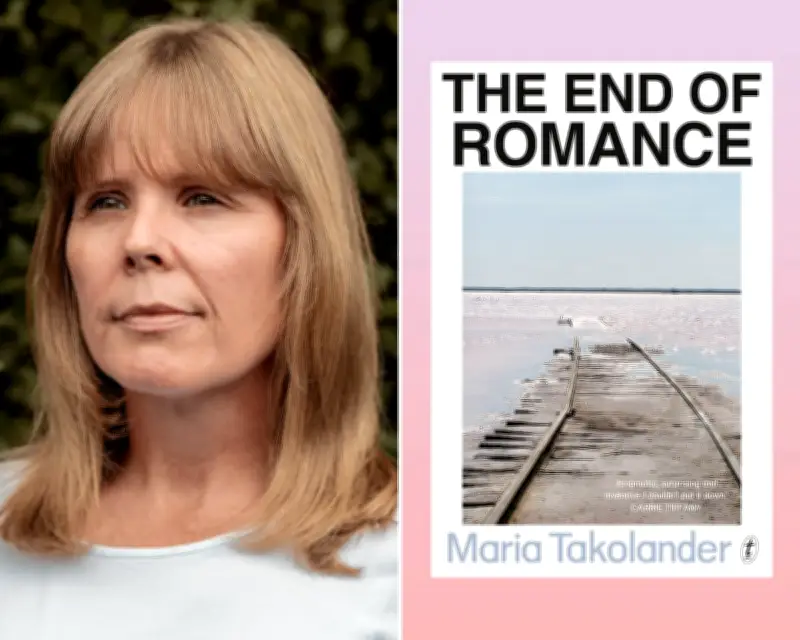
In her latest work, 'The End of Romance,' author Maria Takolander presents a scathing critique of contemporary relationships, asserting that the modern dating landscape has rendered authentic romantic connection nearly impossible. Drawing on personal anecdotes, cultural analysis, and sociological data, Takolander paints a grim picture of love in the digital age.
The Rise of the Single Household
Takolander points to a startling statistic: the number of single-person households has surged by 40% since the year 2000, according to census data. She argues that this trend reflects not just changing preferences but a fundamental shift in how people value relationships. 'We have traded intimacy for convenience,' she writes, 'and the result is a generation that is deeply lonely but afraid to commit.'
The book delves into the mechanics of dating apps, which Takolander calls 'emotional vending machines.' She criticizes the gamification of romance, where swiping left or right reduces human beings to commodities. 'The endless parade of profiles creates a paradox of choice,' she explains. 'Instead of finding love, we find ourselves paralyzed by options.'

The Commodification of Love
Takolander argues that capitalism has co-opted romance, turning it into a market-driven transaction. She cites the rise of 'experiences' over genuine connection, noting that couples now spend an average of 15% more on date nights than a decade ago, yet report lower satisfaction levels. 'We are sold the idea that love can be bought, but the more we spend, the emptier we feel,' she says.
The author also examines the pressure to maintain a perfect online image. Social media, she contends, has created a culture of comparison where relationships are performed for an audience. 'The curated highlight reel of other people's lives makes us feel inadequate,' Takolander writes. 'We end up chasing an illusion, not a real person.'
The Impact on Mental Health
The book does not shy away from the psychological toll of modern dating. Takolander cites a study showing that 60% of frequent dating app users report symptoms of anxiety and depression. 'The constant rejection and uncertainty are corrosive,' she says. 'We are not designed to process so many potential partners so quickly.'
She also explores the phenomenon of 'ghosting' and its effects. 'When someone disappears without explanation, it leaves a wound that is hard to heal,' Takolander notes. 'It reinforces the idea that people are disposable.'
A Call for Change
Despite the bleak analysis, 'The End of Romance' offers a glimmer of hope. Takolander calls for a return to slower, more intentional forms of courtship. 'We need to reclaim the art of conversation,' she argues. 'Put down the phone, look each other in the eye, and be present.'
She advocates for 'digital detox' periods and suggests that society must challenge the commodification of love. 'Romance is not dead,' she concludes, 'but it is on life support. It is up to us to revive it.'
The book has sparked debate among readers and critics. Some praise Takolander's unflinching honesty, while others accuse her of romanticizing the past. Regardless, 'The End of Romance' is a timely and provocative addition to the conversation about love in the 21st century.