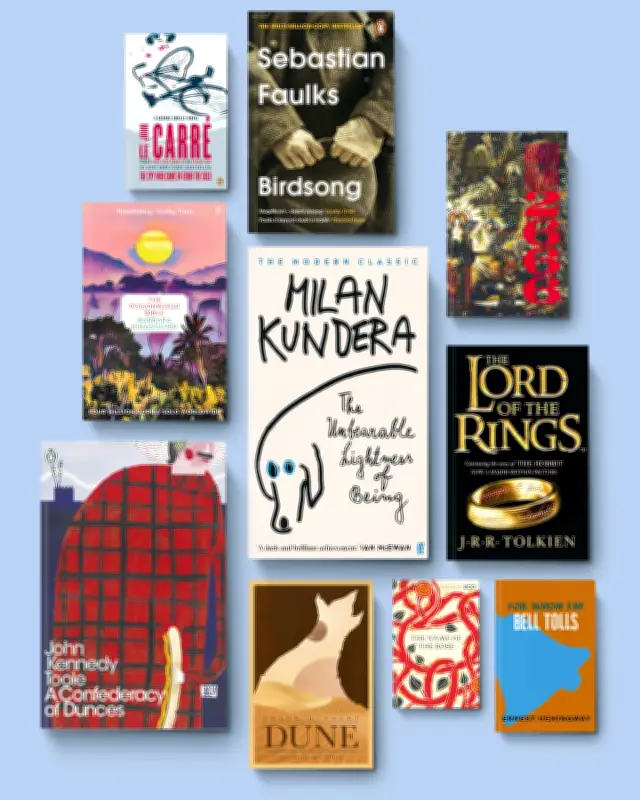
After critics and authors picked their top 100 novels, we asked for your favourites. From Uruguay to the Isle of Skye, more than 3,000 readers cast their votes. Here’s your list – topped by a new number 1.
The Top 10
1. The Lord of the Rings by JRR Tolkien
Grant Currie, Marlow, Buckinghamshire, 55, corporate communications: “I don’t think there is much to say here! A masterpiece of storytelling and universe creation. I think I first read it when I was 13 and just could not put it down. I would sit in my bedroom for hours drawn into a different world. For someone growing up on a council estate, it was escapism at its very finest!”
Kathleen Reeves, Somerset, 65: “I cannot tell you how many times I read this as a teenager, the dreams it planted in my head, the images, music, history and breadth of where a world could be explored if you left your front door and took a first step. A mythology for our chequered isle dappled in depth, darkness, light, resilience, love and compassion.”

2. Middlemarch by George Eliot
Katrina Evans, Sydney, GP: “You can take all your weighty Russian greats so long as I get to keep this classic – warm, wise, witty and just so generous of heart. Critical darlings can sometimes seem cold and distant but this one felt like an old friend. Unerring in its depiction of human folly but forgiving of it too. And it’s really funny. If I believed in God I’d want her to be like George Eliot.”
Carrie, Chester, 45: “This novel is like an old, comforting blanket. I wrap myself in it every few years. To me, no other novelist has such empathy and understanding of her characters. She never sneers or mocks. Somehow, even the most unlikeable characters, like Casaubon, are shown in their true colours and yet with the most startling sympathy and clarity.”
3. Pride and Prejudice by Jane Austen
Heather, Los Angeles, research analyst: “This is a perfect novel that speaks with incredible precision and humour about class and gender. I reread it every 10 years or so – in my teens and 20s it was a fairytale; in my 30s it was a cautionary tale; and now I see it as a horror story (the improbable happy ending is only a thin veneer masking the more likely fate of girls in Lizzie’s and her sisters’ position).”
David, Loanhead, Scotland, 68, retired: “A porcelain gem with a backbone of steel. A novel which resonates with everyone navigating adulthood and the pressures to find a partner with whom to navigate the world – one way or another.”
4. The Grapes of Wrath by John Steinbeck
Dylan Moore, Cardiff, 46, English teacher: “The ultimate road trip. The novel as documentary history, biblical epic and told in language for the common man. The story of the Joad family is the tale of the 1930s dustbowl and a particular American place and time, but its mythic qualities make it the story of humanity too.”
Martin Searle, Thailand/Cornwall, retired: “Painful, gut-wrenching, beautiful, thought-provoking, occasionally oversentimental and always remarkable, this is not an easy book to read. However, everyone should. Its angry message about humankind’s exploitation (and fear/hatred) of our fellow men and women is just as relevant today in our world of economic migration, natural and manmade disasters, refugee movements across continents.”
5. To Kill a Mockingbird by Harper Lee
Gwen Stephens Jones, Llŷn peninsula, Wales, 54, social media marketing manager: “Atticus Finch is the man that all men and fathers should look to for inspiration. The naivety of the kids provides such a jarring contrast to the hate-fuelled Jim Crow South. Even today (maybe especially today) the book still reads as a condemnation of American racial inequality and ignorance.”
Paul Milne, Scotland, 69, retired civil servant: “Eminently readable, funny as hell, an amazing combination of social history, social justice, fine storytelling, an inspirational protagonist (Atticus Finch) and one of the most engaging voices in literature in the narrator, Scout.”
6. War and Peace by Leo Tolstoy
Maggie Walker, Devon, 78: “As well as war and peace, all of human life is here: the longing, searching, loss, love and heartache, the temptation, the decadence, and redemption, the joy of life and inevitable death. And Natasha lives more vibrantly than anyone in print.”

7. Nineteen Eighty-Four by George Orwell
Dhaval Bhate, Singapore, 36, sociologist in training: “Rarely has a novel felt as frighteningly relevant as Nineteen Eighty-Four does today. The chills I experienced while reading it came not only from its brilliance, but from how closely its world echoes lived realities around us. Orwell compels us to remain critical, aware and questioning of power, surveillance and control. At its heart, this novel is a reminder that the ability to think freely, to dissent and to protest is deeply tied to what makes us human.”
8. One Hundred Years of Solitude by Gabriel García Márquez
Daniel Diffin, Westerly, Rhode Island, US, 69, retired physician: “The novel that created magic realism and did it better than any other. Funny, sad, magical, and a great explanation of Latin American history and the Colombian character.”
9. Catch-22 by Joseph Heller
Hamilton, Amsterdam, 43, urban planner: “Reading Catch-22 as a teenager opened my eyes to the absurdity of life and the power of art. I was hooked. Revisiting it in my 20s gave me a deeper understanding of people, their contradictions and the theatre of life. Now, in my 40s, it feels even more truthful and essential than ever. For me, it’s unquestionably No 1.”
10. Ulysses by James Joyce
Jeremy Yapp, Hertfordshire, 52: “The best books contain worlds. This is one of those books. Immortal themes of love and loss; one of the best female characters written by a man in all of literature; fatherhood and filial complications; a magnificent structure; so much richness and pathos and exquisite sadness; a very funny book. And difficult, but every line repays the work.”
Other Notable Entries
The list includes many other beloved novels. Here are a few highlights:
- 11. Anna Karenina by Leo Tolstoy – Olalla, London, 50, physics professor: “I love how all characters in Tolstoy, even those that one dislikes, are rendered human.”
- 12. Moby-Dick by Herman Melville – Aprille McKay, Michigan, US, retired archivist: “I didn’t read it until I was 55, and was floored by how creative the storytelling is.”
- 14. Wolf Hall by Hilary Mantel – George, London, 31: “I have never read a book like Wolf Hall and I am not sure there will ever be another book like it.”
- 15. In Search of Lost Time by Marcel Proust – Mary, California, US, retired public defender: “If I were stuck on a desert island, this is the book I would want to have with me.”
- 16. East of Eden by John Steinbeck – John Watkin, California, US, 68: “Unforgettable characters trying to figure out the meaning of life while stumbling through family scandal and heartbreak.”
- 19. Gravity’s Rainbow by Thomas Pynchon – Nathan Cowie, Australia, 28, public servant economist: “This is fiction at its most indulgent and digressive.”
Readers also voted for contemporary works like Demon Copperhead by Barbara Kingsolver (tied at 63), Piranesi by Susanna Clarke (tied at 70), and A Gentleman in Moscow by Amor Towles (tied at 60). The full list of 100 novels showcases the enduring power of storytelling across genres and eras.