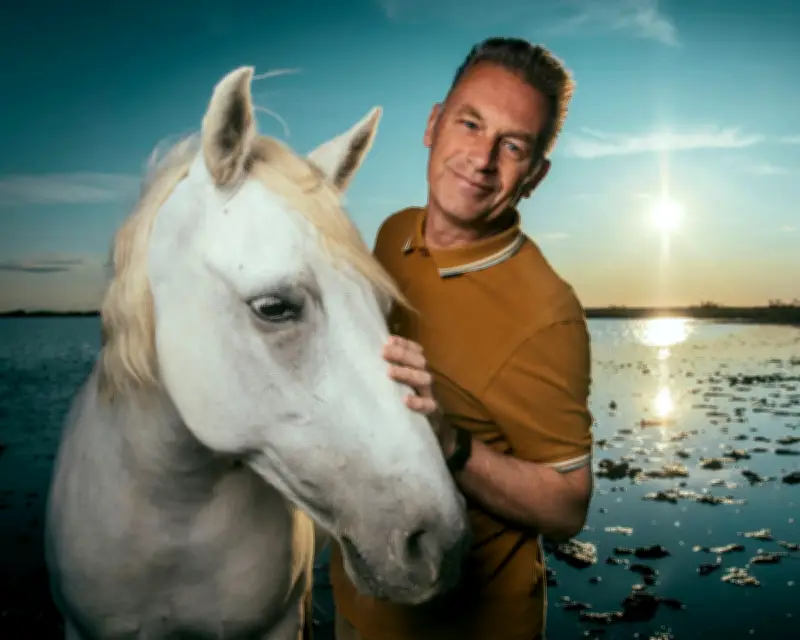
Chris Packham’s new five-part BBC series, Evolution, aims to shatter preconceptions about life itself. The show tells the story of Luca (Last Universal Common Ancestor), the single-celled organism from 4.2 billion years ago that is the common ancestor of all living things. “There is still a physical connection between me and you, and a cell that existed billions of years ago,” Packham says. “I find that absolutely brilliant.”
Challenging Evolution Misconceptions
Packham explains that many people stop learning about evolution at GCSE level, leaving them with the idea that evolution is “laboriously slow, we are its be all and end all, and its story is over.” While acknowledging billions of years of cells floating in a broth, the show focuses on turning points when evolution moved rapidly. Each episode uses a specific animal to explain a process: breathing through the elephant, reproducing through the ostrich, eating through the bat, thinking through the dolphin, and running through the horse.
Packham’s Unconventional Choices
Packham’s storytelling often chooses slimy over cute. “I’m not averse to cute, but I prefer dogs to puppies,” he says. “I just don’t get the big eye, big ear thing. For me, that’s a developmental stage.” The show uses AI-generated images for extinct creatures like the palaeomastodon, which Packham defends pragmatically: “I can get very romantically excited about a fossil, but there’s a limit to how many times I can hold up a piece of rock and say ‘truly remarkable’.”

Human Cultural Evolution
Packham sees human cultural evolution—from the combustion engine to AI—as having a profound effect on our species. He encourages asking childlike questions: “How did an elephant get a trunk? Why has it got a trunk? Why haven’t I got a trunk?”
The Importance of Heads and Anuses
In the episode on eating, Packham notes that early life had a single opening for food and waste, highly inefficient. “As soon as you’ve got a mouth and an anus, you want your sensory organs near your mouth, and if you want your sensory organs to be optimally operating, you want the brain as close as possible to those, so basically you get a head. We didn’t evolve heads until we’d evolved an arse. I quite like that.”
Broadcaster Evolution
Packham’s straightforwardness has made him increasingly radical, whether discussing the climate crisis or hen harriers. He refuses to water down political implications. The throughline from Springwatch to Evolution is that every creature is smarter than thought. “Swallows choose white feathers for nests because a type of bacteria breaks them down, producing a substance that impacts microbes, leading to higher hatching rates. Astonishing.”
Humans Not the Endpoint
The show inevitably puts humans in their place. “We’ve always put ourselves on the pedestal of being the brightest. But we’ve learned so much recently. Even some reef fish have theory of mind. Spiders can dream, so they have a subconscious.”
Mass Extermination vs. Extinction
Packham distinguishes between mass extinction and mass extermination: “We are consciously aware of the fact that we are destroying life. Given our creativity, our imagination, our intelligence, do we want that extermination on our conscience? I don’t think that we do.” He rejects the idea of humans as a scourge: “Yes, we’ve had an impact, but we’ve done remarkable things. We are a remarkable organism.”
Hope and Humility
The series ends with a call for “an evolution of human hope.” Packham finds solace in a 2,000-year-old yew tree near his house. “I go and sit under it and, within minutes, I feel totally inconsequential. Chris Packham is not an important organism. The series says it’s not all about us, it’s about life. Humans are just a part of it and, collectively, it’s extraordinarily beautiful.”
Evolution begins on 13 July at 9pm on BBC Two.