More than 2 billion years ago, during the Paleoproterozoic era, Earth's atmosphere began filling with free oxygen, enabling the rise of aerobic life and ultimately humans. This event, known as the Great Oxidation Event, is now the centerpiece of a new permanent artwork at the Museum of Old and New Art (Mona) in Tasmania. Visitors can inhale oxygen that has been trapped in iron ore since that time.
French-Swiss conceptual artist Julian Charrière conceived the idea, and Mona's owner David Walsh not only approved but created a bespoke space for it. "I want people to get all the way back to the beginning of the earth," Charrière said during a media call. "It's like a time machine."
The artist sourced ancient iron ore from Australia's Pilbara region. Each day, machinery in an on-site lab extracts water from the ore, which is then processed through a Hofmann apparatus to electrolyze the water and release oxygen. That oxygen is released into the room, to be breathed by visitors for the first time, connecting each person "to the beginning of life on earth."

Solitary Experience in a Vault-Like Corridor
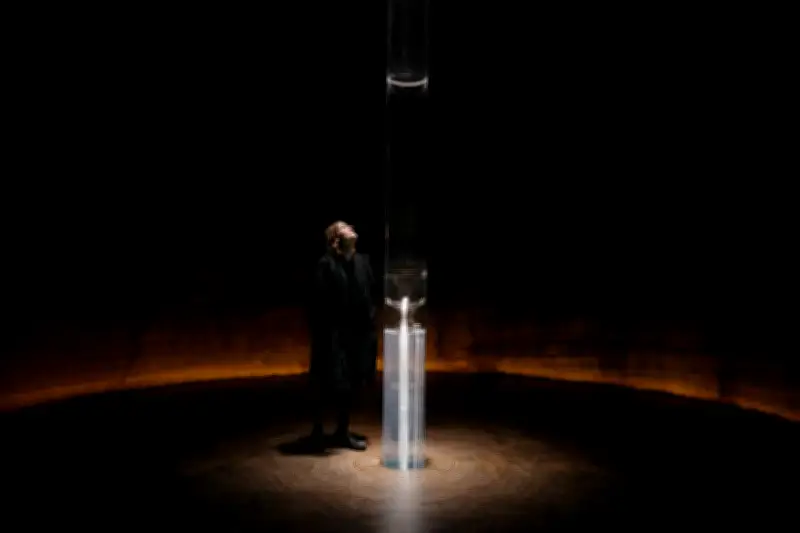
Breathe is designed as a solitary experience. Visitors enter one by one through a vault-like corridor reminiscent of a huge mining drift. The tunnel is flanked by raw sandstone and lined with deep red rocks from the Pilbara. A side room contains the lab. As you walk, the temperature drops, and the tunnel opens into a high-ceilinged cylindrical room—like an underground windowless tower. Lighting depends on the amount of sunlight reflected through a small opening above, so in Tasmanian winter it is quite dim.
Walking over tiles made of polished ancient tiger ore, you circle another cylinder: a floor-to-ceiling clear glass tube housing the Hofmann apparatus. Sitting in front, you see a small opening, your closest access to Charrière's pure, ancient oxygen.
In inhaling, "you are connected to the beginning of life on Earth but you are also—and that is the crazy thing about this space—you are also the first person to inhale that oxygen," Charrière said. "You are breathing something which is so pure and has not been touched by any being before you. And the beauty of the piece is you will carry it until you die. You're going to become a small part of this installation and you become a big part of the great oxygen cycle, and you will only finally free this oxygen once ... once you're going in the other world." He means: once you die.
Hard Core Exhibition: Deep Time and Deep Earth
Breathe, a permanent installation, opens alongside Charrière's major new exhibition Hard Core, showcasing the ambition and scientific curiosity of the Berlin-based artist. Individual elements of Hard Core have been exhibited elsewhere, including at the Venice Biennale, but the full show finds its ideal home underground at Mona, with exposed rock, a mix of industrial and elemental, and a fusion of science and art. "We decided to really focus on works that relate to geology in some way," the artist said.
In Blue Fossil Entropic Stories (2013), a series of photos depicts Charrière standing on and dwarfed by an Icelandic iceberg, making his mark with a blowtorch. In Not all Who Wander Are Lost, glacial rocks take up parts of the room, drilled into with removed columns lined up along the floor. In Nobodies Dreams Survives, living snails slowly eat away at a calcium carbonate sculpture. Atlas features a beautiful large rotating marble that is mechanically polished and will slowly erode over the exhibition's timeline. Controlled Burn is a hypnotic film of imploding fireworks, shot at sites in Germany, Belgium, and the North Sea.
The show takes you through a mirrored room of more rock, reflection, and strobe-like light, before you cocoon yourself within a dark carpeted space where you can lie down and absorb the livestreamed rumblings of an active volcano.

Parts of Hard Core evoke previous Mona shows, such as Theo Merciere's Mirrorscape or Jonsi's Hrafntinna (Obsidian), although Charrière's volcano immersion is more meditative. As a whole, it takes you on an epic trip through deep time and deep Earth, examining our relationship to the planet. "Each sculpture, each installation, each work is trying to bring deep time into the realm of human experience. That's basically the 'hard core' of this show," Charrière said. "You can actually sense what is normally beyond what our senses are able to grasp."
Hard Core is open at Mona from 6 June to 29 March 2027.