Brisbane's Gateway Bridge: From 'Deadliest Bridge on Earth' to Vital Transport Link
Constructed four decades ago, Brisbane's Gateway Bridge initially earned the grim title of the deadliest bridge on Earth. This shocking reputation remains largely unknown to the 160,000 drivers who now traverse it each day. In the 1970s, then roads minister Russ Hinze proposed an ambitious plan to redirect traffic between the Gold Coast and Sunshine Coast around the city, addressing severe congestion issues.
The Urgent Need for a New River Crossing
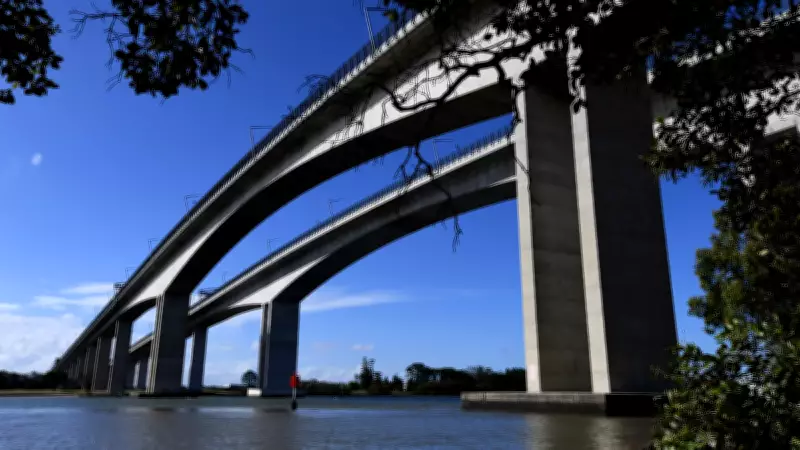
During that era, drivers needing to cross the Brisbane River faced limited options. They could endure long detours via inner-city crossings or join lengthy queues for slow, capacity-restricted car ferries. The city's traffic was frequently gridlocked, causing significant delays for both commuters and freight transport. A new crossing became essential, but a tunnel was considered too costly. Engineers instead looked upward, designing a structure tall enough for ships to pass underneath while remaining low enough to avoid interfering with aircraft at the nearby airport.
A Massive Construction Effort with Minimal Safety
What followed was an enormous construction project, with massive piers rising from the riverbanks and new road networks developing on both sides. Before the bridge's completion, traffic detoured via the Story Bridge, as Brisbane's north and south were connected by only limited crossings. Safety standards during construction were drastically different from today's protocols. Crews working high above the river often wore just shorts and thongs, frequently without harnesses or protective hard hats. Remarkably, no major incidents occurred during the five-year construction period.

A Spectacular Public Opening
The bridge's opening in 1986 transformed into a public spectacle, with thousands of people walking across the 1.6-kilometer span before it opened to vehicular traffic. News reporters at the time described it as "a once-in-a-lifetime chance to walk the one-and-a-half kilometre world record span and enjoy the unique view." Stretching approximately 1.6 kilometers and rising more than 60 meters above the river, the bridge provides about 59 meters of clearance for ships at its highest point. Its 260-meter main span represented a world-leading design for concrete bridges.
On opening day, members of the public enthusiastically declared it "has to be the best bridge in the world." Prince Philip formally opened the bridge four months later, delivering his characteristically dry remark: "I now declare the bridge to be more open than usual." Initially, motorists paid $1.50 to cross, while truck drivers were charged $7, reflecting the heavier impact of freight vehicles. Some skeptics remained unconvinced, with one truck driver stating, "No, won't ever use it ... too bloody dear."
The Dark Reputation Emerges
Despite the fanfare and engineering achievement, the bridge soon developed a much darker reputation. It became known as "the deadliest bridge on Earth" with more than 120 deaths from accidents and suicides before safety measures were implemented in 1993. Before that year, there were no protective fences and only a low barrier separating pedestrians from the fatal drop below. A television reporter demonstrated the danger at the time, stating, "We're now at the top of the Gateway Bridge. Once you're up here you can see that there's no real safety measures around. The only thing stopping me plunging to my death below is this small wall."
Transformation Through Safety Measures
The installation of safety barriers, crisis phones, and prevention measures fundamentally transformed the bridge into a safer crossing. Events like the Bridge to Brisbane fun run eventually welcomed people back onto the structure in a completely different context. By the mid-2000s, booming population growth in Australia's now third-largest city meant the bridge's original six lanes were insufficient. Consequently, a second bridge was constructed alongside, with each span carrying traffic in one direction.

Expansion and Renaming
The original construction cost approximately $92 million, while the second identical-looking span opened in 2010 with a price tag of about $350 million. Positioned just 50 meters from the original, the new bridge features a dedicated pedestrian and cycle path. Both bridges were later renamed after Sir Leo Hielscher, a German-born public servant who led Queensland Treasury for decades and significantly shaped the state's finances. He described the recognition as "a great honour," although many people still refer to the twin structures as "the Gateway."
Modern Importance and Electronic Tolling
Today, the Sir Leo Hielscher Bridges form one of Brisbane's most critical transport corridors, carrying up to 160,000 vehicles daily. They link the city's north and south while serving as a key route for freight and airport access. The removal of toll booths in 2009, replaced by electronic tolling, led to an immediate reduction in crashes. Currently, motorists pay about $5.50 to cross, with truck drivers charged closer to $18. This vital infrastructure continues to evolve, maintaining its essential role in Brisbane's transportation network while overcoming its tragic past through continuous safety improvements and expansion.