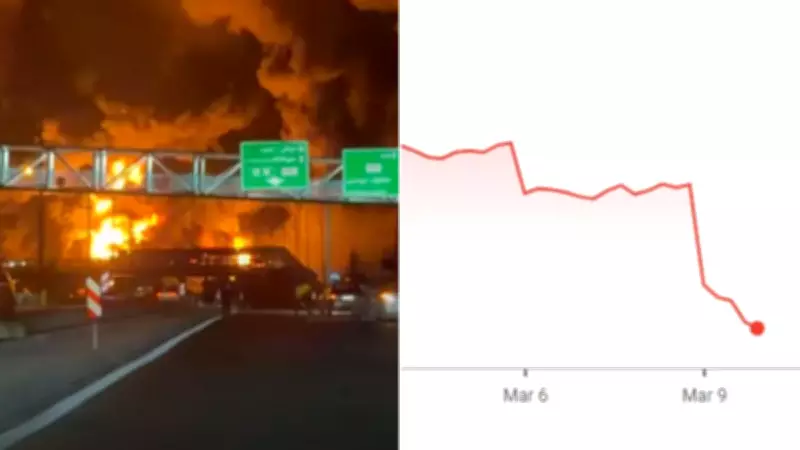
Australian Share Market Plunges Amid Middle East Conflict and Oil Price Surge
The Australian share market has been caught in a global sell-off, driven by escalating conflict in the Middle East that has sent oil prices soaring and prompted investors to flee to safety. The benchmark S&P/ASX200 index plummeted 359.1 points, or 4.06 per cent, to 8,491.8, while the broader All Ordinaries index fell 371.1 points, or 4.08 per cent, to 8,714.0. This sharp decline marks the lowest level for the ASX200 since late November and has erased nearly $130 billion in market capitalisation from the index.
Historical Context and Market Impact
This dramatic drop is one of the most significant since the pandemic, with the only comparable instance occurring in April 2025 when the ASX200 plunged 4.2 per cent amid intensifying trade tensions under former US President Donald Trump. The current turmoil follows Iran's appointment of Mojtaba Khamenei as the new supreme leader, succeeding his father Ali Khamenei, which solidifies hardliner control amid ongoing conflicts with the United States and Israel.
With no resolution in sight and tankers avoiding the critical Strait of Hormuz, a key route for Middle Eastern oil, investors are bracing for prolonged energy price spikes. Recent attacks over the weekend, including Israeli and US strikes on Iranian oil storage facilities that sparked massive fires, have further heightened market fears.

Oil Price Surge and Economic Warnings
Oil prices have surged dramatically in response to the conflict. Brent crude jumped 17 per cent to $US108.73 ($A155.57) per barrel, following a 28 per cent increase last week, while US crude rose 19 per cent to $US108.33 ($A155.00) per barrel. Economists warn of ripple effects across the global economy, with JPMorgan chief economist Bruce Kasman highlighting the dependence on Middle East oil flows through the Strait of Hormuz.
Kasman projected a near-term spike towards $120 per barrel, with prices expected to settle at an elevated $US80 per barrel through mid-year if political resolution remains elusive. Such a scenario could reduce global economic growth by an annualised 0.6 per cent in the first half of the year and raise consumer prices by one per cent annually. He cautioned that a broader, sustained conflict could push oil above $US120 ($A172) per barrel, risking a global recession.
Sector Performance and Market Details
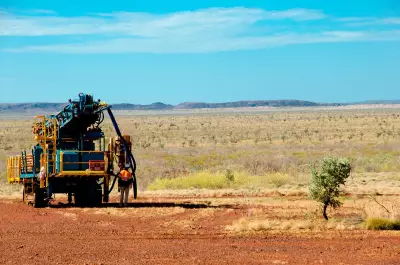
At midday, every sector on the ASX was in negative territory except for energy, which saw a modest gain of 0.2 per cent. The materials sector, including mining, was the hardest hit, dropping 5.6 per cent, with major players like BHP down 5.9 per cent, Rio Tinto retreating 3.9 per cent, and Fortescue losing 3.9 per cent.
Gold failed to serve as a safe haven, with prices falling nearly $75 from Friday to $US5,085 per ounce, impacting goldminers such as Evolution and Northern Star, both down 5.8 per cent. The big four banks also suffered significant losses: CBA fell 4.0 per cent, Westpac lost 4.2 per cent, ANZ dropped 4.3 per cent, and NAB declined 4.9 per cent.
Only seven companies from the energy sector among the ASX200 were in positive territory shortly after midday. Notable gainers included Woodside up 1.1 per cent, Santos climbing 2.6 per cent, Whitehaven Coal lifting 1.0 per cent, and Karoon Energy surging 8.3 per cent. Overall, the ASX200 is down 2.6 per cent since the start of the year, and the Australian dollar dropped to a one-month low of 69.61 US cents.
Global Reactions and Future Outlook
Former US President Donald Trump dismissed concerns over rising oil prices, stating on Truth Social that the spike is a minor cost for global safety and peace, predicting a rapid drop once the Iran nuclear threat is resolved. Meanwhile, global markets reacted to the turmoil: Wall Street futures fell, with the S&P 500 down 1.6 per cent and Nasdaq futures dropping 1.7 per cent. In Asia, Japan's Nikkei futures sank to 52,400 from 55,620 at Friday's close.

Investors shifted to safer assets, with bond markets seeing declines in 10-year and three-year Treasury note futures, while the US dollar strengthened against the yen and the euro slipped. Gold prices eased slightly to $US5,140 ($A7,354) per ounce. For Australians, this market slump may temporarily affect superannuation balances and investments, and the surge in oil prices is likely to increase petrol, transport, and everyday living costs in the coming months.