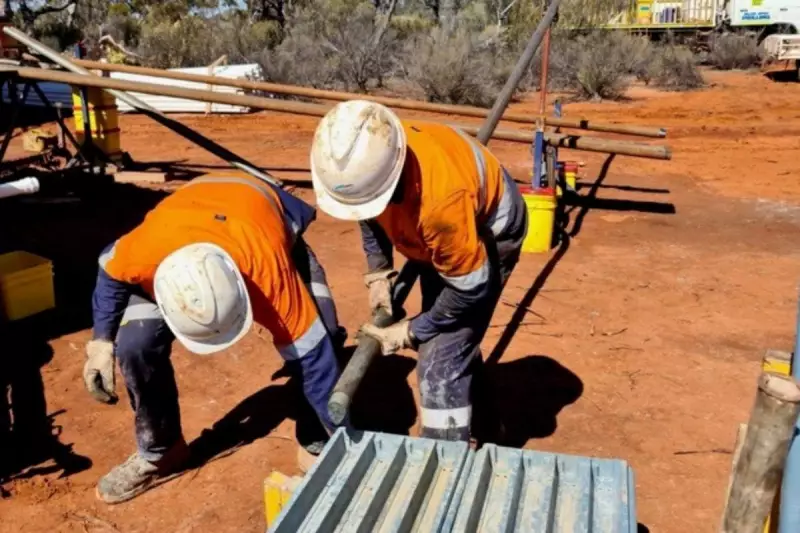
Western Mines Group has officially commenced its 2026 field operations, with drilling rigs now active at the company's flagship Mulga Tank nickel-copper-cobalt-PGE project located in Western Australia's Eastern Goldfields region. This marks the beginning of a comprehensive multi-rig campaign aimed at expanding mineral resources and pursuing high-grade sulphide mineralisation across the expansive site.
Systematic Drilling Strategy Unfolds
The exploration program will initially complete several outstanding drill holes from last year's phase four activities before transitioning directly into new follow-up and step-out drilling. This systematic approach is designed to thoroughly investigate the Mulga Tank ultramafic complex, a significant geological formation with substantial nickel sulphide potential.
Deep Diamond Drilling Extensions
First in the drilling sequence is an extension of a diamond drill hole that was partially funded through the Western Australian Government's Exploration Incentive Scheme. This ultra-deep hole previously reached 1437.5 metres and intersected broad zones of remobilised massive sulphide mineralisation. Western Mines plans to deepen this hole by an additional 50 to 100 metres to confirm the complex's footwall geology and pursue further massive sulphide accumulations.

This extension drilling will also serve as a downhole electromagnetic conduit, enabling more precise targeting of the basal contact zone where mineralisation is often concentrated.
Reverse Circulation Drilling Program
Alongside the deep diamond drilling, the company has scheduled nine reverse circulation holes within the main body of the Mulga Tank Complex. Three of these holes will infill between two areas of indicated resources to reduce drill spacing and improve geological confidence. A further six holes will target extensions beyond the current resource shell, potentially expanding the known mineralisation footprint.
Particular attention will focus on the area surrounding one of the strongest shallow RC holes ever drilled at Mulga Tank, which previously returned a continuous intersection of 269 metres grading 0.33% nickel, 144 parts per million cobalt, and 215 parts per million copper from just 61 metres depth.
Seven additional RC holes are now planned to chase extensions of this impressive mineralisation and hunt for additional shallow high-grade zones, representing a significant focus of the current drilling campaign.
Project Funding and Future Plans
Once the initial phase four work concludes, drilling operations will move to the Panhandle area of the project. Here, combined RC and diamond drilling will test a mineralised komatiite sequence, supported by additional Exploration Incentive Scheme funding secured by the company.
Western Mines Group Managing Director Dr Caedmon Marriott commented on the company's financial position, stating: "Thanks to our October capital raise and numerous EIS grants, we're well funded to deliver consistent drilling over the next several months."
Mulga Tank's Growing Significance
The Mulga Tank project has delivered compelling results over the past three years, demonstrating a vast nickel sulphide system with both disseminated mineralisation and potential for higher-grade massive sulphide accumulations at depth. Situated on the under-explored Minigwal Greenstone Belt, the project already hosts what is recognized as Australia's largest nickel sulphide resource.
Through systematic drilling, Western Mines has steadily built the scale of Mulga Tank, which now contains a substantial metal inventory including:
- 5.3 million tonnes of nickel
- 257,000 tonnes of cobalt
- 161,000 tonnes of copper
- 1.1 million ounces of platinum and palladium combined
With drilling rigs now operational, strong funding secured, and high-priority targets identified, Western Mines appears positioned for an active year that could further define the value of Mulga Tank. The company aims to cement the project's status as a globally significant nickel sulphide discovery through this extensive 2026 exploration program.