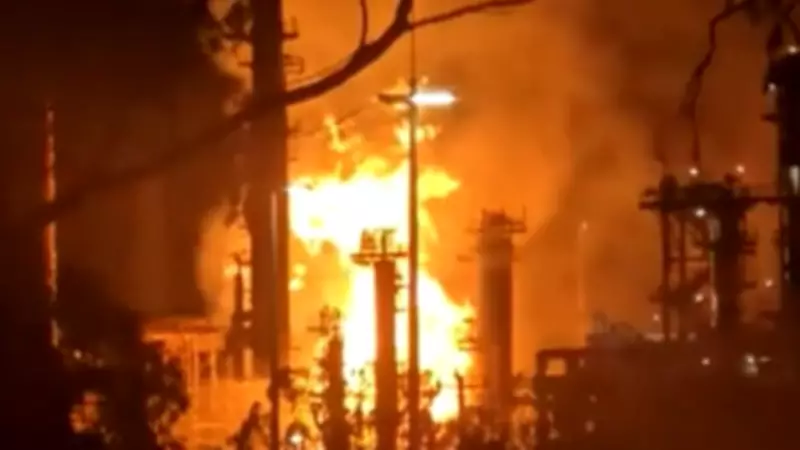
Explosions and Major Fire Erupt at Viva Energy Refinery in Geelong
A significant fire has broken out at the Viva Energy Refinery in Corio, north of Geelong, following multiple explosions reported late Wednesday night. The incident occurred at one of Australia's only two remaining operational oil refineries, raising immediate concerns about national fuel security, particularly as global supplies are threatened by ongoing conflicts in the Middle East.
Investigation Timeline Extended to Over 12 Months
WorkSafe Victoria has announced that a comprehensive investigation into the cause of the fire will be launched once the site is deemed safe. However, officials have cautioned that this process could take more than 12 months to complete. Sam Jenkin, WorkSafe's chief health and safety officer, emphasized that the priority is ensuring all work on the site is conducted safely without risk to workers or the public.
"We understand there is significant community concern about this incident and will continue to engage with our stakeholders during the ongoing response and recovery," Mr. Jenkin stated.

Firefighting Efforts and Containment
Fire Rescue Victoria (FRV) responded to the scene just after 11pm on Wednesday, with up to 50 firefighting vehicles deployed to combat the blaze. FRV deputy commissioner Michelle Cowling confirmed that the fire was caused by equipment failure and remains well-contained within a specific section of the plant, though it is not yet fully under control.
"We won't take our foot off the pedal at all," Ms. Cowling said, noting that firefighters are expected to remain on site late into Thursday night to monitor and prevent any chance of reignition.
Impact on Fuel Production and Supply
The affected section of the refinery is involved in producing high-octane fuels, with significant amounts of liquid hydrocarbons and gases suspected to have fueled the intense fire. FRV assistant chief fire officer Mick McGuinness described the situation as "quite dangerous" due to the highly flammable materials involved.
Energy Minister Chris Bowen acknowledged that the incident will impact production levels, with jet fuel and diesel output continuing at reduced levels as a safety precaution. Viva Energy CEO Scott Wyatt expressed confidence that the company can substitute lost production and maintain market supply.
Broader Implications for Australia's Fuel Security
The Geelong refinery, which has been operating for over 70 years, supplies 10% of Australia's fuel and 50% of Victoria's needs, processing up to 120,000 barrels of oil daily. With Australia refining only 20% of its local liquid fuel demand and importing 80%, this fire underscores vulnerabilities in the nation's energy infrastructure.
Geelong Mayor Stretch Kontelj highlighted the fragility of Australia's fuel security, stating, "And it just shows that we, as a country, need to invest more in this type of capability."
Community and Environmental Concerns
The fire triggered explosions and released a cloud of toxic smoke that blanketed suburbs across Geelong. Initial Watch and Act alerts were issued for areas south of Refinery Road, though these have since been downgraded. The Country Fire Authority (CFA) advised residents in Corio, Norlane, and North Shore to remain cautious as smoke may still impact specific areas.
No injuries have been reported from the incident, according to Victoria Police. Premier Jacinta Allan urged Australians to avoid unfounded speculation and panic, emphasizing that fuel supply remains efficient for now.
Global Context and Future Outlook
The fire occurs against a backdrop of global fuel supply disruptions, with the war in Iran blocking 20% of the world's oil supply through the Strait of Hormuz. Australia's two operating refineries—Viva Energy in Geelong and Ampol Lytton in Brisbane—are now critical to domestic supply chains.
Professor Yuan Chen from the University of Sydney noted that operating conditions combined with equipment degradation over time at aging facilities like Viva Energy can increase the likelihood of such incidents. As the investigation unfolds over the next year, stakeholders will closely monitor the implications for Australia's energy resilience and industrial safety standards.