The Hunter region's industrial and energy landscape is undergoing a dramatic transformation, receiving a combined investment of nearly $1 billion within a single day. This monumental boost centres on two major projects: a new large-scale battery and a cutting-edge solar panel factory, announced as crucial negotiations continue to secure the future of the region's largest power user, the Tomago Aluminium smelter.
AGL's Tomago Battery Breaks Ground Amid Smelter Talks
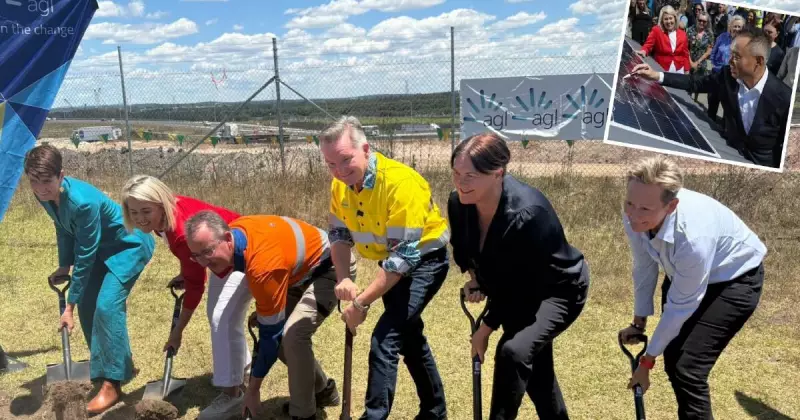
AGL Energy has officially commenced construction on an $800 million battery energy storage system at Tomago, situated mere kilometres from the aluminium smelter that bears the same name. The 500-megawatt, four-hour duration battery is scheduled for completion by mid-2027 and will create approximately 200 construction jobs, plus six ongoing roles.
AGL Chief Executive Damien Nicks confirmed the company remains in active discussions with Tomago Aluminium, whose contract for power supply runs until the end of 2028. "Tomago is a big, important customer for us and has been for a number of years," Mr Nicks stated during the groundbreaking ceremony. He acknowledged the ongoing talks but refrained from commenting on separate negotiations involving state and federal governments.

The battery's location is strategically vital. Built on land owned by AGL adjacent to major transmission lines that also feed the smelter, it minimises infrastructure costs and maximises efficiency. The site's proximity to the Newcastle Gas Storage Facility offers further operational synergy. In a symbolic touch, spades made from parts of the decommissioned Liddell power station were used in the ceremony, marking a shift from old coal to new storage technology.
Federal and State Governments Back $171m Solar Manufacturing Plant
Just hours before the battery announcement, Energy and Climate Change Minister Chris Bowen unveiled plans for a major solar manufacturing facility at Black Hill in the Lower Hunter. The $171 million Hunter Valley Solar Foundry project, spearheaded by the Chinese Sunman Group, will establish a plant capable of producing 500 megawatts of solar modules annually.
The project is a direct beneficiary of the federal government's $1 billion Solar Sunshot program. Funding includes a $151 million grant from the Australian Renewable Energy Agency (ARENA) and $20 million from the NSW Government's Net Zero Manufacturing Initiative. The facility is expected to support around 100 full-time jobs and produce roughly 800 modules each year for both domestic and export markets.
"By backing this project in the Hunter, we're helping turn Australian innovation into industrial strength - creating good local jobs, strengthening our supply chains and building a Future Made in Australia," Minister Bowen declared at the site.
Tomago Aluminium's Future Hangs in the Balance
These significant investments unfold against the backdrop of uncertainty for the Tomago Aluminium smelter. In October, the company warned it was considering closure, having failed to secure an economically sustainable long-term energy contract beyond 2028. The smelter is the single largest electricity consumer in New South Wales, and its fate has profound implications for the regional economy and the national energy grid.
Both federal and state governments are actively involved in negotiations to develop a plan to keep the smelter operational. An announcement regarding its future is anticipated before the end of the month. The new battery infrastructure nearby could play a pivotal role in any future energy agreement, providing flexible, dispatchable power to support the smelter's intensive operations as the grid transitions.
The dual announcements within 24 hours signal a powerful pivot for the Hunter region, traditionally a heartland of coal-fired power. The combination of large-scale storage and advanced renewable technology manufacturing points to a diversified economic and energy future, even as the region works to retain its existing industrial base.