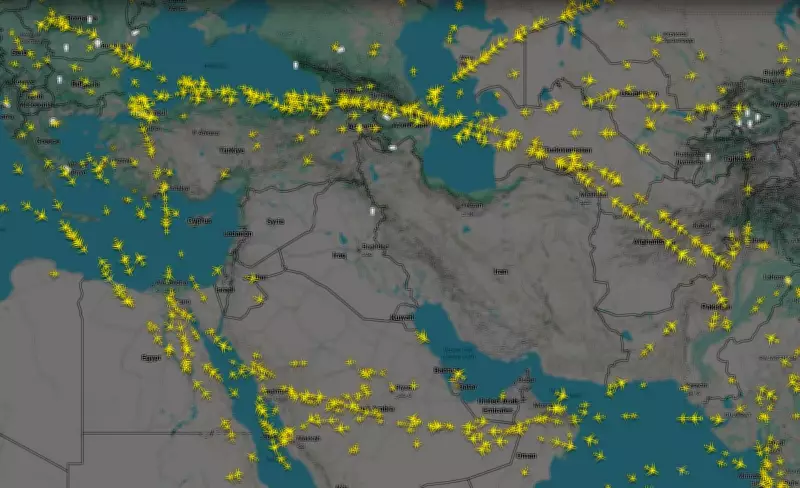
Limited Flights Depart UAE, Offering Hope for Stranded Travellers Amid Middle East Air Closures
A small number of flights have departed from the United Arab Emirates, raising a slight hope for travellers caught up in the extensive airspace closures across the Middle East. This development comes as around 100,000 Australians are stranded in the UAE, with the federal government issuing a do not travel warning to the country amid ongoing regional conflicts.
Government and Airline Responses to the Crisis
Foreign Minister Penny Wong addressed the situation, stating, "We have 115,000 people and that is a lot of people to try and to assist. And the best way of getting people out will be for commercial flights to resume." She added, "So, we will look at when that is likely. We're obviously engaging with the airlines on this." Hopes are rising that stranded travellers may soon be able to head home as some repatriation flights take off from the UAE, including limited operations from Dubai and Abu Dhabi.
These flights occurred as the US State Department urged its citizens in 13 countries, including the UAE, Jordan, Saudi Arabia, Egypt, Lebanon, and Oman, to "depart now via commercial means due to serious safety risks." However, sweeping airspace closures and flight cancellations across the region have left many with few options to heed this advice.

Impact of Airspace Closures and Flight Disruptions
Since US and Israeli strikes on Iran and retaliatory attacks on Israel and Gulf states began on Saturday, commercial flights have been halted or heavily restricted. This has left tourists, business travellers, migrant workers, and religious pilgrims stuck in hotels, airports, and aboard cruise ships. Airspace remained closed on Monday over Iran, Iraq, and Israel, with Jordan instituting a temporary closure starting Monday afternoon.
Other Gulf countries, including Qatar, Bahrain, Kuwait, and Saudi Arabia, had partial or temporary closures that could be extended, according to flight-tracking service Flightradar24. The service reported that after explosions from a drone in Riyadh, flights into King Khalid International Airport near Riyadh were holding or turning back. Aviation analytics firm Cirium noted that about 13,000 of the roughly 32,000 flights scheduled into and out of the Middle East since Saturday have been cancelled.
Airlines Operating Limited Evacuation Flights
Henry Harteveldt, president of travel market research firm Atmosphere Research Group, explained that airlines operating evacuation flights are likely doing so with government backing, and the carriers' home countries may be assuming part of the financial risk. He stated, "Airlines aren't going to resume operations until they are fully confident that there is a zero - or as close as possible to zero - risk that their aircraft will be attacked."
Long-haul carriers Etihad Airways and Emirates, based in Abu Dhabi and Dubai, along with budget carrier FlyDubai, announced on Monday they would operate limited flights from the country, where air defence systems were deployed to intercept Iranian missiles and drones. Flightradar24 reported at least 16 Etihad flights left Abu Dhabi during a three-hour window on Monday, heading to destinations such as Islamabad, Paris, Amsterdam, Mumbai, Moscow, and London. However, the airline's website indicated all regularly scheduled commercial flights remained suspended until Wednesday afternoon.
Emirates said customers with earlier bookings would get priority for seats aboard the limited flights it planned to operate starting Monday evening. FlyDubai stated it would operate four outbound flights and five inbound. Dubai Airports, which runs the city's two airports, showed a larger number of flights on Tuesday but urged passengers to go to airports only if their airline had notified them with confirmation, as operations remained curtailed.

Global Implications and Travel Alternatives
The disruptions have far-reaching consequences because Gulf airports serve as critical global transit hubs linking Europe, Africa, and Asia. Dubai International Airport alone handled a record 95.2 million passengers last year, making it the world's busiest airport when measured by international travel. For Australians wanting to travel to Europe, current advice suggests routes via Cathay Pacific or Singapore Airlines, as well as some Chinese airlines, remain available despite the regional closures.