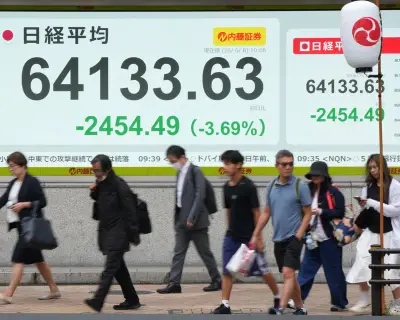
Last week's National Accounts made for difficult reading. After what had been nascent improvement, the nation's quarterly report card showed the economy slipping back into mediocrity. And we need to prepare ourselves for worse to come in the June quarter because of the war in Iran. Inflation will accelerate and the fallout will cascade through our supply chains, from fertilisers to plumbing equipment. The economy is likely to shrink in the current quarter.
Headline Results from the Last Quarter
Real GDP growth was just 0.3 per cent, down two-thirds on growth at the end of 2025. But for the boom in data centres and higher public spending, the economy would have stalled. Productivity fell again, after no gain at all in Q4. The best measure of productivity - output per hour worked - is now below where it was before the pandemic. Over roughly the same period, productivity in the US surged 20 per cent. And the per-capita recession lingered for another quarter. Output per person has fallen now for 10 of the past 15 quarters, an unprecedented run of failure going back six decades. There have been deeper downturns, but never one this long.
Living Standards Under Pressure
Weak productivity and falling incomes mean Australia's living standards are being slowly squeezed. Remember, rising productivity is the only thing that delivers higher living standards over time. Everything else is fleeting. Crucially, we've lost our economic dynamism, the 'secret sauce' that nourishes productivity. Dynamism is the pace at which we change jobs, the rate of business entries and exits, and the speed of diffusion of new technology. For years, our metrics have been going the wrong way - we lost the recipe. And it's not hysteria to say we're in a productivity crisis. The malaise explains why our economy can barely grow above 2 per cent without generating inflation. Our speed limit, our potential rate of economic growth, has declined. As productivity dwindles, we bump up against constraints at ever-lower rates of economic growth.

Compounding Factors
The extended decline in living standards comes at a time of persistent and worsening inflation and rising interest rates. Remember, inflation was accelerating and the Reserve Bank was lifting interest rates before missiles started raining down on Tehran. No wonder so many voters are cranky with incumbents. All the while, our Reserve Bank is among the first major central banks to lift interest rates this year, reversing the three rate cuts of last year. Markets price further tightening for later this year, partly because inflation expectations have become untethered. With options dwindling, the narrow path Governor Michele Bullock has spoken about has become a tightrope.
The Root Causes
Australia's economic chickens are coming home to roost. We are squabbling over respective shares of a shrinking economic pie, rather than growing a bigger and better pastry. A toxic mix of misguided policy, neglect and laziness has brought us here. Doing hard yards on genuine reform in recent decades could have mitigated the damage to the economy. Instead, we rested on our laurels. Our creaking, inefficient, incentive-sapping tax system has not been reformed for a quarter of a century. This indolence is unforgivable. We became complacent as the rise of China drove record commodity prices that underpinned ever-higher living standards. Buoyed by our higher incomes, we neglected problems as they emerged; our soaring terms of trade papering over the cracks. We ignored the lack of resilience in our supply chains. We allowed income tax to shoulder an ever-greater share of federal taxes, dulling the incentives to work. We underinvested in new productive capacity and allowed red and green tape to grow like weeds, strangling businesses. We drove our budget into deep structural deficit by spending beyond our means. And inevitably, commodity prices retreated as China diversified its own supply chains.

Government Response
To its credit, the federal government has unleashed a refreshed deregulation agenda. But these changes come late. The recent budget with its increased taxes on investment takes us in the wrong direction. In sensitive matters of incentive and risk, perception matters alongside reality. The cure to our malaise is not complicated. Lifting our flagging productivity is not quantum physics. But acting on the obvious to-do list requires huge doses of political courage and national cohesion, including across state borders. Both have been sadly lacking.
Pathways to Recovery
First, faster growth in private investment is essential. Until recently, business investment was languishing at a 30-year low as a share of GDP. Outside the data centre explosion, it still is. Second, we should prune the thicket of regulation bringing cost and complexity to business. Productivity Commission chair Danielle Wood calls many of these rules "hairballs" choking innovation. We are slow to innovate, although we are fast followers. We should tread carefully regulating AI to avoid killing what could be a golden goose for productivity. Third, curbing spending in the low-productivity care economy would help, as would reducing the relative size of government. Higher public spending and an ever-growing government footprint are crowding out more productive private sector investment. Fourth, we should stop bailing out failing legacy industries with taxpayers' funds. They represent a past made in Australia, not the future. Deregulating our complex and rigid labour market would be a bonus, but that is not going to happen any time soon while the unions seem to be writing Canberra's policies.
Conclusion
Meanwhile, as we squabble, we risk losing our newly-found appetite for reform that has emerged from crisis, as it always does. This would be devastating, particularly if another fortuitous wave of high commodity prices doesn't wash up on our barren shore.