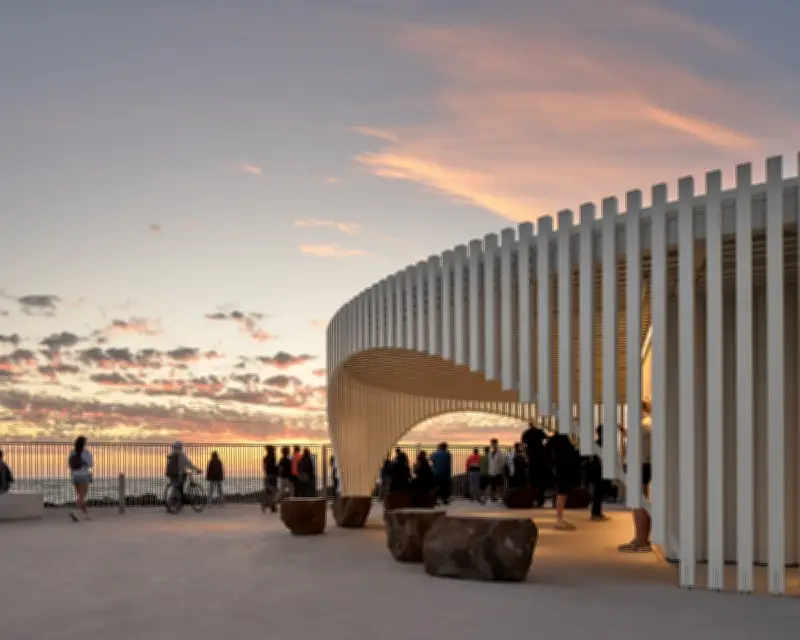
St Kilda's reimagined pier has added more accolades to its growing trophy collection, securing top honors at the 2026 Australian Institute of Architects' Victorian awards. The $53 million state government project, designed by Jackson Clements Burrows Architects alongside Site Office Landscape Architecture and AW Maritime, claimed the Victorian architecture medal on Friday, awarded to the most outstanding project of the year.
Multiple Awards and Community Praise
The pier also won the Dimity Reed Melbourne prize and the Joseph Reed award for urban design. In March, it was co-winner in the built outcomes category at the national Urban Design awards. The project has faced controversy, including a failed attempt by Parks Victoria to introduce pay-per-view access to the resident penguin colony. However, the Victorian jury panel praised the project for successfully balancing the competing demands of tourists, locals, fishers, ferries, marina users, and even the penguins.
“The project demonstrates how complex infrastructure can also become playful, social and deeply civic,” the judges said.

Sustainability and Community-Centered Design
Building on recent national and New South Wales awards, sustainability, resource efficiency, and community-minded public design were central themes at the Victorian awards. Jury chair, architect and academic Simon Knott noted that this year's standout projects were defined by their ability to transcend purely utilitarian briefs and prioritize human interaction.
“[They] feature beloved landmarks that have transcended their function as a piece of infrastructure,” he said. “We saw multiple community projects that are delightful sites of human congregation where community-centric design has been at the forefront, taking prosaic pieces of existing architecture and making them a place of recreation.”
Even sites with a “grim history” had been “utterly transformed with deft hands,” Knott added.
Sunbury Asylum Transformed into Arts Precinct
One such site is the former Sunbury Lunatic Asylum, built in 1879, later renamed the Sunbury Hospital for the Insane and then the Caloola Training Centre. After nearly two decades as part of Victoria University's campus, it has been transformed into the Sunbury community arts and cultural precinct. The project won several awards, including the John George Knight award for heritage and the award for interior architecture.
The judges praised the design by Architecture Associates with Openwork as an adaptive reuse of an institutional complex previously defined by human containment. “A fine balance is required when a building designed to restrict and remove persons from society becomes one that celebrates community coming together,” the judges' statement said. “To let the building's story unfold … sometimes directly, sometimes by shadowing the past … is a skill that has many facets. The architects utilise all these skills.”
Commercial and Educational Architecture
The push to convert underutilized urban spaces into functional workspaces was evident in Fieldwork's design of 65 Dover Street in Cremorne, which claimed the Sir Osborn McCutcheon award for commercial architecture. Fieldwork was commended for its “elegant and nuanced” response to the site, which includes a rooftop recreation space with a half-size basketball court.
“65 Dover St sets a new benchmark for commercial architecture of this scale – integrous, gracious and refined,” judges said.
The Henry Bastow award for educational architecture went to Baldasso Cortese's Edmund Rice centre at Emmanuel College in Warrnambool. Clad in Colorbond manor red, the learning hub is organized into three domains – wisdom, communication and discovery – all facing a central courtyard.
Residential Awards Favor Sustainable Refits
In the residential categories, winners were dominated by sustainable refits of heritage structures over traditional “knockdown rebuild” strategies. Robert Simeoni Architects' Palmerston Street house in Carlton took out the heritage award and the John and Phyllis Murphy award for alterations and additions. The architects' design was admired for its restrained reimagining of a former 1870s hotel, while negotiating rising construction costs and material shortages.

“It works directly, honestly and poetically within these limitations to find a spatial and material language that delights in its own economy,” the judges said.
For new builds, the Harold Desbrowe Annear award went to Edition Offices' “House in a Garden,” a striking elevated timber form nestled into the canopy of the Birrarung flood plain, offering “a cinematic sense of immersion within a highly choreographed landscape.”