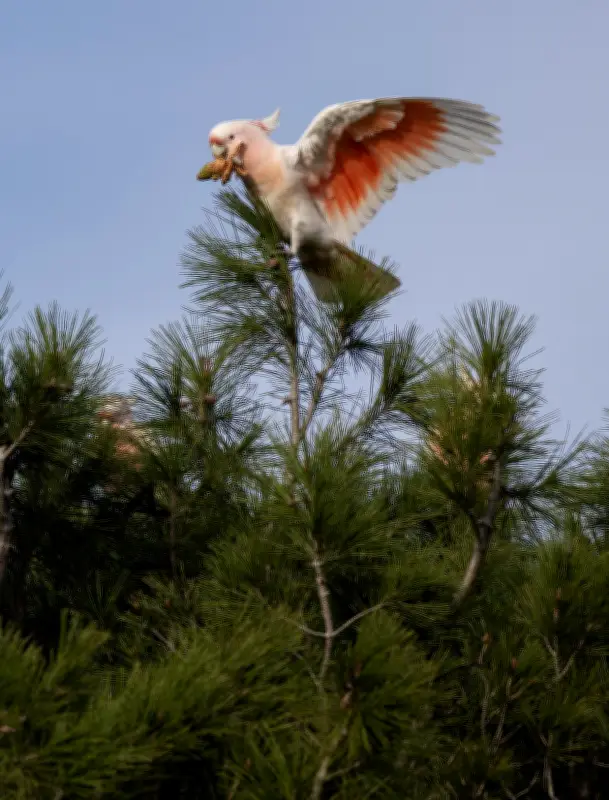
At the entrance to Wyperfeld National Park in north-west Victoria, more than a dozen pink cockatoos are scattered across a hedge of Aleppo pine trees like Christmas ornaments. These exotic pines, not the native conifers the birds depend on for nesting and food, still provide a temporary haven. The feathered creatures appear content, nestled among the spruce, ripping into pine cones with their agile claws and beaks, producing gentle cracking sounds that punctuate the soft roar of Mallee winds.
This serene scene belies the devastation within the park. In January's catastrophic bushfires, 70% of the cockatoo's core habitat, known as "pine plains," was scorched, leaving behind charcoal shadows and empty space. This is dire news for Lophochroa leadbeateri, an endangered bird formerly called the Major Mitchell's cockatoo. Ecologist Dr. Victor Hurley, who has monitored the birds for decades, calls them "flame-crested" or simply "flamin' cockatoos," referencing their fiery red and yellow striped crest and the blaze of salmon pink under their wings.
Ancient Trees Essential for Breeding
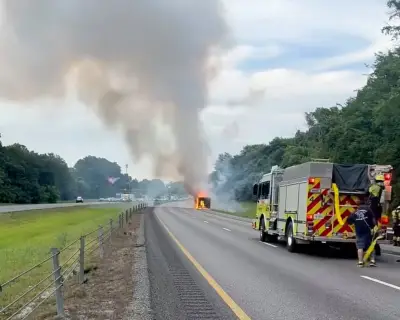
Hurley explains that the species relies on slender cypress pines (Callitris gracilis) for breeding hollows. However, to accommodate a growing cockatoo family, the trees must be ancient—at least 85 years old, ideally 125 years or more. Very large, old pines were already vanishingly rare due to historical land clearing and major fires in 2014, which tore through 60% of pine plains, destroying 97% of known cavity-bearing trees in the burnt area. That was before the 2025-26 bushfires, which torched 440,000 hectares across Victoria—larger than the area burned on Black Saturday—including 59,000 hectares in Wyperfeld.

The fires have taken a toll on many endangered birds. Eastern bristlebirds lost 82% of their habitat at Howe Flat near Mallacoota, a key stronghold, with post-fire surveys showing a 30% population decrease. In South Australia, fires in Deep Creek National Park affected half the habitat for western beautiful firetail and Mt Lofty Ranges southern emu-wren.
Homes for the 'Wimpy' Kids
Two fires in 12 years have been devastating for the cockatoos at Wyperfeld, Victoria's largest breeding site. Previously, there were 178 large, old native pines within the burnt area; barely a handful remain. A small unburnt grove at the eastern end of the park offers a glimpse of the lost habitat—a sparsely treed patch of semi-arid woodland dotted with hardy casuarina and slender cypress pines, with small lichens and mosses growing on the sandy forest floor.
Here stands something resembling a crucifix: a hollowed-out log strapped to a repurposed power pole, with a bird-sized door. It is an early proof-of-concept for an artificial hollow, MacGyvered by Hurley in 2009. As long as a tree is large enough, cockatoos will excavate their own living space, clearing out the cavity and tidying up. But competition for hollows is fierce. "The flame-cresteds seem to be the wimpier kid in the school yard," Hurley says, often losing out to more assertive galahs or feral European honeybees that fill the space with honeycomb.
Artificial Hollows Offer Hope
Hurley, along with a dedicated band of volunteers known as the Mallee Woodpeckers, has spent countless hours monitoring the birds and building artificial hollows. Modern designs are carved into the trunks of dead but standing trees, including those charred on the outside. They chainsaw a slice out of the tree, carve out a space inside at least 20 cm wide, and replace an arc of the outer bark to make it weatherproof. The final product is barely noticeable—just a tiny door opening onto a cosy space, sometimes with a perch point. Together with Parks Victoria, about 150 new hollows have been added to the park.
Will Trimble, area chief ranger for the southern Mallee at Parks Victoria, says it is exciting to see cockatoos investigating the artificial hollows, even as they are being built. In addition to creating new hollows to reduce competition for nesting spots, the public land manager is planting more slender cypress pines to replace those lost in the fires. "Parks Victoria rangers are doing our best to help native animals and plants recover from the fires," he says. "Pink cockatoos are one of the highlights of Wyperfeld National Park and we want to see them thrive."

Traditional Owners Concerned
Barengi Gadjin Land Council, which represents local traditional owners, says the destruction of cockatoo habitat is a major concern. "The pink cockatoo features in our stories and is an important species for us," says Colin Gorton, the council's on Country manager. While the land council supports short and long-term recovery efforts, Gorton notes that "it will be many years before the trees, lost to the fires, will be able to support the pink cockatoo population in the region."
Michael Gooch runs wildlife tours and accommodation with his partner on their large bush reserve next door to the park and volunteers to help monitor the cockatoos. They had a car packed ready to go throughout the fire season, once relocating a guest from Canada to the Patchewollock pub. The birds are a massive drawcard for local and international visitors, especially with the growing popularity of birdwatching among younger generations. Most guests are birders seeking the "Mallee trinity": pink cockatoos, regent parrots, and malleefowl.
Long Road to Recovery
Apart from the few remaining old trees, the next cohort of pines sprouted in the 1990s and are still half a century away from being suitable for nesting hollows. The younger pines serve another important purpose as food. Jane White, an environmental scientist who volunteers with the Mallee Woodpeckers, says the cockatoos like to travel with a packed lunch. "You often see them carrying a Callitris branch with a seed across the landscape." It is a reciprocal arrangement: the birds are the main seed dispersers for the pines, and as long as the tree is large enough, they excavate their own hollows, which a myriad of lizards, mammals, and other birds rely on. "They're invested in their community," she says. "They're helping with providing houses and food and shelter for all the other bird life."
Fiona Murdoch, founder of Friends of Mallee Conservation, has a couple of "pinkies" on her conservation property, part of which was also burnt in the fires. "They fly over most days and they generally bring their young one back to show us," she says. Murdoch feels "pretty shattered" by the loss of so many old trees. "It's been a pretty horrible few months. The trees are hundreds of years old, so they're not coming back in my lifetime." Artificial hollows are not an ideal solution, she says, but it is the only one available in our lifetime. "We can't magic up a tree, but you can build a habitat hollow."