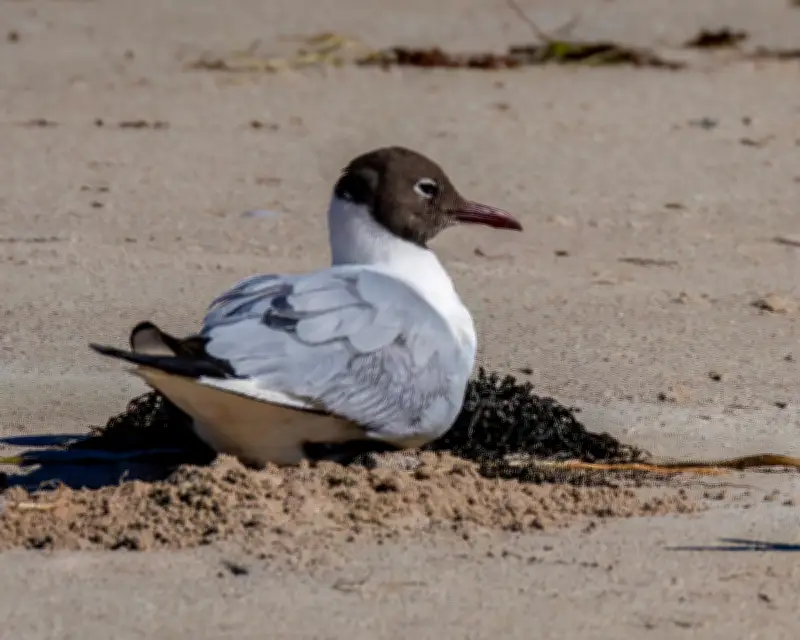
A lone seabird has caused a stir in Australia's birdwatching community after landing on the Western Australian coast, thousands of kilometres off its usual migratory flight path. The black-headed gull, which typically flies between Europe and Asia, has been spotted in the coastal city of Geraldton.
It was first reported last Tuesday by a local Facebook group, following a severe storm front that battered south-west Western Australia. The unassuming bird has drawn a number of twitchers—keen birdwatchers who often travel long distances to see a new species—with at least one enthusiast travelling from the east coast to catch a glimpse of the avian visitor.
“The birds migrate from Asia to Europe, so it is a long way from where it should be,” says Steve Pidgeon, a Geraldton local of 42 years and member of Birdlife Midwest-Geraldton. “They haven't had a reported sighting since 1991, so it's pretty rare.”

Unusual Arrival Due to Storm
While weather events frequently blow birds outside their normal territory, experts say this arrival is unusual due to how far south the gull travelled. The closest regular populations of the black-headed gull are in India, Japan and the Philippines.
“We quite often see rare or vagrant species turn up after severe weather events,” says Tegan Douglas of Birdlife Australia. “The thing that makes it a little bit unusual with the black-headed gull is that this storm front mostly came from the south-west, and this observation is already at the extreme southern end of its distribution.”
“The next southernmost record of that bird in Australia was in Broome, about 1,500 kilometres north-east of Geraldton, and that was 35 years ago, back in 1991. Sometimes you expect birds to overshoot or get caught up in a weather system and end up a little bit far from home, and that's probably what's happened here.”
Twitchers Flock to See the Gull
For the uninitiated, the arrival of such a rare bird triggers a phenomenon among enthusiasts. “Most people don't think of birdwatching as being an extreme sport,” Douglas says. “But the twitcher is kind of the extreme end of enjoying birdwatching as a hobby. There are people who are so competitive about having the most number of birds on their list for the year or for the country that they will drop everything, feign sickness to get off work, book flights, and drop a whole heap of cash.”
For Douglas, news of the black-headed gull was enough to set her on the longest twitch of her life. She coordinated with a friend to carpool the four-hour, almost 400-kilometre drive from Perth to Geraldton. The journey was made easier by a collaborative network of local birdwatchers. Rather than gatekeeping information, Douglas says WA birdwatchers use WhatsApp chat groups to coordinate the search, tracking the bird's movements across the coast in real-time.
“There was someone who flew over from the east coast, and people here were offering them a lift to get up to Geraldton to try and cut costs,” she says. “The birdwatching community is really supportive of each other.” When Douglas arrived in Geraldton, she received a notification about where to travel to reach the elusive gull. “We searched those beaches and searched around the port, and then we ended up at the foreshore in town, and that's where it was. So convenient.”
Living with the Cousins
Despite being far from home, the black-headed gull is living a remarkably ordinary life on the Geraldton foreshore. Douglas observed it blending in with flocks of local silver gulls, “fossicking for chips” and “just doing regular seagull things”. “It's really similar in size to our silver gulls, and it's also really quite similar in habits,” she says. “Where the black-headed gull normally comes from, there's lots of other species of gull that it hangs out with.”
Pidgeon, who went looking for the gull on Saturday after receiving a tip-off from a friend, managed to photograph the rare visitor for his Instagram. “There are a lot of birdwatchers that have travelled from all over the state and Australia to see this bird,” he says.

How long the rogue traveller decides to stay on the coast of midwest WA remains a mystery. Because it is in an unfamiliar environment, it doesn't know the local threats or predators, though Douglas says the “rockstar” is “pretty lucky because it's landed in with a bunch of cousins”. “People behaving respectfully around wildlife, and around particularly rare wildlife, is what definitely helps them stay longer,” Douglas says. “There's no need for that with this gull. It will sit quite happily on the beach, like 10 to 15 metres away from people. It's really chill.”