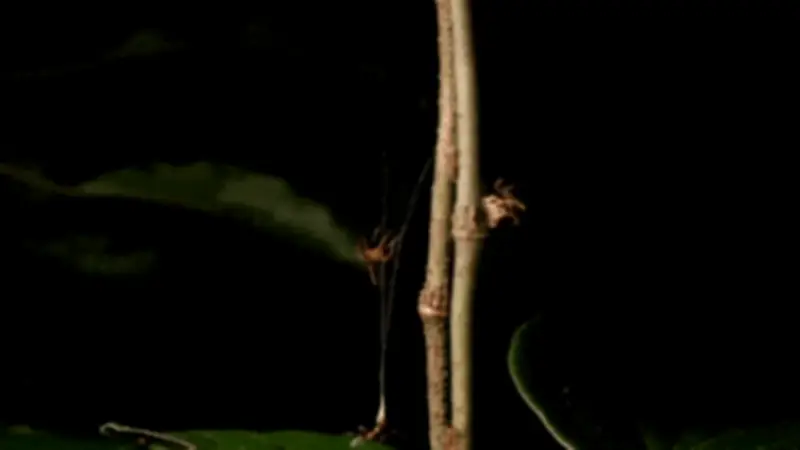
In the tropical rainforests of Queensland's Cape York Peninsula, researchers have discovered a spider with a unique hunting strategy. The ballista spider, belonging to the genus Propostira, constructs a spring-loaded snare that specifically targets the highly territorial green tree ant (Oecophylla smaragdina). The findings were published today in Current Biology.
How the Ballista Spider Hunts
During the day, the spider rests in a silken retreat on the underside of leaves. At night, it descends on a silk line to find an anchor point, leaving a tension line as it returns to the core web. It repeats this process to build a fan-shaped web of silk tension lines, forming a small conical scaffold. The spider then wraps the scaffold in a thinner silk that appears to attract ants and provoke an attack, possibly through pheromones.
Worker green tree ants quickly respond, biting the cone. The bite detaches the cone, and the ant is pulled upward and propelled into the core web in a fraction of a second. The ant experiences accelerations up to 1,367 metres per second squared—roughly 140 times gravity and 15 times the g-forces experienced by jet pilots. The spider waits until the ant is fully entangled before wrapping it in silk for later consumption.

Superior Energy Performance
The ballista spider's snare outperforms other silk-based catapult systems. Gram for gram, it stores more energy and exerts more power than any known biological catapult. A kilogram of the web would store 78.17 kilojoules of kinetic energy and briefly exert 11.73 megawatts of power. This exceptional power likely evolved to rapidly yank ants away from their nests and trails, where fellow ants might come to their defence.
Extreme Specialisation
The ballista spider exhibits two unusual traits. First, it is extremely specialised to a single prey species, suggesting it may add specific pheromones to the thin wrapping silk to attract green tree ants. Second, the snare is triggered by the prey itself, rather than the predator sensing and triggering the snare. This demonstrates how extreme prey specialisation can drive the evolution of exceptional biomechanical performance.