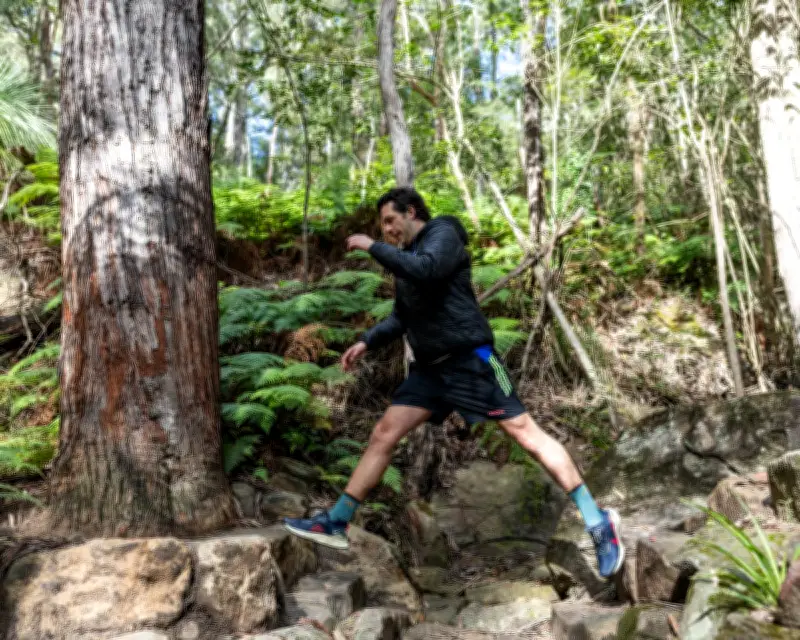
Nick Visser explores Sydney's new Hornsby Park, which sits atop an ancient volcano. Photograph: Blake Sharp-Wiggins/The Guardian
A quarry atop an ancient volcano is Sydney's newest bushland park. It's just the start of an 'intergenerational project'. Hornsby Park is the latest former industrial site transformed into a peaceful green escape in a city known for its vistas.
From Quarry to Parkland
Sydney's newest bushland park in Hornsby, on the city's upper north shore, has been created at the site of an old quarry abandoned since 2003. The 60 hectares is a peaceful retreat just 10 minutes on foot from the local train station, which will eventually service 6,000 new homes. Hornsby Park sits atop an ancient volcano on Dharug and GuriNgai country. The former industrial site has been revegetated with the quarry walls stabilised.

"We've got to get more [housing] density into that space [around the train station]," says Glen Magus, the acting general manager of Hornsby Shire council. "And right in our back yard in Hornsby we've got this 60-hectare site that's really a blend of nature, history and culture. It's a rare moment for council to actually get an opportunity like that ... something that we can provide liveability for our community."
Heritage Steps and Scenic Views
Guardian Australia visited the park last week. I'm a denizen of the inner city, more used to plane trees than eucalypts. But it won me over immediately. A highlight is Hornsby's heritage steps, which stretch for about 1km, connecting Hornsby pool at one end and the Great North Walk at the other. Constructed in the 1930s, the stairs are steep in parts, but provide perfect access for a sun-mottled walk through fern groves and blue gums that grip the volcanic soil. Lorikeets, rosellas and kookaburras are flitting about when I visit.
The first stage of Hornsby Park opened in March. The main attraction is, of course, the old quarry itself. A remnant of its working history remains in the form of an old crusher plant, fenced off from would-be climbers. Then there's a new red metal viewing platform that's stunning – even in a city famous for its vistas.
Jutting out 14 metres above the ground below, the 42-metre-long platform draws in visitors who can then look down to the turquoise water filling the lower level of the quarry. "Oh wow, this is lovely," a woman says. "One day, you might be able to swim in it?"
One day, perhaps. But for now, Hornsby council says: "The quarry void and lake are not currently accessible to the public. Any future consideration of swimming would require careful assessment of community safety, access and funding, including advocacy to state and federal governments."
Transport Oriented Development
Hornsby is one of eight precincts rezoned by the New South Wales government as a transport oriented development (Tod) precinct. That means someday 6,000 new homes can be built near the train station. "Often what's missed in the [call for more] density ... is you also need to support that with infrastructure, having the bush walks and the mountain bike tracks and all those sorts of things," Magus says. "We're in the unique position where we can do that."
Future Plans
Hornsby Park remains a work in progress. A massive stretch called the Old Man's Valley will host sports fields and a "pump and jump" cycling track, among other amenities. It's currently just a large dirt field but the $24.3m project is scheduled to open in May 2027. A walking and cycling track around the top of the quarry, with scenic lookouts, is also under construction. Shots from a nearby rifle range echo over the site at times, but after a while they blend into the rush of wind through the trees.
Shazzy Toner, 33, and her daughter Elika visited last week to drink in the view of bushland and water from the southern lookout metal boardwalk. The accessibility, easy parking and pathways for her daughter to scoot along were a boon. "I have three kids, and we don't have a lot to do, we feel, other than the parks," Toner says. It's great "having somewhere we can go for a picnic, and it doesn't have to be by the beach, something a bit more local".

Victor Lin, 76, has ventured into the new park a few times, climbing down the heritage steps. "In the past, when we walked around the Hornsby area, it's a rural bush track," he says. "In lower areas, sometimes you have to watch out for leeches and stuff like that. You don't have quite the same problem [here]. It's good for us who are getting a bit elderly."
Brownfield Redevelopment in Sydney
Sydney is no stranger to redeveloping industrial land or brownfield sites. Mike Horne is the director of Turf Design, the firm behind a major overhaul of the stormwater system at Sydney Park in Alexandria. Landscape architects view parkland as essential to a healthy city, just like roads, schools or hospitals, Horne says. Sydney Park, a 42-hectare bastion of Sydney's inner west, has been developed over four decades. The site was a brickworks for more than a century, then a rubbish tip when the clay ran out, and finally a parkland. Beneath a large hill at its northern end is a mountain of old cars, broken refrigerators and garbage. It was first opened as a park in 1991.
"Making the best use of urban space is super important in Sydney, where there's not a lot of space around," Horne says. "You're not just making a pretty park, you're creating a pretty piece of rehabilitated infrastructure, which is far more important. You're creating a place that's working hard for people. It's not just repairing the environment."
Sydney Park captures and cleans 850m litres of stormwater annually from the surrounding suburbs. The water is now filtered through a system of pools and wetlands that attracts birds – and the public. Other projects, including Sydney Olympic Park and the new Bays precinct, have recast polluted or formerly industrial land into public green spaces.
Elisa Palazzo, a senior lecturer in urban design at UNSW, notes Sydney is buttressed by the Pacific Ocean to the east and the Blue Mountains to the west. It can benefit immensely from redeveloping old industrial sites and "redensifying" areas often already near city centres and infrastructure, Palazzo says. "We need houses, we know that," she says. "But we also need public spaces. Most of this housing will be apartments, and apartments need a provision of public space higher than that of normal single-family households." Redeveloping brownfield sites can be expensive and complex, but they need to be made safe. "It's also a positive because you clean them up and reclaim them," Palazzo says.
An Intergenerational Project
Councillors in Hornsby expect the park to grow over time to fill out the 60-hectare site. "It's an intergenerational project," Magus insists. "What you've got there – it just takes time to develop the next stage." Horne agrees Hornsby Park will take time to reach its full potential. But Australia is a great example for how this type of redevelopment can work, he says. "I would say in Sydney, but also Australia in general, we're world leaders in this type of work, for sure. We sort of underrate ourselves. We're so busy we forget how bloody good we are."