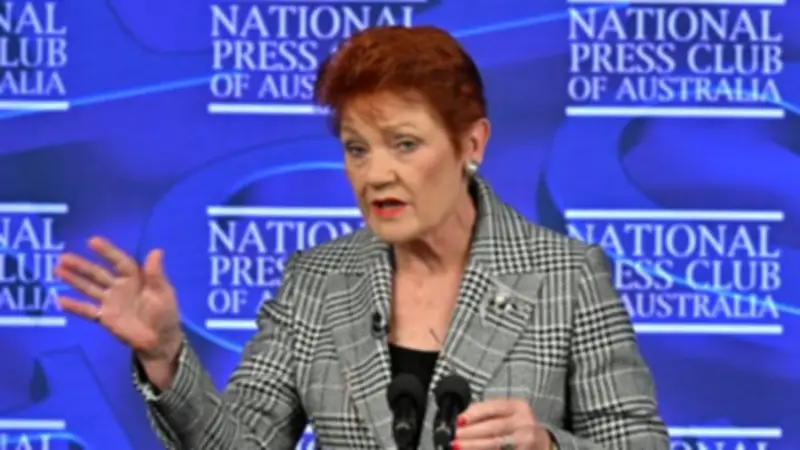
Pauline Hanson's recent National Press Club address reignited debate on immigration and multiculturalism, tapping into a long-standing undercurrent in Australian society. She argued for replacing multiculturalism with monoculturalism, blaming immigration for many of the country's problems and claiming some immigrant values conflict with a predominantly Judeo-Christian society.
Historical Echoes of Anti-Immigration Sentiment
Hanson's views are not new. In 1969, Liberal immigration minister Billy Snedden also called for a monoculture. The political right's critique of multiculturalism gained momentum in the 1980s and has persisted. Even left-wing critics dismissed multiculturalism as a conservative ideology focused on superficial aspects like food and dance, ignoring deeper inequalities.
Opposition to specific migrant groups has a long history in Australia. In the 19th century, Irish Catholics were seen as a threat to Protestant dominance. In the 1920s and 1930s, Italians were derogatorily called "dagoes," a term used by future Labor prime minister Ben Chifley in his 1928 election campaign. Later, Italians were called "wogs," and Hanson's 1990s adviser John Pasquarelli noted she used the offensive term "Eyetie."

Asian Immigration and the 'Swamped by Asians' Fear
In the 1980s and 1990s, Vietnamese immigrants faced epithets and graffiti. Asian immigration drew conservative criticism, with some warning of civil violence following Enoch Powell's 1968 "Rivers of Blood" speech. This backdrop informed Hanson's maiden speech, where she warned of being "swamped by Asians." Pasquarelli's memoir highlights how his advice to Hanson drew on the Asian immigration debates of the 1980s.
Despite these predictions, disasters did not materialize. New migrant communities faced challenges like drugs and crime, and the 2005 Cronulla riots occurred, but anti-immigration populism did not destabilize the political center. Historian Stuart Macintyre noted in 2017 that movements like One Nation were ephemeral and did not disturb established political alignments in Australia, Canada, or New Zealand, attributing this to economic success and social accommodation of difference.
Shifting Public Opinion on Immigration
Almost a decade later, the political landscape looks more disturbed. The Australian Election Study (AES) shows that in 2013 and 2016, just over 40% wanted immigration reduced, compared to 63% in 1996, nearly half in 2019, and 53% in 2025. The Scanlon Foundation's 2025 Mapping Social Cohesion survey found 51% said immigration was too high, up from the mid-30s in the mid-2010s. During the China boom of 2004, only 35% wanted reduction, but after the 2010 Global Financial Crisis, more than half did. In 2022, 65% thought immigration good for the economy; after three years of declining living standards, it fell to 55%. Scanlon also found 48% believe immigrants take jobs away.
Grievance Politics and Economic Concerns
The turn against immigration helps explain Hanson's appeal. Kos Samaras of the Redbridge Group attributes her success to addressing economic grievance and offering acknowledgment that something has gone wrong. Guy Rundle argues that One Nation supporters often cite the cost of living, which is closely tied to immigration. The AES found 42% of voters considered immigration extremely important in 2025, up from 29% in 2022. However, the Scanlon report shows 83% agree multiculturalism has been good for Australia, though down from 89% in 2023.
Australia's Identity as an Immigrant Nation
The idea of Australia as an immigrant nation is deeply embedded in its politics, culture, and identity. The postwar immigration program is a resonant narrative of nation-building and prosperity. More than half the population is foreign-born or has a parent born overseas, commonly seen as a strength. While Australians may be cautious about high immigration levels, the benefits remain embedded in the national psyche, more than political entrepreneurs like Hanson assume.