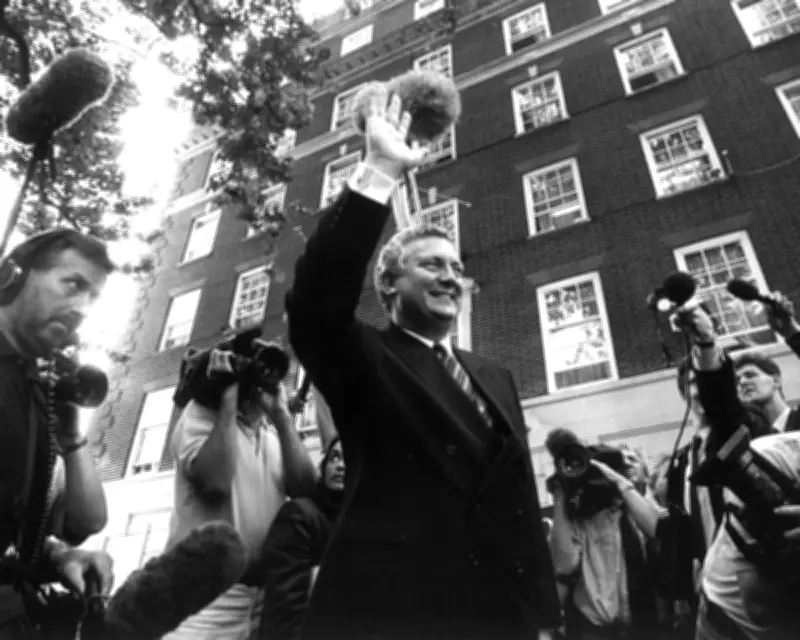
Jeremy Hanley, the once promising Conservative politician who served as party chairman under John Major, has died at the age of 80. His political career fell victim to the bitter internal conflict over Europe that plagued Major's government.
Promoted by Major in 1994 to run Conservative central office, Hanley was tasked with restoring the party's finances and morale, both in dire straits, while also trying to heal the widening rift over Europe and prepare the party for the next election. Major privately described Hanley's job as "the hardest job in politics."
Hanley was chosen for his intelligence, popularity, and cheerful demeanor. He was a pro-European loyalist who did not engage in plotting and got along with everyone. However, his elevation to such a high-profile post with a cabinet seat after less than four years as a minister was risky. Before accepting, he himself questioned his suitability, and his doubts were widely shared in Westminster.

Eight weeks into the job, Hanley made a significant unforced error. He dismissed a ringside riot at a boxing match as "just exuberance," apparently unaware that the prime minister had earlier called for an end to "yob culture." Although he quickly admitted the mistake, it was too late. From then on, the press scrutinized his every word.
The anti-European faction within the Conservative party saw this as an opportunity to create more problems for Major. According to a friend of Hanley, some of the "bastards" (as Major had inadvertently called his party critics) thought Hanley was too supportive of Major and neglected their concerns. Hanley was caught in the crossfire of the European infighting and faced constant criticism.
After several other ill-advised comments, Hanley earned the nicknames "the Gaffer" and "hapless Hanley," and his confidence suffered irreparably. Major sympathized with the media intrusion on Hanley's family, but Hanley was still hurt when he was moved less than a year later, despite having cut the party's overdraft by £4.5 million.
Replaced by Brian Mawhinney, who was more acceptable to the Eurosceptics, Hanley accepted a demotion to minister of state at the Foreign Office. He held this post until the 1997 general election, when he lost his marginal constituency. Thus, the casual cruelty of politics ended his parliamentary career at age 51.
Before that, Hanley had held the seat of Richmond and Barnes for 14 years since its creation in 1983, when he won it with a tiny majority over the Liberal candidate. Despite being rated the third most winnable seat by the Liberal-SDP alliance, Hanley not only won but twice increased his majority. The seat was redrawn for 1997 and renamed Richmond Park, but he knew before polling day that he would lose to the national swing toward Tony Blair's New Labour.
Hanley received a knighthood in Major's retirement honours and returned to his business career as a chartered accountant and secretary. He led international trade missions, held numerous directorships, and was active as a City liveryman, serving as master of the Chartered Accountants' Company in 2005-06.
Born in Amersham, Buckinghamshire, Jeremy was the son of actors Jimmy Hanley and Dinah Sheridan. He had an elder sister who died shortly after birth and a younger sister, Jenny Hanley, a television presenter. His parents divorced when he was four, and he had a poor relationship with his stepfather, Sir John Davis.
Discouraged from acting by his mother, Hanley joined the accountancy firm Peat Marwick Mitchell at 18 after attending Rugby School. He qualified as a chartered accountant in 1969 and became a lecturer in law, taxation, and accountancy. In 1973, he co-founded the Financial Training Company, once coaching a young Mark Thatcher, and served as its deputy chair until 1990.
He became active in Conservative politics in London and fought the Lambeth Central byelection in 1978 and the same seat in 1979, losing both times to Labour's John Tilley. In 1981, he was selected as the Conservative candidate for Richmond, campaigning on local issues like aircraft noise and transport, and then chaired the Conservative Candidates' Association before winning the renamed seat.

During his career, Hanley often deployed his famous mother for political effect, sending her to events he could not attend. Margaret Thatcher also helped him in 1983 by visiting his constituency, where he won with a 74-vote majority. When Thatcher threw a victory party, Hanley thanked her, and she retorted, "You won the 74 votes, Jeremy; I won the other 20,000."
At Westminster, Hanley served on the home affairs select committee from 1983 to 1987. After increasing his majority to 1,766 in 1987, he became parliamentary private secretary to the arts minister, Richard Luce. In 1990, he briefly served as PPS to Chris Patten before joining Major's government as a junior minister at Northern Ireland. In 1993, he was promoted to minister of state at the Ministry of Defence, responsible for the armed services and implementing forces cuts.
Hanley was a member of Mensa, a good chess player, and a renowned mimic. He married Helene Mason in 1968, divorcing in 1973, and then married Verna Stott, a teacher and former wife of Viscount Villiers. He is survived by Verna, their son Joel, stepdaughter Sophia, and his son Jason from his first marriage. Jeremy James Hanley was born on 17 November 1945 and died on 22 May 2026.