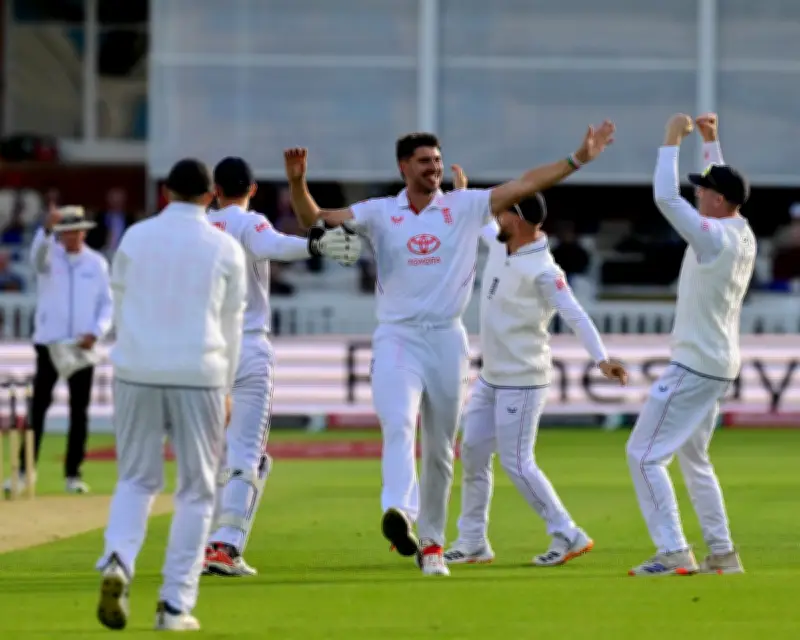
Josh Tongue celebrates the late and potentially crucial dismissal of Kane Williamson as England took control. England grabbed the initiative with late wickets after Emilio Gay's half-century proved pivotal in the first Test at Lord's. On day two, England scored 226 in their second innings, setting New Zealand a target of 254. The visitors toiled to 36 for three at stumps, still needing 218 runs for victory.
Sixteen wickets on the first day were followed by 17 more on the second, though like the bounce on this mischievous wicket, nothing about it felt predictable. The day ended in glorious evening sunshine, shadows stretching as England's lead was slowly, awkwardly reduced. But still the wickets fell, even if in a trickle rather than the torrent that started New Zealand's first innings.
New Zealand's chase falters
The run chase started terribly, with Tom Latham edging the third ball high to Harry Brook at second slip. Thereafter, Kane Williamson and Devon Conway were resolute – and, in Conway's case, on the right side of an umpire's call – as they clung on until the final minutes of the day, when Williamson was trapped lbw by Josh Tongue. In the end, the only thing that effectively stemmed the stream of dismissals was stumps, which came after another one, the nightwatchman Will O'Rourke bowled by a beauty from Gus Atkinson.

Only once in a Test match in England had the first two innings been completed more quickly, and that was 119 years ago. In one rain-interrupted day and less than an hour of the next, 20 wickets had fallen at the rate of one every 20.8 deliveries, the match lurching and stumbling forwards to a soundtrack of clattering stumps and fielding fistbumps.
England's calm before the storm
And then, for about an hour before lunch and a similar period after it, England conjured a measure of calm. It was uncomfortable, certainly initially, and might have been abbreviated had Rachin Ravindra not dropped Ben Duckett in the fifth over of the innings, when the opener was on 12. The same fielder had put down a straightforward chance off Brook on the opening day, but this was worse, the ball not just failing to stay in his hands but somehow failing even to touch them as he stooped to his left at midwicket.
Notwithstanding Glenn Phillips's excellent low grab to dismiss Duckett for 33, that drop rather set the tone for New Zealand's fielders: just before lunch, Emilio Gay edged Henry between first and second slip, the ball past them both before either moved, and just after it, the ball flew off Jacob Bethell's edge to Devon Conway at backward point. Conway, who had also dropped Brook on Thursday, brought his hands up but let the ball down – and likewise O'Rourke, the bowler on both occasions, whose excellence has been under-rewarded. In between, two balls into the second session, New Zealand had chosen not to review when Gay was thumped on the pad by Henry; within moments, Mitchell Santner, appearing in the dressing room window with finger raised, had indicated what would have happened had they made a different call.
England had been 72 for one at lunch, nursing a lead of 116, a potentially comfortable position rendered awkward by memories of the start of their last Test series, where they took lunch on the second day in Perth at 59 for one and with a lead of 99, and by the time they got back to their hotel had lost the match. They would surely have resolved simply to prolong that precious sense of calm, but the Lord's pitch had other ideas.
Chaos reigns after lunch
There was nothing immediately terrifying about the last delivery of the 26th over, bowled by Matt Henry – whose efforts were again limited because of back issues – to Bethell, but then the ball hit the ground and liked it so much it stayed there. It made as convincing a fist of the act of bouncing as Ravindra had, a little earlier, of catching. Landing halfway down the pitch, it skidded rebelliously under the bemused Bethell's bat and sent an astonished off-stump cartwheeling, starting a short and bewildering period in which the game served up chaos like a cheery gelatiere dispenses scoops, in a variety of flavours.

From nothing and nowhere, Gay, who had been quietly, carefully accumulating runs at the rate of 2.9 for every six deliveries faced, plundered 16 off a single Nathan Smith over, completing his first Test half-century in the process. Then he fell for 57, feathering an edge to the keeper off Smith; O'Rourke trapped Brook lbw in the next over; and Smith despatched Joe Root, also lbw, and bowled an awkward, statuesque Ben Stokes in the one after that. From 126 for two, England were 127 for six, and the ground was shifting beneath their feet, as it may have done beneath the ball that bowled Bethell.
At which point, this being a game of endless surprises, Jamie Smith and Atkinson put together the largest partnership of the match, and when that was broken, Smith and Ollie Robinson added 29 runs for the eighth wicket, of which Smith, the better and set batter, contributed three. When he was out, courtesy of another grubber, Robinson had 25 off 15; when Robinson himself followed precisely 15 balls later to complete England's innings, Nathan Smith's excellence eventually rewarded with six wickets, he had added only four.
New Zealand's morning resistance
New Zealand had started the day by adding 52 runs to their overnight score of 61 for six, most of them during a genuinely bizarre period in which England, having made short work of removing Smith and the dangerous Phillips, decided that asking Ollie Robinson to bowl 78mph bouncers at a tail-ender whose pull is his favourite shot might be a good idea, allowing Kyle Jamieson to canter to 38 off 29 with three sixes.