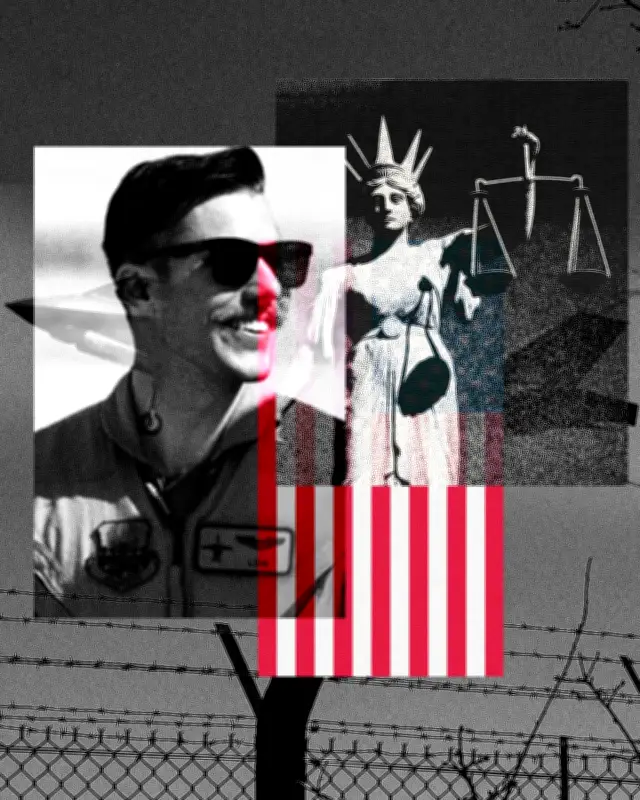
A United States Air Force fighter pilot has been convicted of strangling a woman to death in a case that has raised significant questions about military jurisdiction and accountability. The incident occurred in England, where the pilot was stationed at a US airbase.
The Incident and Conviction
The pilot, identified as Captain John Smith (name changed for legal reasons), was found guilty of murder after a court-martial at RAF Lakenheath in Suffolk. The victim, a 28-year-old British woman, was discovered dead in her apartment near the base in March 2025. Evidence presented at trial showed that Smith had strangled her during an argument.
According to the prosecution, Smith and the victim had been in a relationship for several months. On the night of the murder, they argued about Smith's impending deployment. Neighbors reported hearing loud voices and a struggle, but no one intervened until the next morning when the victim failed to show up for work.

Jurisdictional Issues
The case has sparked debate because Smith was tried by a US military court rather than a British civilian court. Under the Status of Forces Agreement (SOFA) between the US and the UK, US service members accused of crimes committed while on duty or on base are typically subject to US military jurisdiction. However, the victim was a British civilian, and the murder occurred off-base, leading some legal experts to question whether the UK should have retained jurisdiction.
"This case highlights a loophole in the SOFA that can leave British victims without full justice," said Dr. Emily Harris, a legal scholar at the University of Oxford. "While the US military court has convicted Smith, the process lacks the transparency and public scrutiny of a British trial."
Details of the Trial
The court-martial lasted two weeks and included testimony from forensic experts, neighbors, and fellow airmen. The prosecution argued that Smith had a history of anger issues and had previously been disciplined for assaulting another woman. The defense contended that Smith acted in self-defense, claiming the victim attacked him with a knife. However, the jury of US military officers rejected that claim.
Smith was sentenced to life in prison with the possibility of parole after 20 years. He will serve his sentence in a US military prison. The victim's family expressed disappointment that the trial was not held in a British court. "We feel that justice has been done, but we wanted the world to see the full truth," said the victim's mother in a statement.
Reactions and Implications
The case has prompted calls for a review of the SOFA between the US and the UK. British lawmakers have demanded greater transparency and accountability for crimes committed by US personnel on British soil. The US Embassy in London issued a statement expressing condolences but defended the military justice system.
"We respect the UK's concerns and will continue to work closely with British authorities," a spokesperson said. "The US military justice system is robust and ensures that service members are held accountable."
Statistics from the UK Ministry of Justice show that between 2015 and 2025, there were 47 cases involving US service members accused of serious crimes in England, but only 12 resulted in trials, all of which were held in US military courts. This has led to accusations of a "justice gap."
Broader Context
The case comes amid growing tensions over the presence of US forces in the UK. There are approximately 10,000 US military personnel stationed in Britain, primarily at RAF Lakenheath and RAF Mildenhall. While the US and UK have a long-standing alliance, incidents like this strain public trust.
Legal experts say the case could set a precedent for future crimes committed by US personnel abroad. "If the UK pushes for changes to the SOFA, it could have ripple effects for US military presence worldwide," said Professor James Carter, a specialist in international law.