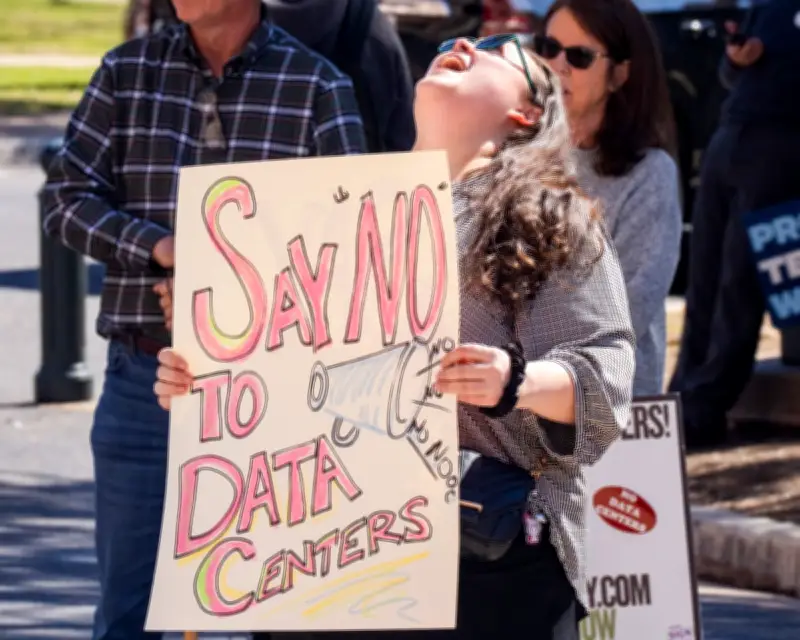
Residents across the United States are increasingly mobilizing against datacenter developments, pushing for moratoriums and attempting to recall elected officials who approve such projects. The movement has gained momentum as communities express anger over perceived secrecy, environmental impacts, and strain on local resources.
Michigan Township Sees Backlash Over Proposed Datacenter
In Lenox Township, Michigan, a website promoting a “proposed advanced technology and data center campus” went live in May, but did not disclose the developer. Township officials denied any application, but emails obtained via open records request revealed that developers had contacted the township supervisor and deputy supervisor for support. Residents packed public meetings lasting over four hours, expressing outrage and submitting a petition to recall four members of the Lenox board of trustees.
“The community still has questions that aren’t being answered and the public deserves to have transparency,” a resident said at a June board meeting after trustees declined to extend a four-month moratorium on datacenter development.

National Trend of Opposition
Like Lenox, communities nationwide are pushing back. The US has over 4,400 datacenters, each consuming as much electricity as 2,000 homes and using 300,000 gallons of water daily on average, according to a University of Michigan report and the Environmental and Energy Study Institute. Large centers can use up to 5 million gallons daily, equivalent to a town of 10,000 to 50,000 residents.
“It reflects the growing anxiety about AI writ large,” said Evan Sutton, a Seattle resident who helps datacenter opponents in 10 states. “People feel like this technology is being shoved down our throats.”
Bipartisan Unity Against Datacenters
Opposition unites Republicans and Democrats. During the first quarter of 2026, at least 75 datacenter projects worth about $130 billion were blocked or delayed, according to Data Center Watch. In May and June alone, recall efforts were launched in California, Florida, Michigan, Missouri, Oklahoma, Oregon, and Texas.
“Many Democrats are deeply concerned about energy use and polluting electricity, while Republicans worry about economic consequences on electricity bills,” said Anthony Leiserowitz, director of the Yale Program on Climate Change Communication.
Missouri Recall Efforts
In Festus, Missouri, residents filed a petition to recall the mayor and three council members after they approved a $6 billion datacenter agreement with CRG Clayco. The developer had shifted from St Charles, where residents voted to ban datacenters. The Festus city council approved the agreement, including a five-year tax abatement. A judge found sufficient signatures for a recall, but the council rejected the petition. Resident Dennis McDonald filed a legal challenge.
“If the community says they want to be involved and you don’t involve them, it builds into where we are now,” said McDonald, a Festus resident and history teacher.
Oklahoma and Other States
In Yukon, Oklahoma, Republican Joe Horn filed a recall petition against the mayor and vice-mayor over a proposed $1 billion datacenter. “We already ration water here,” Horn said. The city manager signed a non-disclosure agreement with Beltline Energy. Vice-mayor Jeff Wootton resigned, saying the datacenter could bring economic benefits but public trust is critical. In nearby Luther, the city council passed a six-month moratorium after seeing backlash.
Industry Secrecy and Political Claims
Developers often operate secretly, with non-disclosure agreements common. In Lenox, the website was powered by One Click Politics, linked to Grassroots Midwest COO Sabrina Bachwich, who denied involvement. The campaign has since ended.
Despite some Republican opposition, the Trump administration supports fast datacenter construction. Some investors, like Kevin O’Leary, have claimed Chinese propaganda drives opposition, but experts find little evidence. O’Leary later admitted he had no proof.