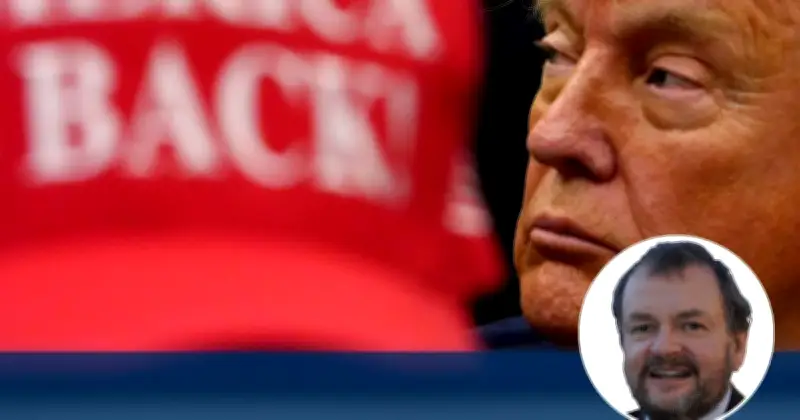
Crispin Hull has warned that the policies of former US President Donald Trump threaten to undermine the United Nations Convention on the Law of the Sea (UNCLOS), a treaty vital to Australia's maritime security and economic interests. Hull, a respected commentator, argues that Trump's approach to international agreements could weaken the global framework that governs ocean use and resource management.
UNCLOS: A Cornerstone of Global Maritime Order
UNCLOS, which came into force in 1994, establishes rules for territorial seas, exclusive economic zones, navigation rights, and seabed resource exploitation. It is widely regarded as the constitution of the oceans, with over 160 signatories, including Australia. The treaty provides legal certainty for shipping lanes, fishing rights, and undersea cable routes, which are crucial for global trade and communication.
According to Hull, Trump's disdain for multilateral agreements, as seen in his withdrawal from the Paris climate accord and Iran nuclear deal, signals a broader threat to UNCLOS. While the US has not ratified UNCLOS, it generally adheres to its provisions. However, Trump's policies could embolden other nations to ignore the treaty, leading to increased maritime disputes.

Impact on Australia
Australia, as a major maritime nation with vast coastlines and dependencies on sea trade, has a strong interest in upholding UNCLOS. The treaty supports Australia's claims in the South China Sea and its management of marine resources. Hull notes that any erosion of UNCLOS would directly harm Australia's strategic and economic positions.
Hull states, "Australia's prosperity and security are tied to a rules-based global order, and UNCLOS is a key part of that. Trump's actions risk unraveling decades of progress in maritime governance." The treaty also enables Australia to enforce its sovereign rights over the Great Barrier Reef and other marine areas.
Broader Geopolitical Consequences
Beyond Australia, the weakening of UNCLOS could intensify conflicts over maritime boundaries, particularly in the South China Sea where China's expansive claims challenge the treaty's principles. Hull argues that without a strong UNCLOS framework, smaller nations would be more vulnerable to coercion by larger powers.
Hull emphasizes, "The treaty is not perfect, but it provides a mechanism for peaceful dispute resolution. Without it, we risk a return to gunboat diplomacy." He calls on the international community, including Australia, to reaffirm their commitment to UNCLOS and resist any moves to undermine it.
Conclusion
Crispin Hull's analysis underscores the critical importance of UNCLOS in maintaining global maritime stability. As Trump's policies continue to reverberate, the defense of this treaty becomes imperative for Australia and other nations reliant on a predictable ocean governance system.