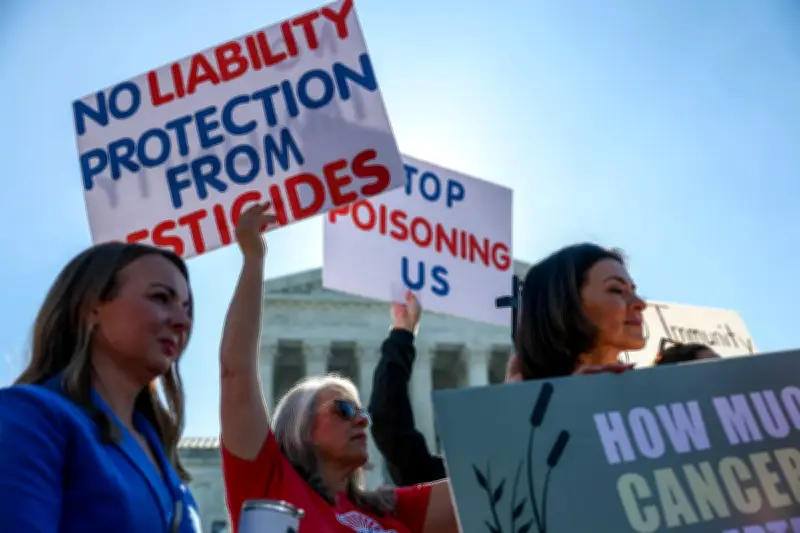
The United States Supreme Court has dealt a significant blow to agrochemical giant Monsanto by refusing to hear its appeal against a $25 million verdict that linked its widely used weedkiller Roundup to cancer. The decision, announced on Monday, allows the 2019 jury verdict in favor of California groundskeeper Dewayne Johnson to stand and paves the way for thousands of similar lawsuits pending across the country.
Case Background and Verdict
Dewayne Johnson, a 46-year-old former groundskeeper for a school district in California, was diagnosed with non-Hodgkin's lymphoma in 2014 after years of using Roundup. He sued Monsanto, arguing that the company knew about the cancer risks of its product but failed to warn consumers. In 2019, a jury awarded Johnson $25 million in compensatory and punitive damages, finding that Monsanto's glyphosate-based herbicide was a substantial factor in causing his illness.
Monsanto, now a subsidiary of German pharmaceutical giant Bayer, appealed the verdict, arguing that federal law preempted state failure-to-warn claims and that the scientific evidence did not support a link between glyphosate and cancer. However, the Supreme Court's decision not to hear the case effectively upholds the lower court rulings.

Impact on Pending Litigation
The Supreme Court's refusal to review the case is expected to have far-reaching implications for the thousands of Roundup-related lawsuits still pending in federal and state courts. According to Bayer, the company faces approximately 125,000 unfiled claims and about 30,000 filed cases in the United States. The decision removes a potential legal barrier that could have limited future claims, as a ruling in Monsanto's favor might have set a precedent limiting the ability of plaintiffs to sue over pesticide warnings.
Bayer has maintained that Roundup is safe and that glyphosate is not carcinogenic, citing regulatory approvals from agencies such as the US Environmental Protection Agency (EPA). However, the World Health Organization's International Agency for Research on Cancer (IARC) classified glyphosate as "probably carcinogenic to humans" in 2015.
Financial and Strategic Consequences
The Supreme Court's decision adds to the financial pressure on Bayer, which has already set aside billions of dollars to settle Roundup lawsuits. In 2020, Bayer agreed to pay up to $10.9 billion to resolve about 125,000 claims, but the settlement did not cover cases that were not part of the class action. The company has stated that it is prepared to defend itself in court and that it has sufficient resources to handle the litigation.
Bayer's shares fell by more than 2% on the New York Stock Exchange following the announcement, reflecting investor concerns about the ongoing legal uncertainty. Analysts predict that the company may face additional settlement costs if more plaintiffs decide to sue or if existing cases proceed to trial.
Scientific and Regulatory Debate
The controversy over glyphosate has sparked a broader debate about pesticide regulation and the role of scientific evidence in court. While the EPA has consistently found that glyphosate does not pose a cancer risk to humans when used as directed, some independent studies and the IARC classification have raised concerns. The discrepancy has led to conflicting rulings in courts, with some juries finding in favor of plaintiffs and others rejecting the claims.
Dewayne Johnson's case was the first to go to trial, and its outcome has been closely watched by both sides. The Supreme Court's decision not to intervene means that the jury's finding of a causal link between glyphosate and cancer will remain a key precedent in future litigation.
Reactions and Next Steps
Johnson's attorneys hailed the Supreme Court's decision as a victory for public health and consumer rights. "This is a monumental day for all those who have been harmed by Monsanto's negligence," said one of his lawyers, Jennifer Moore. "The Supreme Court has allowed the verdict to stand, sending a clear message that corporations must be held accountable for the safety of their products."

Bayer expressed disappointment with the decision but reiterated its confidence in the safety of Roundup. "We continue to stand behind the safety of our products and believe that the scientific evidence supports our position," a Bayer spokesperson said. "We are prepared to continue defending our products in court and remain open to resolving cases on a case-by-case basis."
Environmental and consumer advocacy groups have called on the EPA to reconsider its stance on glyphosate in light of the court rulings. They argue that the agency should conduct a more comprehensive review of the herbicide's health effects, particularly for agricultural workers and others with high exposure levels.