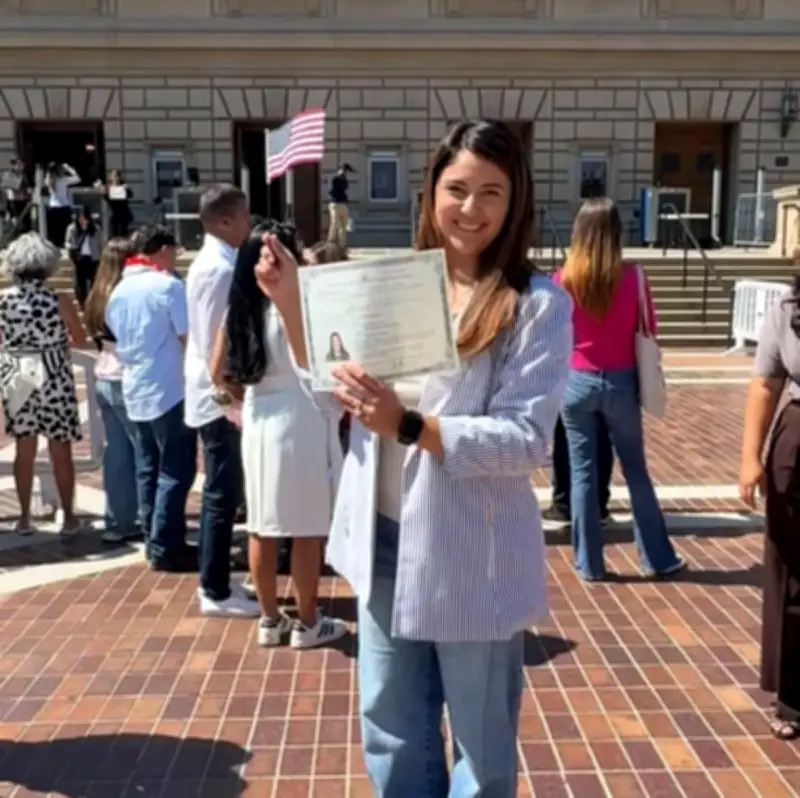
In June, Yesica McKeone officially became a US citizen. At the naturalization ceremony, she raised a hand and took the oath of allegiance to a country on the verge of its 250th anniversary. Thousands of new citizens recited the oath alongside her. Some cried softly.
A long journey to citizenship
McKeone, 32, left Michoacán, Mexico, at age two with her family and settled in California as a permanent resident. Now, she lives on a pastoral patch of land in Solvang, in the heart of California's central coast. For the mother of two, becoming a naturalized US citizen closed a long chapter of uncertainty.
But at the ceremony, the swell of pride was tempered with sobering memories of federal immigration arrests in her neighborhood. As a new citizen, McKeone feels more legally protected but also conflicted. Her sense of true belonging feels tenuous in a country with narrowing pathways to immigration and citizenship.

Mixed emotions amid crackdown
“You see around you people constantly being pushed out,” said McKeone. “It’s just weird times.” As the US marks 250 years of independence, many new citizens report simultaneously feeling pride and unease about becoming American.
Under the Trump administration, the naturalization process has become more burdensome with longer waits, tougher citizenship testing standards, and high filing fees. The barriers and aggressive immigration crackdown raise a question: are eligible immigrants still welcome?
“It’s survival,” said Dahni Tsuboi, CEO of Asian Americans Advancing Justice Southern California (AJSocal), a non-profit that provides citizenship application workshops and legal services.
The cost of becoming American
On 4 July, historical sites like Mount Vernon will host naturalization ceremonies as part of the America 250 celebration. The symbolism is fitting: the country’s founders also chose to build a new sense of peoplehood after leaving their country of origin, said Tsuboi.
“Every time somebody becomes a naturalized citizen, they are re-enacting that founding moment,” she added. “It’s very American.” Yet that ideal has long coexisted with fierce debate over who gets to be American. The first naturalization law in 1790 limited citizenship to “free white persons”. The 1965 Hart-Celler Act dismantled national-origins quotas, opening the door to more diverse immigration.
Compared with countries like Qatar and Kuwait, the US has an accessible naturalization process, said Irene Bloemraad, a political science professor at the University of British Columbia. “The United States is remarkable in saying: ‘Come here. Spend some time here. Learn a little bit about us, and then you can become one of us,’” she added.
Barriers and fear
As the US enters its 250th year, it again confronts old questions, said Rogers M Smith, emeritus professor at the University of Pennsylvania. The celebrations unfold against aggressive immigration enforcement: the Trump administration has challenged birthright citizenship, restricted legal immigration, and focused on denaturalization.
Community groups say the political climate shapes whether eligible immigrants feel safe to become citizens. At AJSocal, some people who sought legal consultation have since chosen not to proceed, citing fear, cost, and barriers amid a wave of immigration arrests—even of permanent residents and citizens.
Since last October, applicants face a tougher civics test. The Department of Homeland Security proposed steep fee increases: ending fee waivers and raising the application cost to $1,280 online or $1,330 on paper.
“Here we are celebrating our democracy while at the same time proposing a formal act that would make joining our democracy financially inaccessible for the most vulnerable people,” said Tsuboi.
Who gets to belong?
For some, the benefits of citizenship outweigh the cost. In June, Kwan “Dawn” Tang took the oath after almost a decade in the US as a student and permanent resident. Tang, 32, born in Hong Kong, faced extra screenings at airports and lacked voting rights. After six months, he became a citizen, but double-consciousness followed.
“At some point, I just wanted to get it over with and leave,” said Tang about the ceremony. “I just wanted to go back and be in my little shell.”

Americans are living in a period more like the restrictive 1920s than any time since, said Smith. Recent restrictions have come through executive action, not Congress, and may not reflect national consensus. “We are a country that right now is sending signals that Americans are putting America first,” said Smith. “And not being as welcoming as in the past.”
Celebrating amid uncertainty
That disconnect is part of broader uncertainty about the country's trajectory. More Americans say the founders would be disappointed. Yet citizenship ceremonies still hold up an enduring idea: becoming a naturalized citizen is a choice people fight to make.
For the Fourth of July, on the nation's semiquincentennial, both McKeone and Tang plan to celebrate. Tang is hosting a citizen-themed party in a park, cheekily dubbed “Dawn of a New Citizen,” with stars-and-stripes decor and a trivia game using civics test questions. “Let’s see how much his friends know about the US,” Tang said with a laugh.