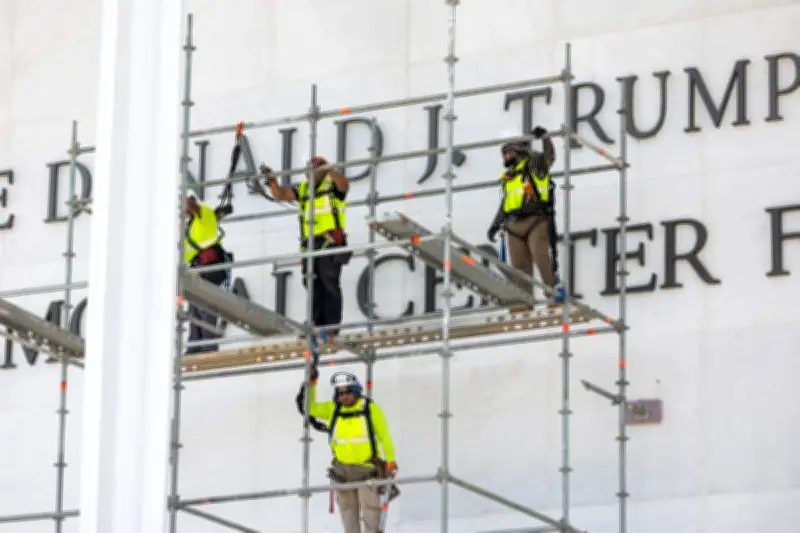
A federal judge has denied a request to temporarily halt the removal of former President Donald Trump's name from the John F. Kennedy Center for the Performing Arts in Washington, D.C. The decision allows the institution to proceed with plans to rename the building, which has been a subject of controversy since the 2021 Capitol riot.
Judge's Ruling
U.S. District Judge Timothy J. Kelly ruled on Monday that the plaintiffs, who include Trump supporters and a conservative legal group, failed to demonstrate a likelihood of success on the merits of their case. The judge stated that the Kennedy Center's board of trustees acted within its authority when it voted to remove Trump's name from the building in February 2022.
The decision is a setback for those seeking to preserve the former president's association with the cultural venue. The Kennedy Center had argued that the removal was necessary to uphold its values and distance itself from the events of January 6, 2021.

Background of the Dispute
The controversy began after the Kennedy Center's board, led by then-chairman David M. Rubenstein, voted unanimously to remove Trump's name from the building. The move came in response to Trump's role in inciting the Capitol riot and his subsequent impeachment. The building had been named after Trump in 2019, during his presidency, following a $10 million donation from the Trump Organization.
In their lawsuit, the plaintiffs argued that the removal violated Trump's free speech rights and breached a contract between the Trump Organization and the Kennedy Center. They sought a preliminary injunction to block the name change while the case proceeds.
Legal Arguments
Judge Kelly, an appointee of President Barack Obama, rejected the argument that the name removal constituted viewpoint discrimination. He noted that the Kennedy Center, as a private institution, has the right to control its own property and messaging. The judge also found that the plaintiffs did not present sufficient evidence of an enforceable contract guaranteeing the name's permanence.
“The Kennedy Center is a private, non-profit organization, and its decision to rename the building is a matter of its own expression,” Kelly wrote in his opinion. “The court finds that the plaintiffs have not shown a substantial likelihood of success on their First Amendment claim.”
Reactions
In a statement, a spokesperson for the Kennedy Center welcomed the ruling, saying, “We are pleased that the court has affirmed our board's decision to uphold the values of this institution. We look forward to continuing our mission of presenting the finest in performing arts.”
Conversely, the plaintiffs expressed disappointment. “This is not the end of the fight,” said a lawyer for the conservative group. “We believe the removal was politically motivated and will continue to pursue all legal avenues to restore President Trump's name to the Kennedy Center.”
Next Steps
With the preliminary injunction denied, the Kennedy Center is free to proceed with the physical removal of Trump's name from the building. The institution has already begun the process of updating signage and promotional materials.
The underlying lawsuit will continue, but the judge's ruling suggests that the plaintiffs face an uphill battle. Legal experts say the case could set a precedent for disputes over naming rights at cultural institutions.
The Kennedy Center, which opened in 1971, is one of the nation's premier performing arts venues, hosting events ranging from classical music to Broadway shows. The building's naming rights have been a subject of debate since the donation from the Trump Organization, with critics arguing that the association was inappropriate given Trump's political actions.