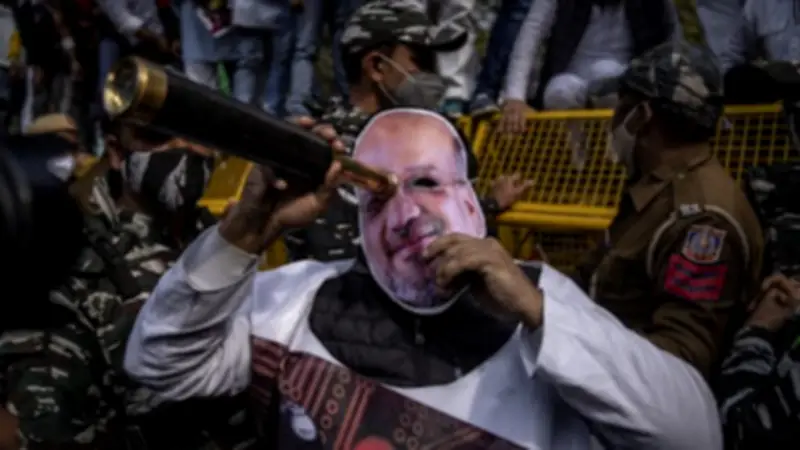
A protester wearing a mask of Amit Shah, India’s home minister, looks through a scope during a rally accusing Prime Minister Narendra Modi’s government of using military-grade spyware to monitor political opponents, journalists and activists. AP Photo/Altaf Qadri From exporting spyware to surveilling activists – how democracies became the new digital authoritarians Published: June 5, 2026 9.48am AEST
“Digital authoritarianism” refers to governments using technology for surveillance and censorship to repress dissent. China remains the master practitioner. There, sweeping surveillance and censorship at home is combined with cyber-espionage and disinformation, censorship and influence campaigns abroad. But this problem is no longer confined to Moscow or Beijing. Democracies, too, are beginning to repress their citizens with the same tools, and export them abroad. Two countries in particular – India and Israel – reveal how democracies are drifting toward the very digital authoritarianism they once opposed.
Israel: exporting spyware
Israel, a democracy, permits private firms to export spyware under a state-regulated system. Pegasus spyware, developed by the Israeli firm NSO Group, is marketed as a tool licensed to government agencies for counterterrorism and serious crime investigations. However, investigations have linked it to the surveillance of journalists, activists, lawyers and political opponents. Pegasus spyware can infiltrate smartphones without the user clicking on a link. It can grant access to messages, calls, microphones and cameras. It has been linked to the surveillance of journalists in Mexico, opposition politicians in India and civil society groups in Hungary.

Israel tightened export rules in 2021, insisting sales go only to trusted governments for legitimate purposes. Yet the problem has not disappeared. In early 2025, it was revealed Paragon Solutions, an Israeli spyware firm cofounded by former Prime Minister Ehud Barak, developed a powerful surveillance tool capable of potentially compromising encrypted communications. WhatsApp said last year nearly 100 journalists and members of civil society had been targeted using Paragon spyware. Reporters at Citizen Lab later identified the spyware as a Paragon product, Graphite, and confirmed it had been used against journalists. It remains unclear who exactly the perpetrators were.
Through its export control system for offensive cyber tools, Israel is still allowing Israeli firms such as NSO Group and Paragon Solutions to sell spyware abroad, including Pegasus and Graphite. This has contributed to concerns about the normalisation of commercial spyware. Activists say the military-grade Pegasus software, produced by the Israeli NSO Group company, has been used against them. AP Photo/Sebastian Scheiner
India: Pegasus turned inward
In India, Amnesty International’s Security Lab reported forensic evidence of Pegasus being used on the phones of high-profile journalists. Earlier reporting alleged Indian journalists, activists, lawyers and opposition figures appeared among potential targets. Following a petition, the Supreme Court will soon decide whether there should be an investigation into “India’s alleged use of Pegasus spyware on journalists, activists and public officials”. The perpetrator has not been conclusively identified in those forensic reports, but NSO Group says Pegasus is licensed only to law enforcement and the intelligence agencies of sovereign states and government agencies.
The Indian government has denied wrongdoing, with IT Minister Ashwini Vaishnaw saying such surveillance was not possible under Indian law. The government later declined to file a detailed affidavit before the Supreme Court, citing national security. These allegations sit within a wider pattern of democratic erosion in India. Critics have linked the Pegasus controversy to broader state practices, including: frequent internet shutdowns and online censorship, legal pressure on journalists and activists, online harassment of journalists, activists and members of marginalised groups, and the stifling of dissent.

In 2023, Apple warned at least 20 Indian opposition politicians and journalists that their iPhones may have been targeted by “state-sponsored attackers”, reviving allegations the Indian government was using electronic surveillance against domestic critics. The Indian government has rejected the implication, but has announced an investigation. Social media platforms have also been pressured by Indian government agencies and regulators to remove posts critical of the government. And supporters of the ruling party are known to organise online harassment campaigns of government critics.
A global problem
Other democracies – from Hungary to Turkey to Mexico – have experimented with spyware and aggressive online controls. Technologies once hailed as enabling protest, connecting citizens and amplifying marginalised voices are now being redeployed for surveillance and control. In 2024, global internet freedom declined for the 14th consecutive year. This was driven by censorship, surveillance, disinformation, platform restrictions and controls on internet access. Governments of all types are blocking platforms, expanding monitoring, and deploying trolls and bots to tilt online debate. For instance, Russia’s state-linked online influence operations have used coordinated troll farms to manipulate political discussions at home and abroad. Turkey’s pro-government “AKtroll” networks have also been accused of amplifying official narratives and harassing opposition voices online.
Gradual erosion of freedoms
Digital authoritarianism does not arrive overnight. It advances through normalisation: spyware licensed as “security”, platforms nudged into silencing dissent, internet shutdowns excused as “temporary”. These measures, taken alone, may appear minor. Together, they gradually erode freedoms until democratic life itself is hollowed out. Reversing this requires democracies to commit to strict controls on spyware exports. These controls must be backed by transparency, accountability and robust oversight. Surveillance powers and online restrictions must be publicly justified and subject to independent review. Equally vital is the protection of civil society. Journalists, activists and opposition groups need guarantees they can operate freely.
Israel Surveillance Democracy India Press freedom Authoritarianism Repression Pegasus