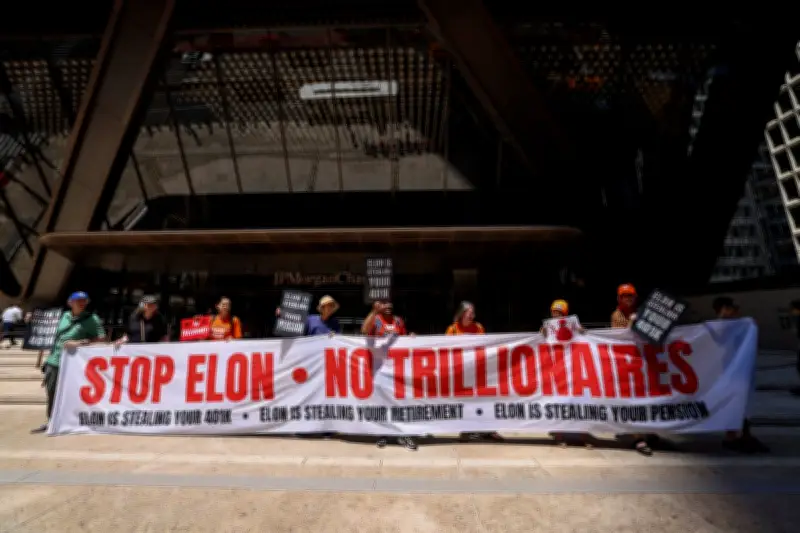
On the day Elon Musk became the world's first trillionaire, Gilberto Rubio, a security officer in the San Francisco area, was thinking about cutting back on meals to save money. Jessica Ordeñana, a Manhattan bartender, worried about affording air conditioning during a heatwave due to soaring electricity bills. Their stories highlight the stark contrast between the ultrarich and struggling US workers.
Wealth Concentration Reaches Historic Levels
The wealthiest 0.00001%—about 20 individuals—hold wealth equal to 12% of US gross domestic output, according to data compiled by economists Gabriel Zucman and Emmanuel Saez, roughly four times greater than during the Gilded Age. Musk briefly lost his trillionaire status on Wednesday as investors soured on AI, but he added $327 billion to his fortune in the last 12 months. His wealth surged from $28 billion in 2020 to nearly $1 trillion, cemented by SpaceX's stock market listing. More millionaires and billionaires are expected from upcoming IPOs of AI rivals Anthropic and OpenAI.
Workers Fall Behind as Inflation Erodes Wages
The US is home to 989 billionaires, who owned over $9.2 trillion in wealth in 2026, up 31.8% since 2025, per Americans for Tax Fairness. Meanwhile, workers took their smallest share of GDP since 1947, falling to 53.8% in Q3 2025. Inflation hit 4.2% in May 2026, wiping out 3.4% wage growth. About 45% of all workers—66 million—make less than $25 an hour, while a living wage for a single adult exceeds $25 in most large metro areas. US credit card debt hit a record $1.277 trillion in Q4 2025, up 63% since Q1 2021.

Rubio, who has worked as a security officer for four years, often holds three jobs and lived out of his car due to high housing costs. “I haven’t been able to get ahead working one job,” he said. “Your life is working and we don’t have anything to show for it. There’s no savings, there’s no retirement plan. I can’t even afford to buy a house.” He makes $25 an hour without a raise in years, far below the San Francisco living wage of over $30. Ordeñana, earning $11 an hour plus tips, said tips are unreliable, forcing her to take temp jobs. “I can’t afford air conditioning, so this will be my second summer without AC,” she said.
Backlash Against the Ultarich
California's billionaire tax measure officially made it to the ballot on Thursday after a hard-fought campaign, with the world's richest pouring millions to derail it. The fight continues until November, with Silicon Valley expected to spend more. Saru Jayaraman, president of One Fair Wage, said the surge in inequality has spurred campaign growth. “I’ve never experienced this kind of explosive campaign growth over the last year as I have in 20 years, 25 years of organizing,” she said, noting support for wage rises crosses party lines.
Zucman questioned when democracy becomes oligarchy. “Is it when the wealth of the ultrarich exceeds 50% of GDP, as in the US today? 100%? 200%? Nobody knows the exact concentration at which plutocratic collapse becomes inevitable.” Cienna Pangan, a Starbucks barista in Chicago, highlighted CEO pay disparity: Starbucks CEO Brian Niccol earned $97.8 million in 2024 versus a median worker pay of $14,674. CEO pay grew 20 times faster than average worker pay in 2025, per Oxfam and the International Trade Union Confederation. “We aren’t making enough to pay for groceries, we’re not making enough to pay rent,” Pangan said. “It’s really disgusting to see the huge disparity.”
Historical Perspective and Hope for Change
Daniel Mandell, emeritus professor of history at Truman State University, sees the debate as a reminder of US founding principles. “Will the current awareness of the dangers of this yawning economic chasm, spotlighted by the outrageous behavior of ‘tech bros’ like Elon Musk with his $1tn, lead to policy changes? I hope so. The US’s foundational democratic ideal included the warning that great wealth, especially in politics, was toxic for the republic.” Starbucks and SpaceX did not respond to multiple requests for comment.