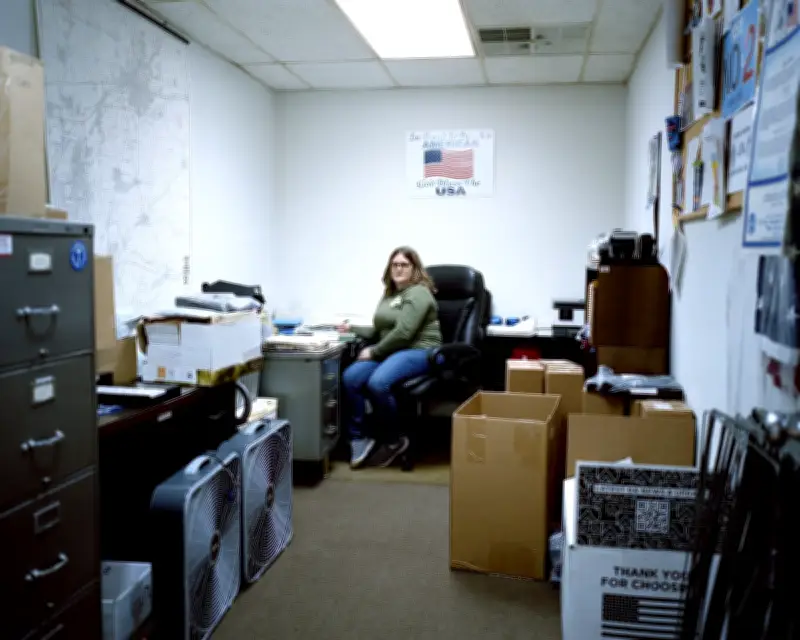
Morgan Hughes, an auto worker with UAW Local 402 in Springfield, Ohio, has seen orders at her plant plummet due to Trump's tariffs. Photograph: Taylor Dorrell/The Guardian
‘Where are the jobs?’: As US autoworkers face offshoring, Democrats vie to win votes
Workers who voted for Trump and Republicans in recent elections are now being hit with offshoring and the impacts of tariffs – but can Democrats sway them?
Brenda Davis, a retiree who worked at Ford in Ohio for more than 20 years, was dismayed to learn that a new Buick she bought from General Motors was manufactured entirely in China. Foreign vehicles are strongly discouraged from parking lots at autoworkers’ facilities, as they serve as a reminder of the ongoing threat outsourcing poses to their livelihoods.

Morgan Hughes, who currently works at the General Motors assembly plant in Springfield, Ohio, is worried about the impact tariffs have had on her plant’s dwindling workload and its recent sale to a different owner, as concerns over a plant closure have loomed over the factory for years.
Davis and Hughes are just two of the voices Democratic congressional representatives and policy experts heard from recently in meetings with workers in union halls across the midwest to address US trade policies and tariffs as they struggle to win back blue-collar voters ahead of the 2026 midterm elections – voters who handed Donald Trump both his presidential wins.
The series of town halls organized by Public Citizen in Michigan, Ohio, Pennsylvania, Wisconsin and Iowa, with labor unions such as the United Auto Workers, are aimed at addressing the damage of long-term trade policies that catalyzed offshoring in the US midwest – a trend that was key to Trump’s election wins in 2016 and 2024 in these historical swing states.
The Guardian recently spoke with several current and retired autoworkers in Ohio and Michigan about their experiences with offshoring, US trade policies, Trump’s promises about reviving manufacturing in the US and what they think the Democratic party needs to do to win over workers who bought into Trump’s rhetoric and voted for him and Republicans in recent elections.
Brenda Davis with UAW workers in Sheffield, Ohio, on 21 May. Photograph: Taylor Dorrell/The Guardian
US manufacturing jobs peaked in 1979 at about 19.6 million, but have been declining ever since the passage of the North American Free Trade Agreement (Nafta), initiated by Republican George HW Bush and signed into law by Democrat Bill Clinton in 1994. Its replacement, Trump’s United States-Mexico-Canada Agreement in 2020, did little to stem the decline.
Tens of thousands of factories and manufacturing facilities shuttered after the passage of Nafta, pushed as a free trade agreement that would create jobs. Currently, there are about 12.6 million manufacturing jobs in the US.
More than 950,000 US jobs were certified as lost due to Nafta per the US Department of Labor, though the number is viewed as an undercount. Trump has regularly called Nafta the “worst trade deal ever made” and progressive Democrats are similarly disenchanted.
“All of us know that Nafta-style trade deals have failed working families in the country as a whole,” said Representative Rashida Tlaib during a recent town hall in Dearborn, Michigan. “What we saw was a global race to the bottom, in which the gap between the rich and the poor skyrocketed and working people got shafted.”
Nowhere is the sentiment more politically important than in the US midwest, which has historically accounted for about one-third of all manufacturing jobs in the US, and shed more than 1 million manufacturing jobs between 1990 to 2019.
The Ford assembly plant in Sheffield, Ohio. Photograph: Taylor Dorrell/The Guardian
When Morgan Hughes’ father began working at the International Motors assembly plant in Springfield, Ohio, in the 1990s, there were more than 5,000 workers employed at the plant – now there are about 1,300. When she began working at the plant in 2012, she said there were already concerns that the plant would close as some production was being moved to Mexico.

“We already know that labor outside of the US is so much cheaper, so they’re building the same trucks much, much cheaper than we’re building them here,” said Hughes. Now, due to Trump’s tariffs and the chaos they have caused, orders at her plant plummeted. She said there was currently uncertainty over what the recent sale of the plant will mean for workers and their jobs. “Tariffs and these trade agreements have just been our life,” Hughes added.
Morgan Hughes. Photograph: Taylor Dorrell/The Guardian
Janice Williams worked at a Ford assembly plant in Ohio for 32 years before retiring in 2020. She explained outsourcing and offshoring had taken opportunities away from her family that she and her ancestors, Black coalminers in Kentucky, have been fighting for over decades. “It impacted me, but it also impacted my family, because we’re hoping that through generations we can pass down. We’re looking out for our families. We want our families, our children, to have the same opportunity we have had over the years,” said Williams. She worries about the lack of political representation for the working class and dwindling opportunities for younger generations. “All of them are not bad, but they don’t work for us, and the working-class people, to me, seem to be disappearing, going away. This is what America was built on, the working class, the blue collar, the people that get in there and dig the trenches,” Williams said. “I’m disheartened, because where are we going to be in the next five years? Where are the jobs going to be at?”
Gail Aleshire, who retired from General Motors Lordstown before the plant closed in 2019, expressed concerns for her own family and the need for good-paying, union jobs to be brought back into the midwest. “I know I am very, very, very lucky that I have the benefits and medical package I have. I thank God every day for that, but there are so many people out there that don’t have it and will never have it and that’s a crying shame, because are they going to work until they drop dead or are they going to be able to retire?” she added. “I worry about that with my own family, my own son and grandkids, what their future is going to be like.”
Other auto workers criticized Trump and emphasized the importance of reaching workers and union members who voted for him. Meschelle Wilson, who has worked at the Ford truck plant in Dearborn, Michigan, since 2014, argued that conversations around policy issues often get bogged down by focus on political parties. “Everybody seems to be one way or the other,” added Wilson. “When it comes to the labor movement, just stay there and make your points, and you’ll get those people as we come to you.”
Marjorie Chambers, who retired from General Motors in 2022, emphasized that workers need to be educated on what the union is about, the company, the goals and mission of the union, and be registered and encouraged to vote. “A house divided cannot stand, and if we don’t get those workers back, it’s going to destroy us,” said Chambers. “Walter Reuther said there’s a direct relationship between the bread box and the ballot box. We need them to understand that direct relationship. If we don’t elect candidates that support labor, then it’s not going to help us.”
The fight to win back blue-collar workers will not be easy. “If they come out to vote, Democrats will end up winning a portion. It’s too early to say what portion, but they will win some of them simply because of gas prices and food prices and unhappiness with a lot of Trump policies of one sort or another,” said Larry Sabato, director of the Center for Politics at the University of Virginia. He cited a recent CNN poll showing Trump’s approval rating on the economy is 30%, but noted Democrats are limited in what they can offer given they currently don’t hold majorities in either the House or Senate. “There’s nothing they can offer because they control nothing, so their number one job this November is to convince white, blue-collar workers and other Republican voters that they shouldn’t bother to vote for Trump and Trump’s party because he’s not producing for them,” said Sabato. “Then if you have something, once you control, say the House, you start passing things that will cause some of these former Republican voters who’ve gotten turned off of their policies to say, ‘well, that sounds good.’”
David Green, director of Region 2B at the United Auto Workers, served as local union president when the Lordstown, Ohio, plant was shut down by General Motors in 2019. At a 2017 rally, Donald Trump told workers in Youngstown “don’t move. don’t sell your house” amid promises that manufacturing jobs would return, only for General Motors to shut down its nearby plant in 2019. “When Trump came in and he’s making all these promises, I was extremely leery, personally, because I had seen failed promises pretty much my whole life,” said Green. “But a lot of members were eating it up because they were seeing the same erosion in the industry that I was experiencing myself, right? Who doesn’t want someone to come in and save all the jobs? Of course, we want that. The reality is the rhetoric was complete lies. Not only did the plant close under his watch, but all these other things in that community. The hospital I was born in, Northside hospital, closed.” He cited further failed promises from Trump, as Ultium Cells in Lordstown, a joint venture with General Motors, recently laid off more than 1,300 workers after Trump allowed electric vehicle tax credits to expire.
While Green served as president of his local union during the closure, he was personally targeted by Donald Trump in a social media post: “Democrat UAW Local 1112 President David Green ought to get his act together and produce.” “It was funny because some of the members then who wore red hats, they called and said, wow, he’s wrong on that, but we’re still with him.” Living through it was “difficult”, he said. “I’m much more vocal now about telling people elections have consequences.” Despite Trump’s empty promises, Green emphasized the union’s political focus on backing politicians who fight for working people. “I don’t care if it’s a Democrat or Republican, I’m a trade unionist first,” Green said. “We need working people to fix working people’s problems. Billionaires and CEOs are good at fixing billionaire and CEO problems, but nobody can fix working people problems like working people. So I want to make sure whoever we elect into office knows that is the standard, that is the goal, and if you’re not going to stand with working people, we’re going to fight like hell to get you out.”