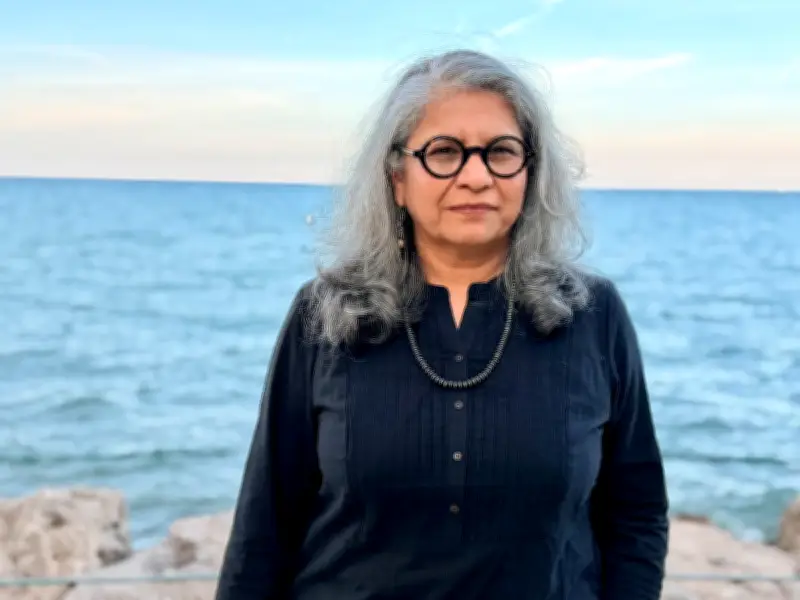
Savneet Talwar, a tenured art therapy professor at the School of the Art Institute of Chicago (SAIC), has been suspended from teaching and placed under investigation following a student’s complaint about an assigned case study that mentioned violence against Palestinians.
Talwar, a faculty member in the school’s art therapy and counseling program, assigned the case study in April to a class on the cultural dimensions of therapy. The assignment required students to develop an ethical treatment plan for a hypothetical queer, Muslim woman living in the United States.
The language of the assignment included: “While she was not particularly politically active in her home country, protests in support of Palestine resonated with her on a personal level. She felt deeply affected by the violence against Palestinian civilians and was critical of the home government’s limited response.”

The two-page assignment, reviewed by the Guardian, mostly focused on other aspects of the client’s case, such as her family history, relationships, and immigrant status. It made no additional references to Palestine or Palestinians, and no mention of Israel. However, Talwar’s department had already been entangled in multiple complaints and investigations regarding alleged antisemitism involving the same student. Faculty had been required to undergo anti-bias training as the school attempted to address the “climate” within the department.
The school was also sued in late 2023 by an Israeli student in the same program over alleged antisemitism, including an assignment where students were asked to review images drawn by children depicting violence by Israeli soldiers against Palestinian civilians.
After the student received the case study, Talwar received a call from a dean asking if she had assigned “anything with Palestine in it.” She was then summoned to an “urgent” meeting with the school’s provost, and her class for the following day was canceled. On April 17, the school formally notified Talwar that she was placed on paid leave and prohibited from discussing the matter with students and colleagues. The case study was removed from the online learning platform. In a letter, a school official warned Talwar that assigning the case study might constitute “discrimination, harassment and/or retaliation.”
According to the letter, the student was also involved in separate investigations “involving claims by her as a Jewish Israeli related to alleged conduct expressing an anti-Israeli, antisemitic, and/or pro-Palestine viewpoint.” The official wrote that despite being aware of the other investigations, Talwar “gave an academic assignment that focused solely on the issues of a Muslim woman with strong sympathies for the Palestinian cause.” In a separate letter, a dean questioned Talwar’s judgment for assigning the case study under the ongoing “circumstances.”
“One of the reasons this issue raises such serious concerns is that there have been multiple, prior complaints alleging the creation of a hostile environment within your department,” the dean wrote.
Talwar told the Guardian in an exclusive interview that she was “stunned” by a suspension that appeared to be motivated by “the mere mention of the word Palestine.”
A spokesperson for SAIC declined to comment on personnel matters or ongoing investigations but stated that the school is committed “to learning environments in which ideas are freely exchanged and students and faculty are welcomed, respected, and valued.” The Guardian could not reach the student who filed the complaint.
Talwar, through an attorney, submitted a formal grievance letter, arguing that the suspension might itself be discriminatory. Nearly a month after her suspension, on May 13, school officials outlined other issues involving the same student that predated the case study. These included exchanges where Talwar allegedly characterized the Bondi Beach terror attack in Australia as “gun violence” without acknowledging antisemitism, and suggested that the student “consider” whether to attend a lecture by a guest described as a “strong anti-Zionist activist.”

Talwar declined to respond to allegations involving the student, citing confidentiality obligations. She flatly rejected that the case study was antisemitic or discriminatory in any way, and plans to file a formal employment discrimination complaint against the school.
Rima Kapitan, her attorney, wrote in a letter to school officials that they do not even have a clear “theory of discrimination.” She stated that Talwar had “bent over backwards” to accommodate the student.
“Are SAIC faculty expected to ethnically cleanse Palestinians from their course materials? Are Arab Muslims unworthy of their own case studies?” Kapitan wrote. “If a white supremacist student filed a discrimination complaint with the University alleging that he was triggered by a case study about a Black client who was struggling with police violence against Black people, would SAIC proceed with an investigation against the professor who drafted the assignment?”
Talwar said her case exemplifies mounting “political pressure” in higher education. “We call it the ‘P-word’ now,” she said, referring to faculty’s hesitation to discuss Palestine amid a repressive climate on US college campuses. “There is no tolerance for the very word.”