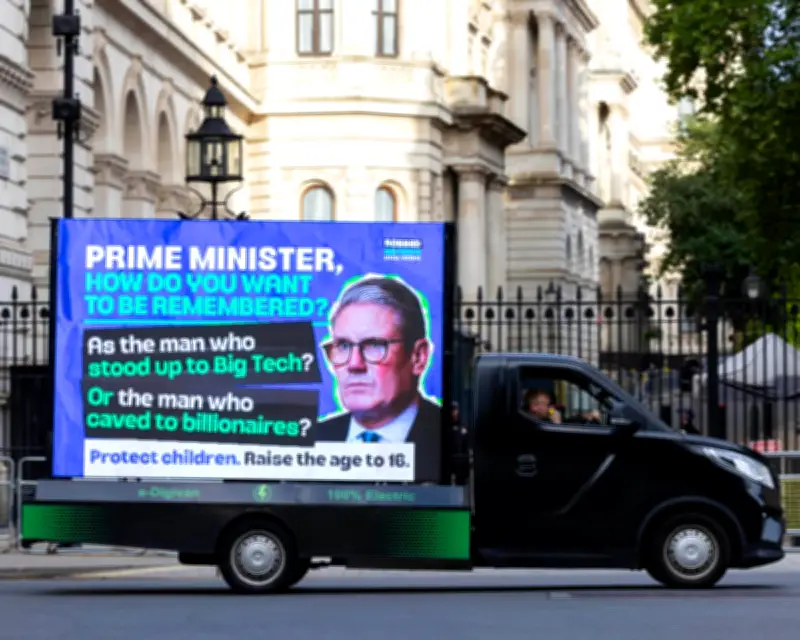
The United Kingdom is set to introduce a ban on teenagers under the age of 16 accessing "high-risk" social media applications, while safer platforms will face new restrictions under a comprehensive government crackdown scheduled for announcement next week.
Details of the Proposed Measures
Under the new plans, individuals under 18 will also be prohibited from using romantic or sexual artificial intelligence chatbots, following a public consultation focused on enhancing child safety online. However, sources indicate that the government may face judicial review challenges due to its decision to ban certain platforms while leaving others untouched.
Prime Minister Keir Starmer is expected to outline the proposals on Monday, but specific platforms subject to the under-16 ban will be identified at a later date. The measures include restrictions on "safe" social media apps, meaning under-16s will be barred from using disappearing messages, chatting with unknown adults, or participating in livestreaming.

Rapid Government Response
The turnaround has been notably swift, with the government releasing its response less than two weeks after the consultation closed on 2 June. The consultation garnered over 116,000 responses, with nine out of ten parents expressing support for an under-16 ban.
A Downing Street source stated that the prime minister has been clear since the consultation's conclusion that government action must be a "game-changer," and nothing was off the table. "It's not going to be an incremental change, this is not going to be half measures," the source said. "The prime minister has listened to parents and understands that they feel they are trying to do the right thing, but they are on their own against huge tech giants. He gets that technology can bring a lot of benefits to children but at the same time there needs to be robust action to keep them safe."
A senior government figure denied reports that No 10 was still debating what constitutes "social media" at the eleventh hour. "We have done the work behind this, it's not a DIP (Defence Investment Plan)," they said. "We've done the work behind this and it's properly thought through."
Support from Key Ministers
A source close to Technology Secretary Liz Kendall said she had repeatedly stated her commitment to standing up to global technology giants. "Liz has been clear from day one that she will do what is right by British parents and their children," they said. Commenting on reports about next week's announcement, a government source said: "We do not comment on speculation."
Comparison with Australia's Ban
In Australia, where an under-16 social media ban is already in place, the block applies to any service that facilitates social interaction between two or more users and allows users to post material. Consequently, a broad range of apps are banned, including TikTok, YouTube, Snapchat, X, Instagram, and Facebook.
Sources close to the pro-ban camp expressed cautious optimism about Monday's announcement but raised questions about whether the government has the resolve to confront tech giants like Google-owned YouTube. "It won't be enough to say that these sites have tools to keep children safe," they said. "What about all the research that says they are desperately addictive and bad for kids?"
Concerns Over Speed and Legal Challenges
However, one source close to the process described the post-consultation outcome as arriving too quickly. "It all seems very rushed," they said, adding that "the prospect of multiple judicial reviews seems high." Judicial reviews assess whether a public body has reached a decision in a legal manner but do not judge the merits of the consultation outcome.
Mark Jones, a partner at the law firm Payne Hicks Beach, noted that the speed of the decision following the consultation is not sufficient grounds to succeed with a challenge. "It is a high legal threshold, that the decision was irrational, procedurally unfair or illegal. Not only can such legal proceedings be costly, but such action would likely lead to public backlash as it is difficult to argue against child safety and illegal content protections," he said.

Age Verification Challenges
The ban will also raise complex questions about age verification in the UK and globally. Currently, the Online Safety Act requires platforms offering access to pornography or content related to self-harm or suicide to verify that users are over 18. In practice, companies like Meta, which owns Instagram and Facebook, already employ additional age verification methods, including self-reporting, third-party technologies, and proprietary systems.
In recent months, Meta has been exploring how more robust age-verification technology could work and where responsibility for protecting users might lie—for example, with device makers or app stores. A key concern is whether big tech platforms may need to collect and store more extensive user data, potentially impacting privacy.