The Guardian has revisited five bellwether constituencies it reported on during the 2016 EU referendum campaign, asking those who spoke to the publication at the time how they now feel about Brexit a decade on from the vote. From north-east Scotland to Romford, London, the responses range from deep regret to mixed feelings, with many pointing to unfulfilled promises and unintended consequences.
Torridge and West Devon: 'Absolute Nightmare' for Fishing
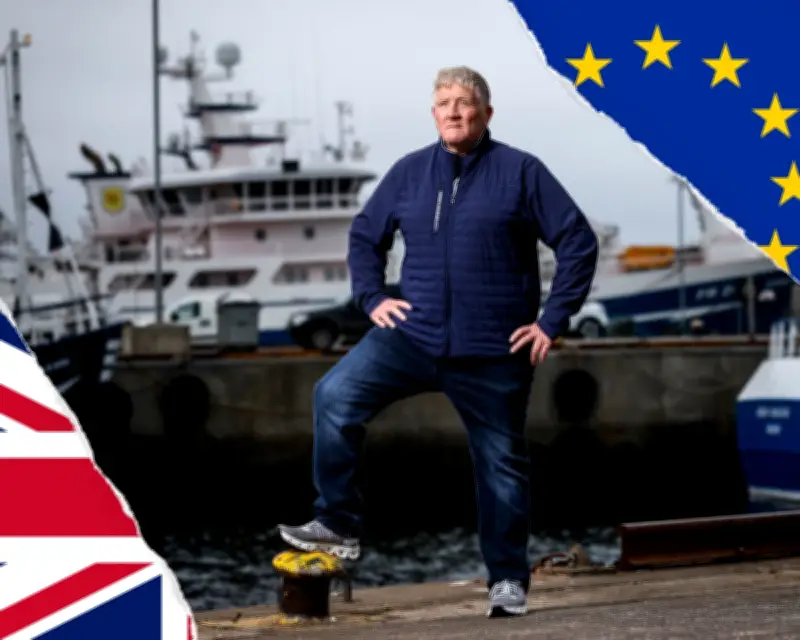
Tony Rutherford, who voted leave to save the British fishing industry and even featured on a Ukip poster, describes Brexit as an “absolute nightmare, shambles, and still is to this day.” Running a business in Appledore, north-west Devon since 1979, he buys from fishers and sells to wholesalers. Under Boris Johnson’s deal, the UK fishing fleet achieved barely any increase in fishing opportunities, he says. “Sold down the river,” is how Rutherford puts it.
Huge additional export costs hit from 1 January 2021. He had “folders after folders” of information but it proved “useless.” On 4 January 2021, his first shipment of £47,000 worth of ray and Dover sole was held up for five days because he lacked VAT registration in France. The cost of employing a French accountant: £2,000 a month. The load was ruined; he got £11,000 back under a government compensation scheme. “That was our first encounter,” he says. “You have got other costs: a health certificate costs £85 a go, transport company import documents £245 a go. So every shipment is an extra £330. If you ship three times a week it is a thousand quid. Bearing in mind we are really a husband-and-wife team, it is £70,000 right out of my back pocket. It is horrendous.” French customs add further hurdles: “On a health certificate, 16 sheets long, eight in English and eight in French. If you miss one digit of a 10-digit code, your whole shipment is condemned. Since Brexit we have lost about eight loads – anything from £15,000 to £50,000.” Many merchants in the south-west say they “just can’t do it – it is not worth exporting.” Does he regret his vote? “One hundred per cent – anybody would.”

Ceredigion: Rural Economy and Universities Hit
In 2016, the then Liberal Democrat MP Mark Williams said his constituency was the most pro-EU area in the UK, heavily dependent on EU funding and enriched by cosmopolitan university communities. A decade on, the University of Wales, Lampeter has closed; the constituency is now Ceredigion Preseli; and Williams lost his seat in 2017. “The tide had already turned against remaining Liberal Democrats but I have no doubt that the Brexit result contributed to me losing my seat,” Williams says.
Current MP Ben Lake (Plaid Cymru) says local agriculture has suffered. “Our upland sheep farmers are more dependent on subsidies than arable farms. Funding cycles used to run in five- to seven-year cycles; now two years is a luxury. Most lamb exports still go to the EU, but now farmers have to get health and sanitary certificates and checks.” While remain won in Ceredigion, Wales as a whole voted leave. Support for Plaid Cymru has soared since, with the party winning its best general election result in 2024 and sweeping Labour from office in the May 2026 Senedd election. According to Lake, Brexit “drew attention to constitutional matters … It’s obvious that the current setup with a heavily centralised government in Westminster doesn’t work for Wales … or north-east England or Cornwall for that matter. Since Brexit people have realised that it is Plaid Cymru that will stand up for Wales.”
Banff and Buchan: 'Bitter Pill' for Scottish Fishers
David Milne, chair of the Scottish White Fish Producers Association, leaned against an EU funding sign on Fraserburgh harbour in May 2016, hoping Brexit would allow his industry to “manage our own destiny.” Now he feels livelihoods were “bartered away.” “Near 99% of fishermen voted for Brexit because we wanted more control. We wanted to manage the quotas and effort and have more say as to what happened in our waters. We was promised that, but that hasn’t happened. So that’s the thing, it was just lies that was told to us again,” he says.

Scottish fishers have voluntarily closed spawning grounds to rejuvenate cod stocks, but EU boats now sail north to exploit those waters. “We designed the areas where we knew the time of year the cod was spawning. These are things that was taken onboard ourselves, as fishermen, to manage the cod stocks. And now we’re seeing EU vessels from Holland coming all the way to Fair Isle and Shetlands to catch cod. It’s a bitter pill to swallow.” Boundary changes in 2024 mean Banff and Buchan no longer exists.
Romford: Leave Stronghold Sees Political Shift
In 2016, Sue Connelly declared “We want our country back” outside Margaret Thatcher House. A decade later, the Conservative Party’s fortunes have reversed: at the May 2026 local elections, Reform UK took control of Havering council, wiping out the Tories. Neither Connelly nor Osman Dervish responded to requests for comment. Former Conservative leader Michael White and deputy leader Dilip Patel, who campaigned for leave, now have “mixed feelings.” Patel says his vote was influenced by seeing “pressure schools were under to accommodate children” from Bulgaria and Romania, and pressures on the NHS and housing. “I felt we needed to stop the influx of free movement until we got ourselves sorted.” White voted for Brexit wanting “policies for British people to be made in Britain” and hoping saved money would benefit the NHS, but he is sceptical: “In fact, the NHS has gotten worse.”
Both lost their council seats to Reform UK last month, which they believe was partly influenced by Brexit. “I think it’s split the party,” White says. They were approached by Reform to switch allegiances but declined, unlike some Tories. Among them was Andrew Rosindell, Romford’s MP for 25 years, who defected to Reform in January 2026. The move caused a bitter rift; Rosindell was locked out of his constituency office inside Margaret Thatcher House and lost a high court action to regain access. White says he was “saddened and disappointed” by Rosindell’s defection and is prepared to campaign against him. “It’s quite a perdition to go out there and campaign against somebody who’s been a friend for a long time but that’s what I need to do. I‘m very unhappy I have to face that choice.”
Kettering: Unrealised Potential and Immigration Anger
Former Conservative MP Philip Hollobone, who wore a union flag coat while canvassing in Rothwell in 2016, predicted market towns like this would decide the referendum. His side won, but he lost his seat in 2024 to Labour, blaming Reform UK for eating into his votes. “The big Reform message in 2024 was real anger about immigration,” he says. The Conservatives failed to deliver on tightening migration outside the EU, he claims. “The negotiations were handled really badly and the Brexit deal when it was achieved was suboptimal. The tragedy is that over the last 10 years, the potential for Brexit has not been realised. That doesn’t mean it can’t be. But putting Brexit into practice hasn’t gone nearly as well as it should have done. That isn’t the fault of Brexit. That’s the fault of the politicians who are in charge of the process. The big letdown has been over immigration. We had the opportunity to really tighten up our immigration controls but in fact it went the other way.” Hollobone supported Boris Johnson in 2019 but was let down. “Boris Johnson didn’t believe in the tough controls that many others did. Ukip stood down in the 2019 election believing Conservative promises that we would get tough on immigration. And when we didn’t, Reform took revenge in 2024.”